
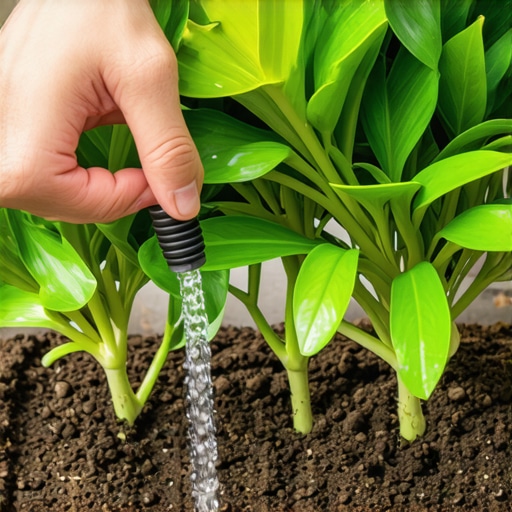
Mastering Precision Irrigation for Shrub Establishment
Adjusting 2026 drip emitters involves matching gallons-per-hour (GPH) output to the soil infiltration rate and the specific transpiration needs of the shrub species. Proper calibration prevents root rot and ensures deep root zone hydration during the critical first two years of growth. Many contractors treat irrigation as a set-it-and-forget-it system, but that is a recipe for plant failure. I always drill into my new crew members: if you do not fix the soil grading first, every plant you put in the ground is just expensive compost. You can have the most expensive smart controller on the market, but if your soil is compacted or your grading sends water toward the foundation instead of the root ball, you are failing the client. We see it constantly during yard cleanup jobs where we have to rip out dead boxwoods because they were drowning in a clay bowl. Real landscaping is about managing hydrology, not just aesthetic placement. When we approach sod install or shrubbery projects, we look at the hydraulic profile of the entire site before a single emitter is clicked into the lateral line.
The Physics of Drip Irrigation and Soil Saturation
Drip irrigation efficiency depends entirely on the hydrostatic pressure within the tubing and the capillary action of the surrounding soil matrix. Unlike overhead sprays, drip systems deliver water directly to the soil surface, minimizing evaporation loss. However, you must understand the difference between sand, silt, and clay. In sandy soil, water moves vertically with gravity, creating a narrow wetting chimney. In clay, water moves laterally through capillary action, creating a wide, shallow bulb. If you use a 2 GPH emitter in heavy clay, you will likely cause runoff or anaerobic conditions.
“Efficient irrigation depends on the soil’s water-holding capacity and the plant’s evapotranspiration rate, which dictates the frequency and duration of water application.” – Texas A&M AgriLife Extension
This is why we calculate the application rate precisely. Most 2026-rated emitters are pressure-compensating (PC), meaning they maintain a steady flow despite elevation changes. Don’t skip the pressure regulator. Without it, your 1/2-inch poly line will eventually blow a fitting. It will fail. It is that simple.
How often should I check my drip irrigation emitters?
You should inspect your drip irrigation emitters at least once every thirty days during the growing season to identify mineral scaling or clogging. A visual check of the soil moisture levels near the root flare ensures the system is delivering the expected volume of water to the newly planted shrubs.
Material Selection: Why Engineering Standards Matter
Selecting the right hardware for a 2026-spec system is the difference between a ten-year lifespan and a two-year headache. We avoid the thin-walled tubing found in big-box stores. It lacks the UV inhibitors required to survive the sun. We use 17mm dripline with embedded emitters for high-density planting or point-source emitters for specimen shrubs. For newly planted shrubs, we often double-loop the emitters. This ensures that even if one emitter clogs, the plant does not die before the next inspection. During a sod install, we ensure the irrigation zones are segregated. Turf needs frequent, shallow watering to establish; shrubs need deep, infrequent cycles. Mixing them on the same zone is a rookie mistake. It leads to fungal outbreaks in the grass and root rot in the shrubs.
| Soil Type | Recommended GPH | Watering Frequency | Wetting Pattern |
|---|---|---|---|
| Sandy Loam | 1.0 – 2.0 GPH | 3x Weekly | Vertical / Narrow |
| Silt / Loam | 0.5 – 1.0 GPH | 2x Weekly | Spherical / Balanced |
| Heavy Clay | 0.25 – 0.5 GPH | 1x Weekly | Horizontal / Wide |
The table above is a baseline. Your site-specific conditions, like southern exposure or wind corridors, will require adjustments. If you are doing a yard cleanup and find salt crusting on the soil, your water quality might be high in total dissolved solids (TDS), requiring more frequent emitter scrubbing.
What is the best GPH for shrub drip emitters?
The best GPH for shrub drip emitters is typically 0.5 to 1.0 GPH for loam soils, as this allows for slow infiltration without causing surface pooling. For larger specimen shrubs in well-draining soil, a 2.0 GPH emitter may be required to reach the deeper feeder roots effectively.
The Installation Checklist for Shrub Hydration
Before you bury your lines or mulch over your emitters, follow this engineering protocol. Don’t take shortcuts.
- Verify the PSI at the end of the longest run using a pressure gauge.
- Ensure the backflow preventer is clear of debris and functioning.
- Flush the lateral lines for at least 3 minutes before attaching emitters.
- Check that no emitters are placed directly against the trunk or root flare.
- Verify that the smart controller is programmed for the specific soil type.
“Uniformity in drip irrigation is achieved through pressure-compensating emitters that mitigate flow variations caused by friction loss and elevation changes.” – Irrigation Association Standards
Every time we take over a landscaping contract, the first thing we do is a system audit. Nine times out of ten, the previous guy didn’t flush the lines. The emitters are packed with grit. It is a mess. We fix it by installing 200-mesh filters on the main valve manifold. This protects the delicate internals of the 2026 emitters.
Fine-Tuning for 2026 Technology
Modern irrigation has moved toward ET (Evapotranspiration) based scheduling. Your controller should be pulling local weather data. However, the tech only works if the hardware is calibrated. If your emitter is putting out 1.2 GPH but the controller thinks it is 0.5 GPH, you are over-watering by over 100 percent. This creates a hydrostatic nightmare. Roots need oxygen. When you saturate the soil completely, you displace the oxygen. The roots drown. The leaves turn yellow. The homeowner thinks it needs more water. They kill it with kindness. Stop doing that. Watch the plant. Check the soil with a moisture probe. Don’t guess. Measure. Accurate irrigation is science, not a hunch. Your 2026 drip emitters are precision tools. Treat them that way.