
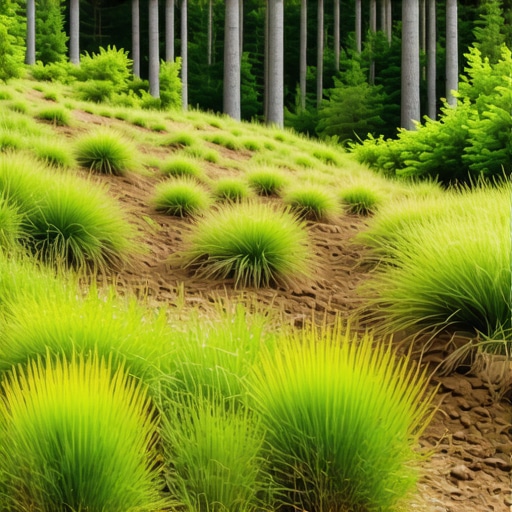
The Engineering of a Slope: Why Plants Fail Without Planning
Stopping soil erosion on slopes requires understanding the kinetic energy of water and the shear strength of soil aggregates, which are best stabilized by native groundcovers with deep, fibrous root systems. Most homeowners make the mistake of thinking a few bags of mulch and some nursery-pot shrubs will hold back a hillside. They won’t. Without a calculated approach to soil grading and moisture management, you are just throwing money into a drainage ditch. You have to think like a civil engineer before you act like a gardener.
The Apprentice Lesson: Root Systems Are Not Negotiable
I always drill into my new crew members: if you don’t fix the soil grading first, every plant you put in the ground is just expensive compost. Last spring, I had an apprentice named Miller who thought he could shortcut a 30-degree incline by just pinning sod install rolls directly onto the clay. I made him stand there during the first heavy rain. Within twenty minutes, the hydrostatic pressure built up behind the grass mats, and the whole mess slid three feet down the hill. It was a $4,000 mistake. I told him then, and I tell every client now: roots are the rebar of the earth. If you don’t select plants with the right root architecture, the soil will eventually liquefy and move. You need a mix of taproots for deep anchoring and fibrous lateral roots to knit the top four inches of landscaping together. We don’t just plant for the surface; we plant for the structural integrity of the subsoil.
“A retaining wall doesn’t fail because of the stone; it fails because of the water trapped behind it.” – Hardscape Engineering Axiom
The Physics of Erosion and Soil Chemistry
Erosion starts at the microscopic level. When a raindrop hits bare soil, it acts like a tiny hammer, breaking apart soil aggregates and sealing the surface pores. This leads to sheet erosion. On a slope, gravity accelerates this water, giving it the power to carve rills and gullies. To stop this, you need a multi-tiered canopy of native groundcovers. These plants act as energy dissipaters. The foliage breaks the fall of the rain, while the organic matter they drop increases the infiltration rate of the soil. We analyze the soil pH and bulk density before we even look at a plant list. If your soil is compacted to a 1.6 g/cm3 density, nothing is going to thrive. You need yard cleanup that includes vertical mulch or aeration to let the roots actually penetrate the profile.
| Plant Species | Root Type | Growth Rate | Soil Preference |
|---|---|---|---|
| Rhus aromatica ‘Gro-Low’ | Deep Taproot | Moderate | Heavy Clay/Dry |
| Carex pensylvanica | Fibrous/Rhizomatous | Fast | Loam/Shade |
| Juniperus horizontalis | Woody Lateral | Slow | Sandy/Rocky |
| Phlox subulata | Mat-forming | Fast | Well-drained |
How do you stop soil erosion on a steep hill?
To effectively stop soil erosion on a steep hill, you must implement slope stabilization techniques such as installing native groundcovers, using biodegradable erosion control blankets, and ensuring proper irrigation to establish deep root systems. Diverting water at the top of the slope with a French drain or swale is often necessary to prevent hydrostatic pressure from washing out new plantings before they can anchor into the subgrade.
The Installation Process: Precision and Compaction
When we start a slope project, we follow a strict protocol. First, we call 811. Never dig without knowing where the gas lines are. Then, we address the grade. If the slope exceeds a 2:1 ratio, you aren’t looking at a simple planting; you’re looking at a terracing project. We use a plate compactor on the flat areas and hand-tamping on the inclines to ensure the base is stable. For irrigation, we never use high-impact spray heads on a hill. It causes runoff. We install drip irrigation with pressure-compensating emitters. This delivers water at 0.5 to 1.0 gallon per hour directly to the root flare, forcing the plant to chase the moisture deeper into the ground. Deep, infrequent watering is the only way to build a resilient hillside. Shallow watering leads to shallow roots. Shallow roots lead to failure. It is that simple.
What are the best plants for erosion control on a slope?
The best plants for erosion control on a slope are native species like Fragaria virginiana (Wild Strawberry) or Arctostaphylos uva-ursi (Kinnikinnick) because they are adapted to the local USDA hardiness zones and possess aggressive rhizomatous growth habits. These plants create a dense underground network that binds soil particles together more effectively than non-native ornamental species which often require excessive irrigation and chemical inputs to survive.
“Soil erosion is a process that involves the detachment, transport, and deposition of soil particles by water or wind.” – Penn State Agricultural Extension
The Checklist for Long-Term Slope Stability
- Conduct a soil ribbon test to determine clay-to-sand ratios.
- Clear invasive weeds during the yard cleanup phase to reduce competition.
- Apply 3 inches of double-shredded hardwood mulch; avoid nuggets that float away.
- Install plants in a staggered, triangular pattern to break up water flow paths.
- Monitor the irrigation system for leaks that cause localized saturated zones.
Maintenance: The First Twenty-Four Months
The first two years are the critical window. During this time, the groundcover is not yet a closed canopy. You have to be aggressive with weed management. If a weed takes hold, its taproot can create a channel for water to penetrate deep into the slope, potentially causing a localized slide. We don’t use 10-10-10 fertilizer from a big-box store. It’s too high in salts. We use a slow-release organic meal that feeds the soil microbiology. Healthy fungi (mycorrhizae) form a symbiotic relationship with the roots, effectively doubling the surface area the plant can use to grip the earth. This isn’t just gardening; it’s a long-term engineering commitment. Don’t skip the details. The earth doesn’t care about your budget; it only cares about gravity and physics.