
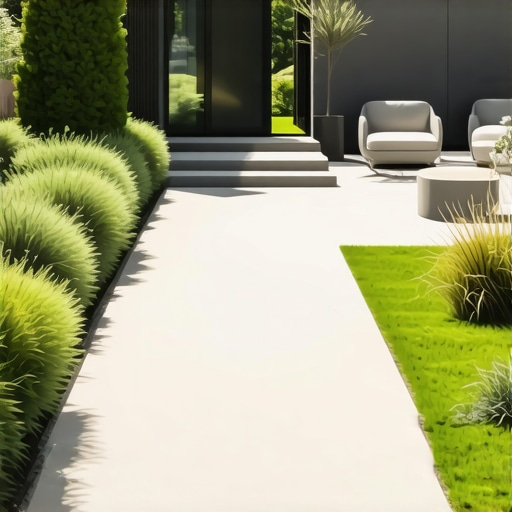
The Engineering Reality of Modern Curb Appeal
Modern curb appeal is often misunderstood as a purely aesthetic pursuit, but true high-end landscaping is built on a foundation of civil engineering and soil science. I recently got called out to tear up a $30,000 patio that was sinking because the previous contractor used a simple sand base instead of a properly compacted 2A modified gravel foundation. That failure cost the homeowner twice the original price to fix. If you want a modern front yard that lasts 20 years instead of 20 months, you have to stop thinking about plants and start thinking about site prep, drainage, and soil chemistry. Modernity in landscaping isn’t just clean lines; it is the integration of structural integrity and biological efficiency.
1. Precision Sod Installation and Soil Micro-Biology
Professional sod installation provides an instant, high-density turf surface that prevents erosion and suppresses weeds through immediate canopy closure and root-to-soil contact. To achieve this, the existing yard cleanup must remove every trace of thatch and debris to ensure the new roots hit bare, mineral-rich soil. Most people think you just roll it out like carpet. They are wrong. If you don’t address the Cation Exchange Capacity (CEC) of your soil before the first piece of turf hits the ground, you are setting yourself up for failure. We test for NPK (Nitrogen, Phosphorus, Potassium) levels and adjust the pH to roughly 6.5 to ensure nutrient availability.
“A healthy lawn begins with the soil; chemical interventions cannot compensate for poor soil structure or improper pH levels.” – Penn State Center for Turfgrass Science
Is professional sod installation worth the cost?
Professional installation is worth the investment because it eliminates the 18-month struggle of weed competition and erosion associated with seeding. It provides a mature root system that, when installed with proper soil amendments, becomes drought-resistant much faster than DIY attempts. We use a 5-ton roller to ensure there are no air pockets. Air kills roots. Period.
| Turf Variety | Traffic Tolerance | Sun Requirement | Drought Resistance |
|---|---|---|---|
| Tall Fescue | Moderate | 4-8 Hours | High |
| Kentucky Bluegrass | High | 8+ Hours | Moderate |
| Fine Fescue | Low | 2-4 Hours | High |
2. Geometric Hardscaping and Drainage Management
Modern hardscaping uses geometric patterns and high-quality pavers to create structural visual interest while doubling as a critical tool for managing surface water runoff. When we talk about “modern” front yards, we are often talking about retaining walls and paver walkways with 90-degree angles. However, the most important part is what you don’t see: the drainage.
“A retaining wall doesn’t fail because of the stone; it fails because of the water trapped behind it.” – Hardscape Engineering Axiom
We use non-woven geotextile fabrics to separate the subgrade from the base material. This prevents the stone from migrating into the dirt. Without this, your $15,000 walkway will be a wavy mess after two freeze-thaw cycles.
How much modified gravel do I need for a patio base?
You generally need a minimum of 6 inches of compacted 2A modified stone for a pedestrian walkway and 8 to 12 inches for any area that might see vehicular traffic. This must be applied in 2-inch “lifts,” with each layer compacted to 98% Proctor density. Anything less is negligence. Don’t skip the tamper. Use a plate compactor. It should literally bounce off the ground when you’re done.
3. Smart Irrigation and Hydro-Zoning
Advanced irrigation systems utilize weather-based controllers and drip-line technology to deliver water directly to the root zone, reducing waste and preventing fungal diseases. Modern landscaping avoids the old-school “spray and pray” method. We group plants by their water needs—this is called hydro-zoning. Putting a thirsty Hydrangea next to a drought-tolerant Juniper is a rookie mistake. One will drown or the other will wilt. We install pressure-compensating emitters to ensure every plant in a run gets the exact same amount of water, regardless of elevation changes. This is where the science of horticulture meets plumbing. We look at the evapotranspiration (ET) rates to program controllers. This isn’t just watering; it’s precision resource management.
Modern Yard Prep Checklist
- Complete yard cleanup: Remove all invasive species and dead organic matter.
- Grade for drainage: Ensure a 2% slope away from the home foundation.
- Soil Testing: Send samples to a local extension office for a full lab analysis.
- Utility Marking: Call 811 before any excavation to locate gas and water lines.
- Irrigation Trenching: Install main lines below the frost line to prevent bursting.
Landscape maintenance doesn’t start next year; it starts the day the install is finished. You need to monitor the moisture levels in the rhizosphere. Don’t just look at the leaves. Stick your finger in the dirt. If it’s bone dry two inches down, your irrigation isn’t doing its job. Modern yards are high-performance machines. Treat them that way. Follow the science. Do the work right the first time.