
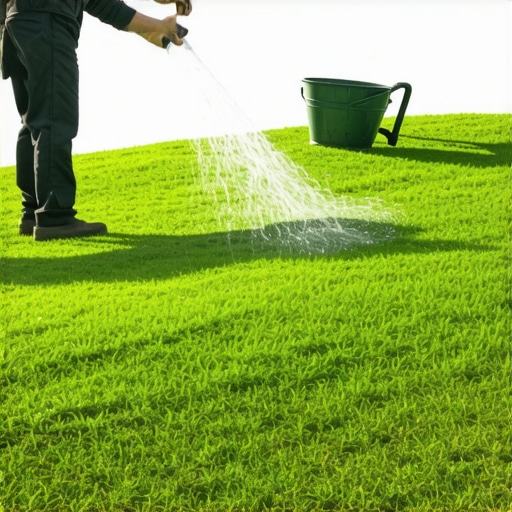
The Hard Truth About Sloped Turf Management
To water new sod on a slope effectively, you must utilize the ‘Short-Cycle’ or ‘Cycle and Soak’ method, which involves running irrigation for 4 to 6 minutes several times a day rather than one long soak. This approach prevents the water from reaching the saturation point where gravity overcomes soil friction, causing runoff, wasted resources, and the dreaded ‘sod slide’ where your expensive investment ends up at the bottom of the hill.
I always drill into my new crew members: if you don’t fix the soil grading first, every plant you put in the ground is just expensive compost. I have seen too many rookies slap down a thousand square feet of premium fescue on a 15-degree incline, turn the rotors on for thirty minutes, and wonder why the yard looks like a mudslide by morning. You aren’t just growing grass; you are managing a hydraulic system. When you install sod on a slope, the interface between the bottom of the sod mat and the top of your tilled soil is a critical failure point. If you over-saturate that layer, you create a lubricated plane. Gravity does the rest. We don’t do ‘mow-and-blow’ hack work here. We do engineering. You need to understand soil pore space and the physics of infiltration rates if you want that turf to strike root before the first heavy rain of 2026.
The Physics of Water Infiltration on Inclines
Water follows the path of least resistance, which on a hill is always downward. When you apply water faster than the soil can absorb it, the soil reaches its infiltration capacity. On flat ground, this creates a puddle. On a slope, this creates a river. This river carries away your topsoil and lifts the sod, breaking the delicate root hairs that are trying to knit into the substrate. This is why we use the short-cycle trick. By applying water in 5-minute bursts, we stay below the soil’s infiltration threshold.
“Surface runoff occurs when the rate of water application exceeds the soil’s infiltration rate. On slopes, this velocity increases, stripping nutrients and displacing newly laid sod before root establishment.” – USDA Soil Conservation Service Manual
We are looking at the microscopic reality of your yard. The soil is a matrix of sand, silt, and clay particles. Between those particles are pores. When those pores are filled with water, the soil is saturated. On a slope, you want the water to move vertically into the soil, not horizontally across it. Short cycles allow for ‘capillary action,’ where the dry soil below the sod actually pulls the moisture down through the profile like a sponge. This forces the roots to chase that water, creating a deep, stable root system that will eventually act as biological rebar for your hillside.
How many minutes should I water new sod on a hill?
For the first 14 days, you should water sloped sod for 5 minutes, 4 to 6 times per day, starting at 6:00 AM and ending by 4:00 PM. This ensures the root zone remains turgid without becoming anaerobic or prone to fungal pathogens like Pythium blight that thrive in stagnant, warm water. It is non-negotiable. Don’t skip a cycle.
| Day Post-Install | Cycles Per Day | Duration Per Cycle | Primary Goal |
|---|---|---|---|
| Day 1-7 | 5-6 | 4-6 Minutes | Prevent mat desiccation |
| Day 8-14 | 3-4 | 7-10 Minutes | Encourage initial root strike |
| Day 15-21 | 2 | 12-15 Minutes | Deepen root penetration |
| Day 22+ | 1 (Deep) | 20-30 Minutes | Drought hardening |
Mechanical Yard Cleanup and Soil Prep
You cannot skip the yard cleanup phase. If you are laying sod over old thatch, rocks, or compacted clay, you are wasting your money. The sod install is only as good as the subgrade. I’ve seen homeowners spend five figures on sod only to have it die because the soil was so compacted that the roots couldn’t penetrate deeper than an inch. You need a minimum of 4 inches of loosened, high-quality sandy loam. We use a power harley rake to chew up the top layer and ensure we have a consistent grade. If there are low spots, they will collect water and rot the sod. If there are high spots, the mower will scalp them. Accuracy matters. Use a transit level. Don’t guess.
What is the best way to keep sod from sliding down a hill?
Beyond the short-cycle watering trick, you must use sod staples or biodegradable stakes every 2 feet in a staggered pattern to mechanically anchor the turf. This physical bond holds the sod in place during the critical first 21 days while the roots are too shallow to provide structural stability against gravitational pull and hydraulic pressure.
“Proper irrigation scheduling is the single most important factor in the success of a sod installation, especially on grade-variable sites where hydraulic conductivity is limited.” – Texas A&M AgriLife Extension
Irrigation Hardware for 2026 Standards
Forget the old impact sprinklers that clank around and dump gallons of water in one spot. For 2026, we are moving toward high-efficiency rotary nozzles like the MP Rotator series. These nozzles deliver water at a much slower rate (0.4 inches per hour) compared to traditional spray heads (1.5 inches per hour). This slower ‘precipitation rate’ is exactly what you need for slopes. It mimics a gentle rain rather than a pressure washer. It gives the soil time to breathe. If your irrigation clock doesn’t have a ‘Cycle+Soak’ feature, get a smart controller. These devices use local weather data and soil type algorithms to calculate exactly when to pulse the water. It saves your lawn, and it saves your water bill. Use technology. Don’t be a luddite.
The Slope Maintenance Checklist
- Check for ‘pooling’ at the base of the slope daily; if it is soggy, reduce cycle times.
- Hand-water the ‘brow’ or top edge of the slope, as this area dries out the fastest.
- Never walk on wet, newly laid sod; you will create ruts that lead to erosion channels.
- Use a sharp spade to check root depth weekly; if you can’t lift the sod, the roots are taking hold.
- Monitor for ‘blue-gray’ tinting in the grass, which is the first sign of drought stress.
The Long-Term Game: Post-Establishment Care
Once you hit the 30-day mark, you need to transition. If you keep watering in short bursts forever, you will end up with a shallow root system that will fry the moment the July sun hits it. You have to force the roots down. We call this ‘drought hardening.’ By the end of month one, you should be watering deeply and infrequently. We want 1 inch of water per week, delivered in one or two heavy sessions. This forces the roots to chase the moisture deep into the cool, damp earth where the temperature is stable. Avoid high-nitrogen fertilizers in the first 6 weeks. You want root growth, not a massive surge of top-growth that the root system can’t support. Use a high-phosphorus ‘starter’ fertilizer with a ratio like 10-25-10. Get a soil test. Know your pH. If your soil is too acidic, the phosphorus gets locked up and the grass starves. It is basic chemistry. Don’t fight the science. Manage the soil, and the grass will take care of itself. In 2026, we have the tools to do this perfectly. Use them.