
The Hardscape Autopsy: Why Most Rock Gardens Are Expensive Compost
I recently got called out to tear up a $30,000 patio and adjacent rock feature that was sinking because the previous contractor thought he could just pile stone on top of loose topsoil. Within two years, the hydrostatic pressure from the hill behind it turned the entire installation into a muddy slide. The homeowner was furious, and rightly so. Most landscapers you hire today are ‘mow-and-blow’ hacks who don’t understand the civil engineering required to make a rock garden last. They throw down some weed fabric, dump some river rock, and call it a day. That is not landscaping; that is a recipe for a maintenance nightmare. If you want a rock garden that actually stays low-maintenance, you have to stop thinking about aesthetics and start thinking about soil mechanics and drainage. Every project begins with a yard cleanup that goes deeper than the surface. You aren’t just raking leaves; you are stripping the site down to a stable sub-grade. If you don’t fix the soil grading first, every plant you put in the ground is just expensive compost. Don’t skip the basics. It will rot.
Secret 1: Engineering the Sub-Base and Hydrostatic Management
The foundation of a low-maintenance rock garden is a compacted gravel sub-base and a non-woven geotextile fabric that prevents soil migration while allowing water to pass through the profile. Most DIYers and cheap contractors use that thin, plastic-like weed barrier from big-box stores. It’s garbage. It tears under the weight of real stone and clogs with fine silt in months. You need a 4-ounce or 6-ounce needle-punched fabric. This separates your structural stone from the native soil. Without it, your expensive rocks will literally sink into the earth over three seasons. You must also account for water. Water is the enemy of stability.
“A retaining wall doesn’t fail because of the stone; it fails because of the water trapped behind it.” – Hardscape Engineering Axiom
How much modified gravel do I need for a patio base?
For a standard rock garden feature or small patio transition, you need at least 4 to 6 inches of compacted 2A modified stone to create a stable, draining foundation. This prevents the freeze-thaw cycles from heaving your boulders and shifting your sod install lines. You calculate this by multiplying your square footage by your depth in feet, then dividing by 27 to get cubic yards. Don’t eyeball it. If you don’t compact it with a plate tamper until the machine literally bounces off the surface, you haven’t done the job.
Secret 2: Selective Horticulture and the Nitrogen Cycle
Successful rock gardens utilize USDA Hardiness Zone specific alpines and succulents that thrive in lean, well-draining soil with a pH between 6.0 and 7.5. Stop buying plants just because they look pretty at the nursery. You need to understand the rhizosphere. In a rock garden, you are mimicking a high-altitude or arid environment. This means you need a substrate that is at least 50% inorganic material—think expanded shale, coarse grit, or crushed basalt. Most people kill their rock garden plants by over-fertilizing. High-nitrogen fertilizers cause rapid, weak growth that attracts pests and leads to flopping. You want plants that are ‘hard-grown.’ They should be small, tough, and adapted to the local micro-climate. If your irrigation system is hitting your rock garden every day, you are going to kill your plants with root rot. Rock gardens need deep, infrequent watering—exactly 1 inch per week—to force roots to chase the water down into the cooler sub-soil layers.
What is the best soil for a rock garden?
The ideal rock garden soil is a gritty, mineral-heavy mix consisting of 1 part compost, 1 part coarse sand, and 2 parts crushed stone or perlite. This ensures a hydraulic conductivity high enough to prevent water from pooling around the root flare, which is the most common cause of plant death in these installs. Never bury the root flare. If you see a ‘mulch volcano’ in a rock garden, fire the person who built it. It will kill the tree or shrub within five years by girdling the roots.
Secret 3: Thermal Mass and Aggregate Interlocking
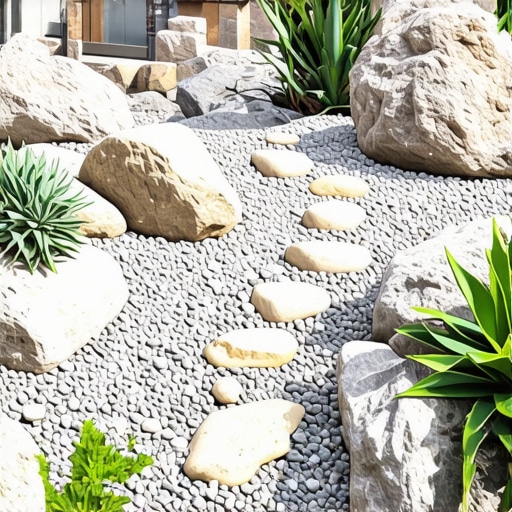
Using angular, crushed stone instead of rounded river rock prevents stone migration and provides better interlocking, which creates a stable walking surface and reduces weed germination sites. River rock is basically a tray of marbles; it moves every time you step on it or blow leaves off it. Angular stone, like crushed granite or basalt, locks together under its own weight. This is critical for long-term maintenance. Furthermore, rocks act as a thermal mass. They soak up heat during the day and release it at night. In colder climates, this can actually extend your growing season by a few weeks, but in hot climates like Georgia or Texas, you have to be careful not to bake your plants. This is where irrigation placement becomes an engineering task, not just a plumbing task. You need to place your drip emitters under the stones to minimize evaporation and keep the root zones cool.
| Material Type | Drainage Rating | Stability Factor | pH Impact |
|---|---|---|---|
| Crushed Granite | High | Excellent | Inert/Neutral |
| Limestone | Medium | Good | Alkaline (Raises pH) |
| River Rock | Very High | Poor | Neutral |
| Lava Rock | High | Moderate | Slightly Acidic |
- Call 811 / Dig Safe before any excavation to mark utility lines.
- Excavate at least 8 inches deep for the main structural boulders.
- Install a 4-inch perforated French drain if the garden sits at the base of a slope.
- Use only non-woven geotextile fabric (4oz minimum).
- Top-dress with 2 inches of angular aggregate to suppress weed seeds.
- Set irrigation drip lines 2 inches below the aggregate surface.
Maintenance and the Long Game
Once the sod install is finished around the perimeter and the rocks are set, your work isn’t over, but it is easier. A truly low-maintenance garden still requires a yard cleanup twice a year to remove organic debris. If leaves and grass clippings sit on top of your stones, they break down into a fine compost that fills the gaps between the rocks. That is exactly where weeds will grow. You aren’t fighting weeds from the ground up; you are fighting them from the top down. Keep the stone clean. Use a high-powered blower, not a rake. If you see a weed, pull it immediately before it sets seed. If you followed the engineered base protocol, the weed won’t have a deep root system and will pop right out. This is the difference between a garden that works for you and a garden you work for. Don’t be a hack. Do the dirt work right the first time.