
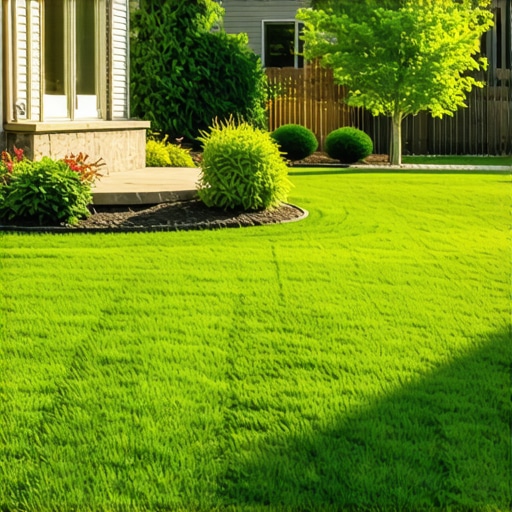
The Visual Warning of a Failing Landscape
The visual signs of a failing landscape include standing water, spongy turf, and efflorescence on foundation walls, indicating that your property’s grading and drainage systems have reached a point of critical saturation or structural failure. When these symptoms appear, the soil has lost its ability to transport water away via gravity. [IMAGE_PLACEHOLDER] I recently got called out to tear up a $30,000 patio that was sinking because the previous contractor ignored basic hydrostatic principles. The homeowner noticed the pavers were dipping toward the house. When we pulled the first row of stones, we found a swamp. The contractor had used stone dust as a base—which holds water like a sponge—instead of a clean, angular 2B stone. No perforated pipe. No geotextile fabric. Just a $30,000 mistake that was rotting the home’s sill plate. It was a classic hardscape autopsy. The water didn’t have a path, so it made one through the foundation.
Why Backyard Flooding Occurs
Backyard flooding is primarily caused by poor soil grading, hydrostatic pressure, and high clay content, which prevent water from moving away from the foundation. When gravity cannot guide runoff toward a designated outlet, moisture pools in low spots, saturating the root zone and eventually compromising structural footings.
“A retaining wall doesn’t fail because of the stone; it fails because of the water trapped behind it.” – Hardscape Engineering Axiom
Understanding the physics of your yard is the first step. Gravity is your only friend here. If your yard has less than a 2% slope—that is a 2-foot drop for every 100 feet of run—the water will sit. It will rot your grass. It will kill your expensive nursery stock. Most ‘mow-and-blow’ crews will tell you that you just need more topsoil. They are wrong. Adding soil without changing the pitch just creates a bigger mud pit. You have to address the sub-grade. This involves excavating the ‘A’ horizon soil and reshaping the denser subsoil to ensure water moves.
How much slope do I need for backyard drainage?
A standard residential grade requires a minimum slope of 1/4 inch per foot away from the foundation for at least 10 feet. This pitch ensures that surface tension and friction do not overcome the force of gravity, preventing water from seeping into basement walls or crawlspaces.
The Engineering of Yard Cleanup and Soil Prep
A legitimate yard cleanup is more than blowing leaves; it is a topographical reset that involves removing organic debris and thatch that impede surface flow and harbor pathogenic fungi. When we go into a site, we look for the high points. We use laser levels, not our eyes. The human eye is easily fooled by long horizons. We calculate the cut and fill requirements. If we are doing a sod install, we don’t just lay the rolls on top of the old dirt. We core aerate to 4 inches to break up the compaction layer. If that soil is heavy clay, we might even incorporate calcined clay or sand to change the pore space.
| Material Type | Drainage Rate (Inches/Hour) | Compaction Stability |
|---|---|---|
| Heavy Clay | 0.05 – 0.2 | High / Poor Drainage |
| Sandy Loam | 0.5 – 2.0 | Moderate / Good Drainage |
| Clean 2B Stone | 20.0+ | High / Superior Drainage |
| Topsoil (High Organic) | 0.1 – 0.8 | Low / Spongy |
The Failure of DIY French Drains
Most homeowners go to a big-box store, buy the thin, black corrugated pipe, and bury it in a shallow trench. This is a mistake. That pipe will crushed under the weight of a lawn tractor. It will clog with silt in two seasons. We use SDR-35 PVC. It is rigid. It has a smooth interior wall that prevents debris snagging. We wrap the entire trench in a non-woven geotextile fabric. This acts as a filter. It let’s the water in but keeps the fines out.
“Surface runoff should be directed away from the foundation at a minimum slope of 6 inches within the first 10 feet.” – Penn State Agricultural Extension
Why is my yard still wet after a French drain install?
Your yard remains wet if the French drain was installed without a proper discharge point or if the trench was backfilled with native, non-porous soil instead of clean, angular aggregate. Without an air gap in the stone, the water cannot reach the pipe fast enough to prevent surface saturation.
Sod Install and Irrigation Alignment
A successful sod install requires a chemically balanced seedbed and an irrigation system calibrated to the evapotranspiration rate of the specific turfgrass species. If you have grading issues, your irrigation will only make them worse. Head-to-head coverage is great, but if your zones are running 30 minutes on a 5-degree slope, the water is running off before it hits the roots. We use cycle-and-soak programming. We run the zone for 10 minutes, let it sit for an hour, then run it again. This forces the water into the soil profile rather than across the surface.
- Check utility lines by calling 811 before any excavation.
- Identify the lowest point of the property for the drainage discharge.
- Excavate a trench 12 inches wide and 18 inches deep for main lines.
- Use a plate compactor on all fill dirt to prevent future settling.
- Install a pop-up emitter at the curb to keep rodents out of the pipes.
Maintaining the Grade Long-Term
Landscaping is not static. Soil moves. Roots grow. You have to monitor the swales. If you see mulch migrating after a heavy rain, your flow velocity is too high. You might need to install rip-rap stone to slow the water down. This isn’t about ‘curb appeal.’ This is about civil engineering on a residential scale. Don’t let a ‘mow-and-blow’ hack tell you that a bag of lime will fix a swamp. It won’t. You need a transit, a shovel, and a plan.