
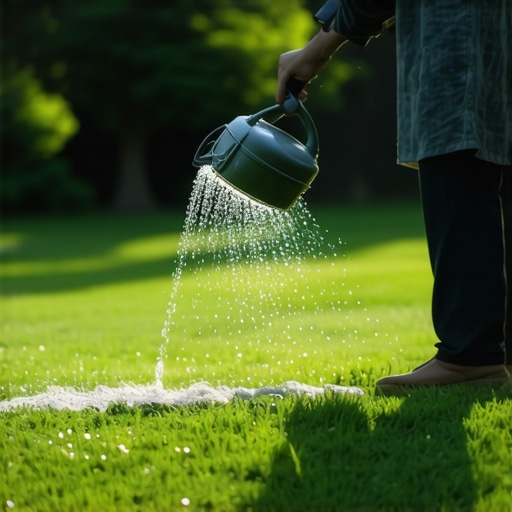
The Anatomy of a High-Stakes Installation
Establishing new sod is not a weekend hobby; it is a race against cellular desiccation and soil interface resistance. I always drill into my new crew members: if you don’t fix the soil grading first, every plant you put in the ground is just expensive compost. I have seen guys throw $10,000 worth of premium Kentucky Bluegrass on top of compacted clay that had the density of a highway shoulder, and they wonder why the lawn turned into a brown door mat within seventy-two hours. The root system of freshly cut sod has been severed from its primary water source. You are essentially managing a biological patient in intensive care. Without the 4:00 AM soak, you are gambling with the hydrostatic pressure of the entire root zone. Success in 2026 requires more than a garden hose; it requires an understanding of soil physics and the exact timing of the diurnal cycle.
“A retaining wall doesn’t fail because of the stone; it fails because of the water trapped behind it.” – Hardscape Engineering Axiom
The Science of the 4:00 AM Window
To maximize root establishment, irrigation must occur at 4:00 AM to allow hydrostatic infiltration before the evapotranspiration rate spikes with the rising sun. This specific window is critical because it utilizes the lowest wind speeds and the highest humidity levels of the day. When you water at noon, you lose up to forty percent of that moisture to evaporation before it even touches the soil. Worse, watering at 9:00 PM creates a damp canopy that sits all night, which is a literal invitation for Pythium blight and Rhizoctonia solani. By starting at 4:00 AM, the water has time to migrate through the thatch layer and penetrate the top four inches of the soil profile, yet the blades dry quickly once the sun hits them, preventing fungal spores from germinating. It is about efficiency and pathology management. Do not deviate.
How long should I water my new sod for the first 14 days?
For the first two weeks, you must run your irrigation zones for 15 to 20 minutes twice daily, with the primary soak at 4:00 AM and a secondary cooling cycle at 1:00 PM. This maintains capillary action within the rhizosphere, ensuring the newly cut roots do not shrink away from the native soil bed. You aren’t just watering the grass; you are hydrating the interface between the sod’s organic mat and the mineral soil below. If that interface dries out, an air gap forms. Once that gap exists, the roots will hit a wall and die. You need to keep that soil-to-sod contact point saturated but not anaerobic. It is a tightrope walk. You want a sponge, not a swamp.
The Soil Interface and Grading Logic
Before the first roll is even dropped, the yard cleanup and grading must be surgical. Most hacks leave rocks, old roots, or construction debris under the sod. This creates localized dry spots where the sod cannot make contact with the earth. We use a harley rake to achieve a pulverized, loose seedbed. We test the bulk density of the soil; it should be crumbly, not clumpy. If the soil is compacted, the roots will simply coil horizontally like a pot-bound plant instead of diving deep. This is why we pull soil cores to check for macropores and micropores. Without those air pockets, water cannot move downward. It just sits on the surface and rots the crown. Grading is the only way to ensure the water you apply at 4:00 AM actually goes where it is needed instead of pooling in a low spot and drowning the grass.
| Phase | Timing | Duration (Per Zone) | Objective |
|---|---|---|---|
| Days 1-7 | 4:00 AM / 1:00 PM | 20 Minutes | Hydrate the interface |
| Days 8-14 | 4:00 AM / 1:00 PM | 15 Minutes | Encourage initial knitting |
| Days 15-21 | 5:00 AM Only | 30 Minutes | Force root depth |
| Day 22+ | 5:00 AM (3x Weekly) | 45 Minutes | Establish drought tolerance |
“Effective turf management relies on the fundamental principle of deep, infrequent irrigation to promote vertical root elongation into the subsoil profile.” – Penn State Center for Turfgrass Science
The Calibration Protocol: The Tuna Can Test
Most homeowners have no idea how much water their irrigation system actually puts out. They talk in minutes, but I talk in inches. To calibrate your irrigation heads, place three empty tuna cans or small tupperware containers in various spots across the zone. Run the zone for twenty minutes. Measure the depth of the water in each can. If you have a quarter inch of water, you need to run that zone for eighty minutes a week to hit the one-inch baseline. If one can is full and the other is dry, your nozzle precipitation rates are mismatched. You have a hardware problem, not a weather problem. You must fix the head layout before the sod dies. Uneven watering is the primary reason for patch failure in new installs. Fix it now.
Why does my new sod look brown even when I water it?
Brown spots in new sod usually indicate localized hydrophobicity or air pockets trapped beneath the rolls where the sod failed to make subsoil contact. If the edges are turning brown, the rolls are shrinking because they weren’t laid tightly enough or the water isn’t reaching the seams. Use a sod roller to press the turf into the mud. If you can lift a corner of the sod and the soil underneath is dry, your irrigation isn’t penetrating. You might have a high clay content that is repelling water. In those cases, we use a non-ionic wetting agent to break the surface tension and force the water down. It is not always about more water; it is about better infiltration.
The Critical Checklist for Week One
- Check seams daily for gaps; if you see a gap, the sod is thirsty and shrinking.
- Lift one corner in each zone; the soil underneath should be moist, not muddy.
- Check the 4:00 AM timer; verify the rain sensor isn’t stuck or bypassed.
- Walk the perimeter; hand-water the edges where the irrigation rotors might miss.
- Monitor for “tacoing”; if the blades fold inward, the plant is in emergency shutdown.
Transitioning to Long-Term Health
By day twenty-one, the strategy changes. We stop the frequent sips and start the deep gulps. We move the watering time slightly later to 5:00 AM and increase the duration. This forces the roots to hunt. If you keep the surface wet forever, the roots stay in the top half-inch. They become lazy. Lazy roots die in the August heat. You want roots that are four to six inches deep by the time the first mow happens. Speaking of mowing, do not touch it until the sod is firmly rooted. If you can’t pull it up with a firm tug, it is ready. Set your mower to the highest setting. Never take off more than one-third of the blade. Scalping new sod is a death sentence. It destroys the photosynthetic factory the plant needs to build more roots. Be patient. Keep the 4:00 AM schedule. Let the biology work.