
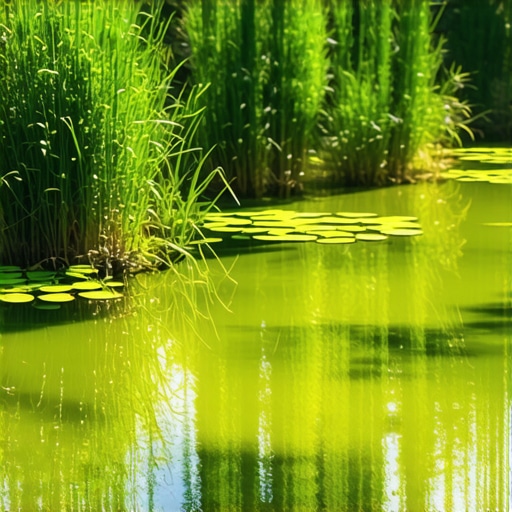
The Forensic Autopsy: Why Your Pond Turned Into a Green Slurry
Pea soup green pond water is caused by a massive explosion of single-celled planktonic algae fueled by excess nitrates, phosphates, and sunlight. Clearing it within 48 hours requires a two-pronged attack: immediate flocculation or UV sterilization to kill the bloom and robust mechanical filtration to remove the dead organic matter before it rots. I see this every summer when a client calls me out to a site where their pond looks more like a toxic waste dump than a feature. I always drill into my new crew members: if you don’t fix the filtration flow and nutrient balance, every gallon of algaecide you pour in the water is just a temporary bandage for a deep wound. Most homeowners treat the symptom, not the structural failure of the ecosystem. When I arrive at a property for a yard cleanup, the first thing I check isn’t the pond itself, but the surrounding landscaping and irrigation. Often, a recent sod install has introduced high-nitrogen runoff into the water, triggering a chemical feedback loop that the existing bio-filter cannot handle.
“Excessive nutrient loading, particularly phosphorus and nitrogen, is the primary driver of planktonic algae blooms in closed aquatic systems.” – Agricultural Extension Office Research
How much UV wattage do I need for a 1,000-gallon pond?
To achieve clear water in a 1,000-gallon pond, you need a UV-C clarifier with at least 15 to 30 watts of output, ensuring the flow rate allows for a contact time of at least two seconds per pass. UV-C light works by disrupting the DNA of the single-celled algae, preventing them from reproducing. It does not kill the algae instantly like a poison; it sterilizes them. This is where the 48-hour clock starts. Once sterilized, the algae die off and begin to clump together. If your pump is too weak or your pipe diameter is too small, the water won’t circulate through the UV housing fast enough to treat the entire volume of the pond. I’ve seen $5,000 filtration systems fail because the contractor used 1-inch kink-free tubing instead of 2-inch PVC, creating a massive drop in PSI and rendering the UV unit useless. Don’t skip the plumbing math.
Will barley straw clear my pond in two days?
The short answer is no: barley straw is a preventative measure that takes weeks to decompose and release the hydrogen peroxide required to inhibit algae growth, making it useless for a 48-hour emergency. You need a polymer-based flocculant. These chemicals act as a coagulant. Algae cells have a negative charge, which keeps them repelled from one another and suspended in the water column. A high-grade flocculant introduces positive ions that neutralize this charge, causing the algae to bind together into heavy clumps that sink to the bottom or get trapped in your mechanical filter. But here is the warning: if you have fish, a massive algae die-off will consume all the dissolved oxygen in the water as the organic matter decomposes. You must run your aeration or waterfalls at 100 percent capacity during this process. It will rot if you don’t move the water.
| Method | Speed of Action | Mechanism | Primary Risk |
|---|---|---|---|
| UV-C Clarifier | 24-72 Hours | DNA Sterilization | Bulb failure/Low flow |
| Flocculants | 2-6 Hours | Coagulation/Settling | Oxygen depletion |
| Algaecides | 12-24 Hours | Cellular Toxicity | Fish kill from ammonia spike |
| Fine Polishing Pads | Immediate | Mechanical Removal | Filter bypass/Clogging |
The 48-Hour Rapid Remediation Checklist
- Hour 0: Test water for ammonia and phosphates. If phosphates are above 0.05 ppm, the bloom will return.
- Hour 1: Apply a polymer flocculant and increase aeration. Do not walk away.
- Hour 4: Install 100-micron mechanical polishing pads in your skimmer or pressurized filter.
- Hour 12: Remove and wash the polishing pads. They will be coated in green slime. This is the algae leaving the pond.
- Hour 24: Ensure the UV-C bulb is active and the quartz sleeve is clean. A dirty sleeve blocks 90 percent of the light.
- Hour 48: Perform a 10 percent water change and add beneficial bacteria (Nitrosomonas and Nitrobacter) to jumpstart the biological cycle.
“The efficiency of UV sterilization is dependent on flow rate: water must remain in contact with the UV bulb for a minimum kill time to disrupt the DNA of single-celled organisms.” – Hardscape Engineering Axiom
The engineering of the pond’s drainage is often overlooked during the initial landscaping phase. If your pond is the lowest point in the yard, every rainstorm washes fertilizers from your sod install directly into the water. This is a design flaw. When we do a yard cleanup, we often install a French drain or a small retaining wall around the pond perimeter to redirect surface runoff. Hydrostatic pressure can also push groundwater through micro-cracks in a concrete pond or under a liner, introducing mineral-rich water that feeds the bloom. You have to think about the microscopic reality. Algae aren’t just an eyesore; they are a symptom of a nitrogen cycle that has stalled. Once you clear the water, you must maintain a biological filter with enough surface area (bio-ribbon or ceramic media) to house the bacteria that convert toxic ammonia into nitrates. Without that surface area, you are just waiting for the next green-out. Stop buying cheap big-box pumps. Use professional-grade external pumps or high-head submersible units that can handle the backpressure of a fine-mesh filter pad. It won’t be cheap, but it will work. The long-term stability of your water feature depends on engineering, not magic liquids in a bottle. Keep the water moving, keep the oxygen high, and keep the nutrients low.