
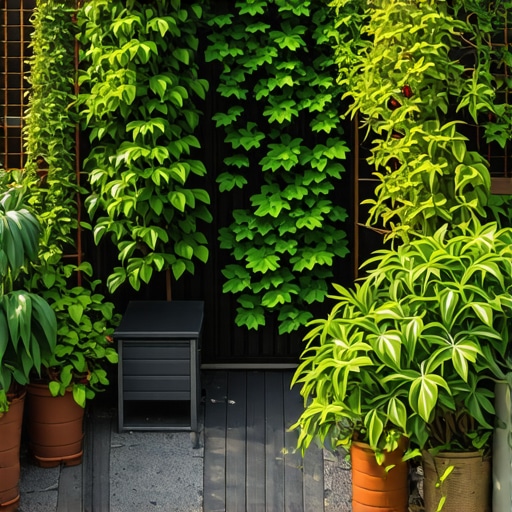
The Foundation of Verticality: Why Small Yards Fail by Design
Vertical trellises in small yards maximize biomass production and functional footprint by utilizing the Z-axis, provided the structures are anchored into load-bearing substrates and integrated with sub-surface irrigation to prevent localized root rot. I always drill into my new crew members: if you don’t fix the soil grading first, every plant you put in the ground is just expensive compost. I have seen too many rookies slap a trellis against a fence and walk away, only for the first heavy rain to turn that corner into a stagnant pond because the grade was pitched toward the house. In a small yard, you have no margin for error. Every square inch of soil must be engineered. We start with a yard cleanup that involves more than just raking; we are stripping back the top 3 inches of spent, compacted ‘contractor dirt’ to expose the true subgrade. If you don’t understand the bulk density of your soil, you aren’t landscaping; you are guessing. In 2026, we are seeing a shift toward precision horticulture where every vertical element is a component of a larger hydrologic system. This means your trellis isn’t just a decoration; it is a windbreak, a thermal regulator, and a vertical drainage plane.
How much modified gravel do I need for a trellis post base?
For a standard 4×4 vertical trellis post, you need a minimum of 0.5 cubic feet of ASTM C33 washed gravel to facilitate drainage at the base of the concrete footer. Excavate a hole 24 inches deep and 12 inches wide. Pour 6 inches of gravel at the bottom. This prevents the post from sitting in a ‘soup’ of water, which leads to anaerobic rot. [IMAGE_PLACEHOLDER_1] No matter what the pressure-treatment rating says, wood in standing water has a shelf life. We use a 4000 PSI concrete mix for the collar, sloped away from the wood at the surface to shed water. This is the difference between a structure that lasts five years and one that lasts twenty.
Engineering the Vertical Plane: Structural Loads and Fastening
A vertical trellis must be engineered to withstand lateral wind loads and the cumulative weight of mature woody vines, which can exert hundreds of pounds of downward force when wet. Most DIYers use flimsy staples or thin wire. That is a failure waiting to happen. We use 316-grade stainless steel cable systems with turnbuckles for tension adjustment. This allows the plant to climb without strangling itself.
“A retaining wall doesn’t fail because of the stone; it fails because of the water trapped behind it.” – Hardscape Engineering Axiom
This axiom applies to vertical structures too. If your trellis is mounted to a wall, you must maintain a 2-inch air gap. Without this gap, you are trapping moisture against your siding, inviting fungal pathogens and structural decay. We use standoff spacers made of HDPE to ensure airflow remains constant. This is critical for the health of the plant as well. Without airflow, you are creating a microclimate for powdery mildew and spider mites. In a small yard, one sick plant can infect the entire canopy in days.
| Material Type | Tensile Strength | Corrosion Resistance | 2026 Cost Index |
|---|---|---|---|
| Stainless Steel Cable | High | Excellent | Premium |
| Galvanized Mesh | Medium | Moderate | Economic |
| Cedar Lattice | Low | Low (Natural Oils) | Standard |
| Powder-Coated Aluminum | High | High | High |
The Root Zone Reality: Soil Science in Confined Spaces
Small yard landscaping requires an intensive nutrient management plan because the root volume is restricted by hardscaping and property lines. When we perform a sod install alongside vertical elements, we are balancing two different biological needs. The turf needs high nitrogen and frequent mowing, while your vertical climbers might need more phosphorus and potassium for wood strength and bloom. We use a split-application fertilizer method.
“Soil compaction is the single greatest barrier to urban plant health, reducing pore space for oxygen and water infiltration.” – USDA Agronomy Manual
We core-aerate the soil to a depth of 4 inches before any planting occurs. This breaks up the plow pan created by construction equipment. For the trellis area, we incorporate 15 percent by volume of expanded shale or perlite. This ensures that even in a small, high-traffic yard, the soil remains aerobic. Oxygen is the most overlooked nutrient in landscaping. If the roots can’t breathe, the plant won’t climb.
Which climbing plants won’t damage brick mortar?
To avoid mortar damage, select twining vines like Clematis or Lonicera sempervirens rather than root-clinging vines like English Ivy or Trumpet Creeper. Twining vines require a trellis or cable system to wrap around. They do not secrete the acidic enzymes or physical rootlets that penetrate and expand cracks in masonry. This is a common point of friction in HOA-governed neighborhoods. Always check your local codes before choosing a species. In 2026, we focus on native pollinators. A vertical trellis covered in Lonicera (Honeysuckle) provides more ecological value per square foot than any other landscape feature. It is about stacking functions: privacy, beauty, and habitat.
Integrating Turf and Hardscape: The Sod and Irrigation Interface
The successful integration of irrigation systems within a small yard depends on hydro-zoning, which groups plants with similar water requirements onto the same valve circuit. You cannot run your sod sprinklers and your trellis drip lines on the same schedule. Sod requires shallow, frequent watering during the establishment phase, whereas woody climbers need deep, infrequent pulses to encourage geotropic root growth. We install pressure-compensating emitters for all vertical elements. This ensures that the plant at the top of a slope gets the same volume of water as the plant at the bottom. When we lay sod, we use a heavy-duty roller to ensure 100 percent root-to-soil contact. Any air pocket under that sod will kill the grass in 48 hours of summer heat. I have seen $5,000 sod jobs die because the contractor was too lazy to rent a water-filled roller. Don’t be that guy. Use a starter fertilizer with a high middle number (Phosphorus) to jumpstart root development. In small yards, the irrigation lines often have to weave through narrow gaps between the trellis footings and the foundation. We use Schedule 40 PVC for main lines and avoid ‘funny pipe’ for anything under a permanent structure. It is about mechanical protection. One wrong swing of a spade during a future yard cleanup and you have a geyser in your yard.
- Test soil pH and adjust to 6.5 using pelletized lime or elemental sulfur.
- Install a 4-inch PVC sleeve under any walkways for future irrigation expansion.
- Apply a 3-inch layer of double-ground hardwood mulch, keeping it 2 inches away from the plant stem.
- Use 12-gauge wire for trellis systems exceeding 6 feet in height.
- Calibrate your irrigation controller for seasonal ET (Evapotranspiration) rates.
Landscape maintenance is not a ‘set and forget’ endeavor. It is a biological process. You are the steward of a tiny ecosystem. Every yard cleanup session should include an inspection of the trellis fasteners. Wood expands and contracts. Metal fatigues. Plants grow. If you don’t adjust your cable tension, the plant will eventually buckle the support structure. The 2026 landscape is a marriage of civil engineering and botany. Treat it with the respect it deserves, and your small yard will outperform the massive, neglected estates every time. Focus on the soil, the structure, and the water. The rest is just biology doing its job.