
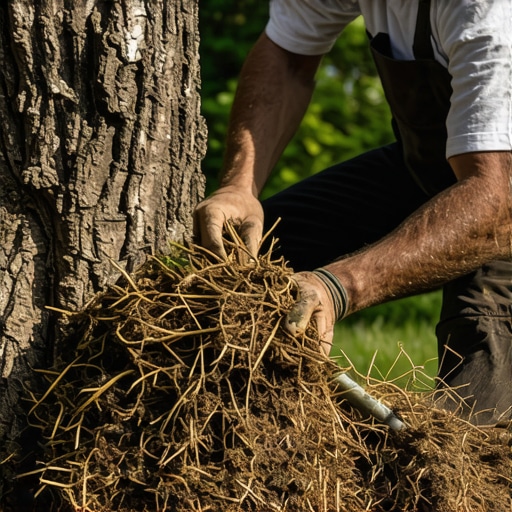
I see the same carnage every spring. The stench of fermented wood chips and the spongy, black decay of a dying silver maple trunk are unmistakable signs of a mulch volcano. It starts with a homeowner or a cut-rate landscaping crew who thinks more is better. It is not. Piling mulch against the base of a tree is a death sentence that works in slow motion. I always drill into my new crew members: if you don’t fix the soil grading first, every plant you put in the ground is just expensive compost. Last spring, I had to show a new hire exactly why we don’t pile chips a foot high. I peeled back the soggy mulch to reveal bark that was literally sloughing off the trunk. Bark is the tree’s skin. If you keep it wet 24/7, it rots. It is that simple. This guide breaks down why these mounds are lethal and how to perform a proper yard cleanup to save your trees.
The Lethal Mechanics of the Mulch Volcano
Mulch volcanoes are excessive mounds of organic material piled against a tree trunk, causing bark rot, oxygen deprivation, and girdling roots. This improper application prevents gas exchange at the root flare, inviting pathogens like Phytophthora and pests that lead to inevitable tree decline or death.
Bark is designed to protect the tree from the elements, but it is not adapted to be submerged in moist organic matter. When you pile mulch high against the trunk, you create a dark, damp environment that never dries out. This leads to the maceration of the bark tissue. Once the bark is compromised, the tree’s vascular system, the phloem and xylem, becomes vulnerable. These are the pipelines that transport sugars and water. If they are crushed or rotted, the tree starves. Furthermore, these mounds often become hydrophobic. A thick layer of mulch can actually repel irrigation water, shedding it away from the root ball where it is needed most. This creates a paradox where the trunk is rotting from too much moisture while the roots are desiccating from a lack of it.
“The root flare is the area where the first main roots attach to the trunk. This area must be visible at the soil surface to ensure long-term tree health.” – Texas A&M AgriLife Extension
The Pathology of Root Suffocation and Girdling
Root suffocation occurs when mulch depth exceeds four inches, creating an anaerobic environment that kills the feeder roots responsible for nutrient uptake. In response, the tree may grow adventitious roots into the mulch layer, which eventually circle the trunk and become girdling roots that choke the tree’s vascular system.
When roots grow into the mulch rather than the soil, they are exposed to extreme temperature fluctuations. Soil provides insulation; mulch does not. In the heat of summer, these roots bake. In the winter, they freeze. As these roots grow larger within the mulch pile, they eventually encounter the solid trunk. Instead of spreading out, they begin to wrap around the base. As the tree grows in diameter, these roots tighten like a noose. This is a structural and biological failure. During a sod install, many homeowners forget that the soil level around trees must remain constant. Adding soil or mulch over the root flare during yard cleanup is a common mistake that leads to these circling roots. [IMAGE_PLACEHOLDER]
How much mulch is too much for a tree?
Any mulch layer exceeding four inches in depth is considered excessive for most tree species. A standard, healthy application is two to three inches of organic material spread in a wide radius around the tree. Crucially, there should be a three inch gap between the mulch and the actual trunk of the tree to allow for air circulation and bark drying.
Can a tree recover from a mulch volcano?
Yes, many trees can recover if the mulch is removed before the bark decay has girdled more than fifty percent of the trunk. The recovery process involves careful excavation of the root flare and the surgical pruning of any adventitious or circling roots that have begun to wrap around the main stem.
| Feature | Mulch Volcano (Hazardous) | Proper Ring (Healthy) |
|---|---|---|
| Depth | 6 to 12 inches | 2 to 4 inches |
| Trunk Contact | Piled against bark | 3 inch gap from trunk |
| Root Flare | Completely buried | Fully exposed |
| Water Access | Sheds water away | Channels water to roots |
The Remediation Process: How to Fix a Mulch Volcano
The remediation process involves the manual removal of excess mulch using hand tools to expose the root flare without damaging the delicate cambium layer. Once the flare is visible, any adventitious roots must be pruned to prevent future girdling and ensure the tree’s structural integrity.
Don’t reach for a shovel first. You will nick the bark. Use your hands or a small plastic hand rake to pull the mulch away from the trunk. You are looking for the point where the trunk widens out into the roots. This is the root flare. If you find roots growing horizontally through the mulch, these are the enemies. They need to be snipped with clean, sharp bypass pruners. Do not leave a stump; cut them back to the trunk or the main root. This is a critical part of any professional yard cleanup. If the mulch has been there for years, you might find that the soil beneath it is compacted. Use a hand fork to gently loosen the soil, but be careful not to disturb the primary roots. If you have an irrigation system, check the head placement. Heads should never spray directly onto the trunk of the tree, as this accelerates bark rot in the newly exposed area.
- Identify the root flare by removing mulch until the trunk widens.
- Remove all organic material within a three inch radius of the trunk.
- Prune circling roots that are smaller than two inches in diameter.
- Spread remaining mulch in a flat doughnut shape, not a cone.
- Ensure the mulch does not exceed a three inch depth across the bed.
“Excessive mulch can lead to root rot, trunk cankers, and the development of circling roots that eventually girdle the tree.” – Penn State Extension
Long-term Tree Care and Soil Health
Proper tree care focuses on maintaining a stable soil pH and ensuring that irrigation reaches the outer drip line where active root growth occurs. Avoiding nitrogen drawdown caused by decomposing wood chips is essential for maintaining the tree’s photosynthetic capacity and overall vigor.
Microbes that break down wood mulch require nitrogen to do their job. If you use a fresh, uncomposted wood chip, those microbes will pull nitrogen directly from the soil, potentially starving your tree. This is why I prefer aged hardwood mulch or pine straw. During a sod install nearby, ensure that the nitrogen heavy fertilizers used for the grass don’t leach too heavily into the tree’s root zone, which can cause a flush of weak, succulent growth that is susceptible to pests. Monitoring the soil moisture is also vital. Use a soil probe to check the moisture level at a depth of six inches. If it is dry, water deeply and infrequently. This forces the roots to grow downward into the soil profile rather than upward into the mulch. Proper landscaping is about working with biology, not fighting it. It takes years for a tree to grow and only one bad season of mulching to kill it. Don’t be the reason your canopy disappears.