
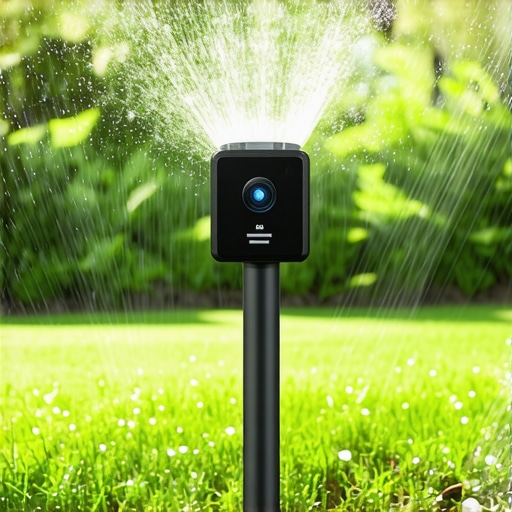
Mastering the Physics of Precision Irrigation
Stop guessing. Water is not a suggestion; it is a chemical requirement dictated by solar radiation and plant physiology. If you are still watering your lawn based on a static timer, you are wasting money and drowning your landscape. I always drill into my new crew members: if you don’t fix the soil grading and sensor calibration first, every plant you put in the ground is just expensive compost. Irrigation in 2026 has moved beyond simple schedules to real-time biological responses. We are no longer just ‘sprinkling’; we are managing a hydraulic system that must sync with the Evapotranspiration (ET) rates of your specific micro-climate. I have seen too many rookies slap a Wi-Fi controller on a wall and walk away, only to find the new sod rotted three weeks later because the ET slope was incorrectly mapped for the shade density. Accuracy matters down to the milliliter.
How Do ET Sensors Improve Irrigation Efficiency?
ET sensors improve irrigation efficiency by calculating the Evapotranspiration rate, which is the sum of water evaporated from the soil surface and transpired by plants. By integrating solar radiation, wind speed, temperature, and humidity data, these sensors adjust watering runtimes to replace only what was lost.
“A smart controller is only as intelligent as the data it receives; without localized ET data, the system is essentially blind to the actual water needs of the plant material.” – Irrigation Association Technical Manual
The Ground-Up Build: Planning the System
Success starts at the curb. Before we even touch a wire, we look at the yard cleanup. A yard cluttered with debris or thick, unmanaged thatch will skew your sensor readings and prevent water from reaching the root zone. If you are doing a sod install, the programming logic changes entirely for the first 21 days. For 2026 systems, the setup begins with mapping your zones by hydro-zone. This means grouping plants with similar water needs together. Putting a high-water-demand fescue on the same zone as a drought-tolerant boxwood is a rookie mistake that will kill one or both. We use ultrasonic flow sensors now to detect leaks at 0.1 gallons per minute. Do not skip the flow calibration phase.
How much modified gravel do I need for a patio base?
While this seems unrelated to irrigation, the drainage of your hardscape dictates where your water flows. You need a minimum of 6 inches of compacted 21A or CR-6 modified gravel for a standard patio, but if you’re installing irrigation lines underneath, those must be sleeved in Schedule 40 PVC to prevent crushing during the 98 percent Proctor density compaction. Most guys forget this. Then they wonder why their heads have no pressure under the pavers. It’s because they crushed the line with a vibratory plate compactor.
The Science of ET Sensor Configuration
Programming a 2026 Wi-Fi controller requires inputting specific soil texture data. You have to know your field capacity and your permanent wilting point. If you have heavy clay, your infiltration rate is roughly 0.1 to 0.2 inches per hour. If you program a standard spray head to run for 20 minutes straight, you’re going to have 15 minutes of runoff. Use the ‘Cycle and Soak’ feature. This breaks the 20 minutes into four 5-minute bursts, allowing the water to penetrate the soil through capillary action rather than running off into the storm drain. Check your nozzle specs. Are they 1.5 GPM or 3.0 GPM? The controller needs to know this to calculate the exact precipitation rate (PR). If your PR is wrong, your ET math is garbage.
| Soil Type | Infiltration Rate (Inches/Hr) | Water Holding Capacity | Irrigation Strategy |
|---|---|---|---|
| Heavy Clay | 0.05 to 0.20 | High | Cycle and Soak / Short Runtimes |
| Silt Loam | 0.30 to 0.50 | Medium | Moderate Runtimes |
| Sandy Loam | 0.50 to 1.00 | Low | Frequent, Light Application |
| Pure Sand | 1.00 to 2.50 | Very Low | High Frequency / Precision Pulse |
How do I set up a Wi-Fi sprinkler timer for new sod?
For new sod, the ET sensor should be overridden for the first 14 days. New turfgrass requires constant moisture at the soil-root interface to prevent desiccation. After the first 14 days, you gradually transition to ET-based scheduling to encourage deep root growth through regulated water stress.
“Irrigation scheduling must account for the management allowable depletion (MAD) to ensure that soil moisture levels do not drop below the threshold that causes permanent plant tissue damage.” – Penn State Agricultural Extension
Post-Installation: The Commissioning Checklist
Once the system is live, you aren’t done. You need to walk the zones. Watch the heads rise. Are they leaking at the seals? Is the pressure-regulated (PRS) head maintaining 30 PSI for sprays and 45 PSI for rotors? If the pressure is too high, the water atomizes into a mist and blows away. The ET sensor won’t know the wind carried your water into the neighbor’s driveway. You have to physically verify the coverage. The 2026 tech is great, but it cannot see a clogged nozzle or a broken riser.
- Verify ET sensor signal strength at the installation site.
- Input specific plant coefficients (Kc values) for each zone.
- Calibrate flow sensors by running a manual 2-minute cycle per zone.
- Set up ‘Freeze Delay’ to prevent system damage during unexpected late-season frosts.
- Check the rain sensor bypass to ensure the ET logic takes precedence during light drizzle.
Year One Expectations and Maintenance
The first year is the ‘settling in’ period. As your landscaping matures and the roots go deeper, you must update the root zone depth in your controller’s settings. A 4-inch root zone setting on a 1-year-old tree is a lie. That tree is pushing 12 to 18 inches deep. If you don’t update the software, the system will continue to water the surface, wasting water and leaving the deep roots thirsty. Check your filters every spring and fall. A clogged filter on a high-tech system makes all that expensive Wi-Fi logic worthless. It will starve. Pay attention to the soil. If it’s compacted, aerate it. No sensor can fix soil that’s as hard as concrete.