
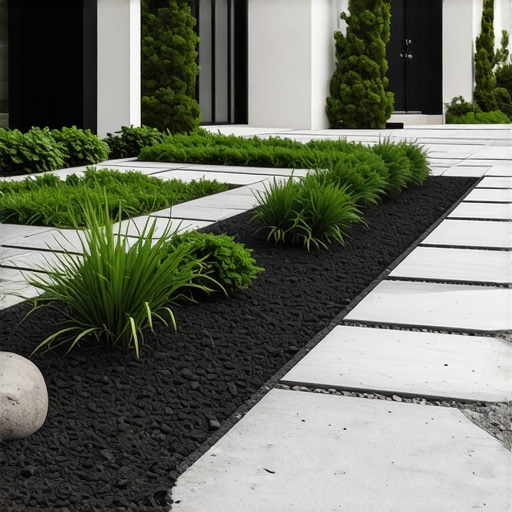
Designing for 2026: The Intersection of High-Contrast Hardscapes and Biological Stability
Modern 2026 curb appeal is defined by high-contrast color palettes, specifically the juxtaposition of deep carbon-dyed dark mulch against cool-toned gray stone pavers or aggregates. This aesthetic relies on geometric precision, automated irrigation systems, and a deep understanding of soil chemistry to prevent the dark organic matter from leaching and staining the expensive hardscape elements. It is about a clean, architectural look that prioritizes structural integrity over mere ornamentation.
The $30,000 Hardscape Autopsy: Why Your Vision Might Sink
I recently got called out to tear up a $30,000 patio that was sinking because the previous contractor thought 2 inches of sand was a ‘suitable base.’ It wasn’t. Within 14 months, the frost-thave cycles had turned that expensive gray travertine into a wavy mess. They skipped the geotextile fabric. They ignored the 95% Proctor density requirement for the sub-grade. When I dug it up, the soil was a sponge. If you do not manage the water, the water will manage you. Hardscaping is 80% what you never see. If the base isn’t right, you are just throwing money into a hole. We excavated the entire site, installed 6 inches of modified gravel (DGA), and used a plate compactor until the ground rang like an anvil. That is the only way to build for 2026. Every plant you put in the ground after a failed hardscape is just expensive compost. Don’t be that homeowner.
“A retaining wall doesn’t fail because of the stone; it fails because of the water trapped behind it. Hydrostatic pressure can exert thousands of pounds of force that no amount of mortar can hold.” – Hardscape Engineering Axiom
The Gray Stone Selection: Engineering the Modern Path
Modern gray stone curb appeal requires specific material choices to withstand environmental stressors. We are seeing a massive shift toward large-format porcelain pavers and natural bluestone with thermal finishes. These materials offer a low solar reflectance index (SRI), which helps mitigate the heat-island effect in urban residential settings. You must calculate your screed depth precisely. Use 1-inch galvanized pipes to ensure a perfectly level bedding layer. If your pitch is off by even 1/8th of an inch per foot, you’ll have standing water. That water will eventually penetrate the joints, freeze, and heave your stone. We use polymeric sand with high-bond strength to lock everything in. It stops the weeds. It stops the ants. It keeps the lines sharp.
Sod Install and Soil Biology: Beyond the Green Carpet
A 2026 sod install is not just laying down rectangles of grass. It is a biological transplant. Most ‘mow-and-blow’ crews slap sod over compacted clay and wonder why it dies in July. You need a soil test first. If your pH is below 6.0, your nitrogen uptake will be non-existent. We till 2 inches of organic compost into the existing soil to break up the surface tension.
“Optimal turfgrass growth requires a soil structure that facilitates at least 25% air space and 25% water retention by volume to ensure gas exchange at the root zone.” – Penn State Agricultural Extension
The Dark Mulch Protocol: Carbon Stability and Nitrogen Drawdown
Dark mulch, particularly the triple-shredded carbon-dyed varieties, is the backbone of modern contrast. However, it comes with a technical warning: Nitrogen Drawdown. As the wood chips break down, the bacteria responsible for decomposition will rob the soil of nitrogen. If you don’t supplement with a slow-release high-nitrogen fertilizer (like a 24-0-12), your ‘modern’ plants will turn yellow and stunted. Furthermore, you must maintain a 2-inch depth. Any more and you create a ‘mulch volcano’ that suffocates the root flare of your trees. This leads to girdling roots and eventual tree death. Keep it away from the trunk. Use a spade edge to create a 3-inch deep ‘V’ trench between the mulch and the sod. It looks sharper. It lasts longer.
The 2026 Material Comparison Matrix
| Material | Durability (Years) | Maintenance Level | Cost per Sq Ft | Best Use Case |
|---|---|---|---|---|
| Carbon-Dyed Mulch | 1-2 | High (Fading) | $4.00 – $7.00 | Contrast borders, moisture retention |
| Thermal Bluestone | 50+ | Low | $25.00 – $40.00 | Main walkways, high-end patios |
| Kentucky Bluegrass Sod | Indefinite | Very High | $1.50 – $3.00 | High-traffic areas, visual flow |
| Crushed Granite (Gray) | 20+ | Medium | $8.00 – $12.00 | Drainage zones, xeriscaping |
How much modified gravel do I need for a patio base?
To calculate your base, multiply the square footage by the desired depth in feet (usually 0.5 feet for 6 inches), then divide by 27 to get cubic yards. Add a 20% compaction factor. For a 500 sq ft patio at a 6-inch depth, you need approximately 11-12 cubic yards of DGA. Do not guess. If you are short, the edges will fail first.
How do I prevent dark mulch from staining my gray stone?
Staining occurs due to water runoff carrying the carbon dyes. You must ensure the hardscape is pitched away from the mulch beds. Additionally, use a high-quality silane-siloxane sealer on your gray stone. This creates a hydrophobic barrier that prevents the dye from penetrating the pores of the stone. Clean the stone immediately after the first heavy rain following a mulch install.
The Irrigation Mandate: Smart Controllers and Drip Lines
If you are installing sod and dark mulch in 2026 without a smart irrigation controller, you are wasting money. We use weather-syncing controllers that pull data from local stations. If it rains, the system stays off. For the mulch beds, we run Netafim drip lines 2 inches below the surface. This delivers water directly to the root zone and prevents the mulch from washing away during high-pressure spray cycles. It also keeps the stone dry, preventing algae growth. Efficiency is the new luxury.
Yard Cleanup Checklist for Maximum Curb Appeal
- Remove all invasive species (English Ivy, Privet) by the root. Do not just cut them.
- Edge all beds with a mechanical edger for a 90-degree vertical wall.
- Inspect all irrigation heads for ‘weeping’ valves.
- Pressure wash gray stone at 2500 PSI maximum to avoid pitting the surface.
- Core aerate the lawn to a 3-inch depth before top-dressing.
Modern curb appeal is a science of details. You can have the best looking yard on the block, but if you didn’t account for the drainage or the soil pH, it’s a temporary facade. Build it right the first time. Compaction is king. Drainage is god. Everything else is just decoration.