
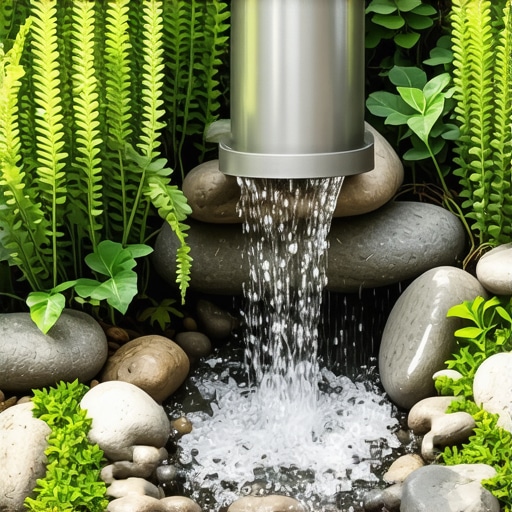
Understanding Infiltration and Soil Hydraulics in Modern Landscapes
Rain garden design leverages engineered soil layers and deep-rooted vegetation to capture and filter stormwater runoff before it enters municipal systems. By calculating the specific catchment area of your roof and matching it with high-porosity soil amendments, you prevent structural foundation damage and eliminate stagnant water issues in your yard.
I always drill into my new crew members: if you don’t fix the soil grading first, every plant you put in the ground is just expensive compost. I’ve seen guys charge five figures for a landscape package where they just threw some sod over compacted clay and called it a day. Six months later, the homeowner has a swamp and the foundation is leaching moisture. You can’t cheat physics. A rain garden isn’t just a hole in the dirt; it is a biological machine designed to handle hydrostatic pressure and chemical pollutants. If you aren’t looking at the percolation rate (perk rate) of your subsoil, you aren’t landscaping—you’re just decorating a disaster. We use a double-ring infiltrometer for precise measurements because a simple ‘bucket test’ doesn’t account for the saturated hydraulic conductivity required for a 10-year storm event. Every inch of rain on a 1,000-square-foot roof produces 623 gallons of water. If your gutter downspout is dumping that next to your slab, you’re asking for a $20,000 repair bill.
“Rain gardens should be designed to handle the water quality volume (WQv), which is typically the first 1 to 1.5 inches of rainfall to ensure effective pollutant removal.” – Mid-Atlantic Extension Service
The Engineering Anatomy of a Functional Rain Garden
A high-performance **rain garden** consists of a ponding area, a mulch layer, an engineered soil mix, and a transition zone to manage **gutter runoff**. These components work together to slow the velocity of water, allowing it to percolate into the ground at a rate of at least 0.5 inches per hour.
When we talk about yard cleanup and prep, we aren’t just raking leaves. We are clearing the way for a 2% minimum slope from the house toward the basin. The basin itself needs to be flat-bottomed. If it’s pitched, the water pools at one end, kills the plants via root rot, and causes the side-walls to blow out. We use #57 stone or clean gravel for the inflow points to dissipate energy. Without that rip-rap, the first heavy storm will scour your soil and wash your expensive perennials down the street. For the soil, we don’t use ‘topsoil’ from a bag. We mix 50% coarse sand, 25% leaf compost, and 25% native soil. This creates the macropores necessary for gas exchange at the root level even when the ground is saturated. In the 2026 standards, we are seeing a shift toward deeper planting beds—up to 24 inches—to maximize the filtration of nitrogen and phosphorus from lawn fertilizers used upstream.
How much modified gravel do I need for a patio base?
For a standard residential patio, you need a minimum of 6 inches of compacted 21A or 3/4-inch modified gravel. This base must be compacted in 2-inch lifts using a plate compactor with a minimum of 3,000 pounds of centrifugal force to ensure the structural integrity of the hardscape above. Don’t skip the geotextile fabric between the subgrade and the gravel; if you do, the stones will eventually migrate into the soil, and your patio will settle unevenly.
| Layer | Required Depth | Technical Specification |
|---|---|---|
| Ponding Zone | 6 to 8 inches | Open air storage for 24-hour drawdown |
| Mulch Layer | 2 to 3 inches | Triple-shredded hardwood (does not float) |
| Bioretention Mix | 18 to 24 inches | 50% sand, 25% compost, 25% native loam |
| Transition Layer | 4 inches | Clean washed pea gravel or coarse sand |
Selecting Vegetation for Saturated and Arid Cycles
Vegetation in a **rain garden** must survive both extreme saturation and extended dry periods, making **native sedges** and deep-rooted perennials the optimal choice. Unlike standard **sod install** projects that require consistent moisture, rain garden plants use long taproots to create channels in the soil, further increasing the infiltration capacity over time.
Stop thinking about ‘pretty flowers’ and start thinking about root architecture. We use species like *Asclepias incarnata* (Swamp Milkweed) and *Iris virginica* because their roots can extend 3 to 5 feet into the earth. This is critical for soil stability. If you’re doing a sod install around the perimeter, use a turf-type tall fescue that can handle occasional flooding but keep it out of the bottom of the basin. Sod in the basin will mat down, go anaerobic, and die. It creates a physical barrier that stops water from soaking in. Irrigation is another sticking point. People think a rain garden means they don’t need irrigation. Wrong. During the first two seasons, those plants need supplemental water via a drip system to establish those deep roots. Once established, the system is self-sustaining, but if you let a new install bake in the July sun, those $15 liners will turn into $15 pieces of charcoal.
Does rain garden soil need special amendments?
Yes, rain garden soil requires a specific blend of coarse sand and organic compost to maintain high percolation rates. Avoid using fine sand or heavy clay, as these will clog the pore spaces and prevent water from draining, leading to anaerobic conditions that kill beneficial soil microbes and root systems. Check your pH levels; you want a range between 5.5 and 6.5 for optimal nutrient uptake in most bioretention plants.
“A retaining wall doesn’t fail because of the stone; it fails because of the water trapped behind it, which creates massive hydrostatic pressure.” – Hardscape Engineering Axiom
The 2026 Checklist for Gutter Runoff Mitigation
Effective **runoff control** requires a systematic approach to site analysis and material selection to ensure the **landscaping** survives local weather volatility. Follow this protocol to ensure your system doesn’t fail during the first heavy spring thaw or torrential downpour.
- Calculate the total square footage of the impervious surfaces (roof, driveway) draining to the area.
- Conduct a percolation test: Dig a 12-inch hole, fill with water, and ensure it drains within 24 hours.
- Call 811 to mark underground utility lines before any excavation begins.
- Install a 4-inch PVC or HDPE pipe from the gutter downspout to the rain garden inflow point.
- Incorporate a defined overflow notch or weir for storms that exceed the basin capacity.
- Apply triple-shredded hardwood mulch; avoid pine nuggets as they will float and wash away.
Maintenance is the part everyone ignores until the yard is a mess. You need a biannual yard cleanup that specifically targets the inflow and outflow points. Clear out the sediment that builds up at the mouth of the pipe. If that sediment enters the garden, it seals the soil surface like concrete. You also need to monitor for invasive species. Weeds love the nutrient-rich environment of a rain garden. If you let them take over, they will outcompete your native plants and ruin the aesthetic and functional balance of the system. It will rot if you don’t stay on top of the silt. Don’t be the homeowner who spends five grand on an install and zero on maintenance. It’s a living system. Treat it like one.