
You smell it before you see it. That damp, musty odor emanating from the crawlspace or basement is the first warning sign of a failed water management system. It begins as a hairline fracture in the parge coat. Then, the efflorescence appears—that white, chalky mineral deposit pushed through the masonry by relentless water pressure. If you ignore it, the soil around your footings turns into a slurry. Your foundation settles. The doors start to stick. The windows won’t open. This isn’t just a maintenance chore; it is a structural necessity.
The Critical Link Between Downspouts and Foundation Stability
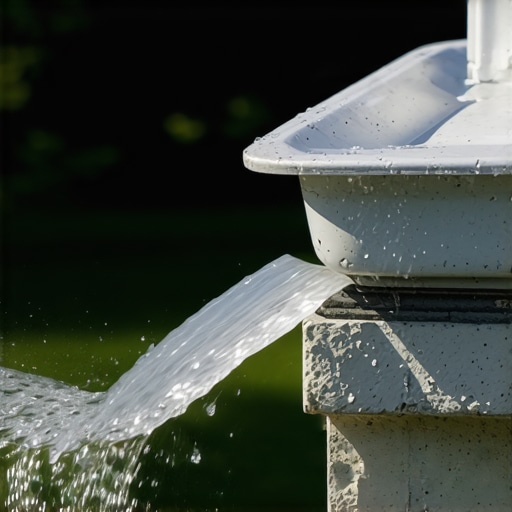
To effectively prevent foundation flooding, gutter downspouts must discharge water at least ten feet away from the foundation wall into a positive-drainage area or a French drain system, ensuring hydrostatic pressure does not compromise structural integrity. [IMAGE_PLACEHOLDER]
I recently got called out to tear up a $30,000 patio that was sinking because the previous contractor made a rookie mistake. They routed the primary downspout from a 1,200-square-foot roof section directly under the patio pavers using cheap, thin-walled corrugated pipe. Over three years, the weight of the pavers and the freeze-thaw cycles crushed that pipe. Every time it rained, thousands of gallons of water were injected directly into the sub-base of the patio instead of being carried away. The result? The limestone screenings turned to mush, the soil lost its load-bearing capacity, and the entire $30k investment dipped four inches toward the house. We had to excavate the entire mess, replace the soil, and install Schedule 40 PVC. It was an expensive lesson in fluid dynamics for that homeowner.
“A retaining wall doesn’t fail because of the stone; it fails because of the water trapped behind it.” – Hardscape Engineering Axiom
The Physics of Saturated Soil and Hydrostatic Pressure
When your gutters are clogged or your downspouts dump water at the corner of your house, the soil becomes saturated. In engineering terms, this increases the hydrostatic pressure against your foundation. Soil has a specific weight, but water-logged soil is significantly heavier. This lateral pressure can exceed the design strength of your concrete blocks or poured walls. In regions with heavy clay, this is even more dangerous. Clay expands when wet. This expansion exerts thousands of pounds of force. Eventually, the wall bows. This is why landscaping is actually civil engineering in disguise. You aren’t just planting shrubs; you are managing the water table of your property.
How much water runs off a roof during one inch of rain?
A standard residential roof generates approximately 0.6 gallons of water per square foot for every one inch of rainfall, meaning a 2,000-square-foot home must shed 1,200 gallons during a single storm event. If your downspouts are obstructed, that volume of water is concentrated into a few square feet of soil near your footings. This concentration leads to erosion, soil piping, and eventual foundation settlement. I tell my crew: think of a downspout as a fire hose. You wouldn’t point a fire hose at your foundation for an hour, so why would you let a clogged gutter do the same?
| Drainage Component | Material Grade | Maintenance Frequency | Primary Failure Mode |
| Gutter Trough | Seamless Aluminum | Bi-annual | Debris Clogs |
| Downspout Extension | Sch 40 PVC | Annual Inspection | Root Intrusion |
| Catch Basin | High-Density Polyethylene | Quarterly | Silt Accumulation |
| French Drain | Perforated Pipe/Gravel | Decade-scale | Soil Infiltration |
Diagnosing the Obstruction: The Forensic Check
Don’t just look at the top of the gutter. The real problem is often at the elbow or the underground transition. If you see water geysering out of the top of the downspout during a rainstorm, the blockage is in the vertical drop. If water is backing up at the ground-level adapter, the underground lateral line is collapsed or filled with roots. Sod install projects often fail because contractors bury the downspout exits too shallow, allowing lawn mowers to crush the pipe or grass to grow over the exit, creates a biological plug. You need clear, unobstructed effluent flow.
The Engineering-Grade Remediation Process
If you want to solve this permanently, stop buying the flexible black corrugated pipe from the big-box stores. It is garbage. It has ridges that catch every leaf and shingle granule, leading to inevitable clogs. Use 4-inch Schedule 40 PVC. It is smooth-walled, meaning water moves faster and carries sediment with it.
- Step 1: Excavation. Trench at a minimum 1% slope (1/8 inch drop per foot).
- Step 2: Bedding. Lay the pipe on a bed of compacted sand or fine gravel. No sagging.
- Step 3: Cleanouts. Install a Y-sweep cleanout at the house so you can snake the line later.
- Step 4: The Exit. Use a pop-up emitter or a daylight exit with a rodent screen.
- Step 5: Grading. Ensure the soil surface slopes away from the pipe trench.
“Surface drainage must be supplemented by sub-surface management in soils with low hydraulic conductivity to prevent structural saturation.” – USDA Soil Engineering Handbook
How to clear a clogged underground downspout?
To clear an underground downspout, first use a high-pressure water jet or a plumbing snake to break up debris, followed by a camera inspection to identify any structural collapses or root penetrations that require excavation. If the pipe is corrugated, it’s often cheaper to replace it than to clean it. If it’s PVC, a simple hydro-jetting will clear years of shingle grit in minutes. Don’t skip the camera. Seeing is believing. If I see a root mass, I know we have a joint failure. If I see a flat spot, I know the ground settled. Digging blindly is for amateurs.
The Long-Term Maintenance Cycle
Your yard cleanup shouldn’t just be about leaves on the grass. It must include the irrigation and drainage systems. Check your gutters every spring and fall. After a major storm, walk the perimeter. Look for standing water. Check the pop-up emitters. If they are buried in mulch, uncover them. Mulch volcanoes around downspouts are a recipe for rot. Keep it clear. It’s simple physics: water always wins. Your job is to give it a path where it can’t do any damage. Failure to do so isn’t just a nuisance; it’s a slow-motion demolition of your biggest asset. Don’t let a $50 gutter clog turn into a $50,000 foundation repair. It is avoidable. Fix the pitch. Clear the lines. Stay dry.{“@context”:”https://schema.org”,”@type”:”HowTo”,”name”:”Clearing Gutter Downspouts”,”step”:[{“@type”:”HowStep”,”text”:”Inspect gutters for surface debris.”},{“@type”:”HowStep”,”text”:”Test flow with a high-pressure hose.”},{“@type”:”HowStep”,”text”:”Locate underground exit points.”},{“@type”:”HowStep”,”text”:”Clear clogs using a plumbing snake or hydro-jet.”}]},{“@context”:”https://schema.org”,”@type”:”FAQPage”,”mainEntity”:[{“@type”:”Question”,”name”:”How far should downspouts extend from the house?”,”acceptedAnswer”:{“@type”:”Answer”,”text”:”Downspouts should discharge at least 10 feet away from the foundation in most soil types.”}},{“@type”:”Question”,”name”:”What is the best pipe for underground drainage?”,”acceptedAnswer”:{“@type”:”Answer”,”text”:”Schedule 40 PVC is the professional standard due to its smooth interior and structural strength.”}}]}.”