
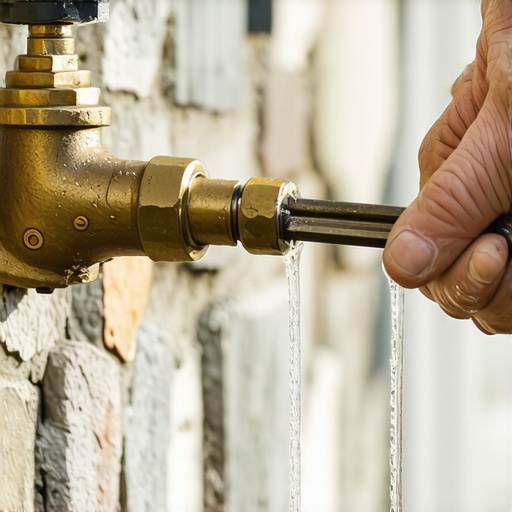
Why Your Spigot is Leaking and the Structural Stakes
Outdoor spigots, also known as sillcocks, typically leak due to a worn rubber washer, a loose packing nut, or a failed vacuum breaker. Ignoring this leak allows water to infiltrate your foundation and saturate the subgrade, leading to hydrostatic pressure and soil instability. Fix it now.
I always drill into my new crew members: if you don’t fix the soil grading and water management first, every plant you put in the ground is just expensive compost. I remember an apprentice, eager to start a sod install, ignored a slow drip at the client’s main hose bibb. Within three days, that drip turned the 4-inch lift of compacted 21A modified gravel we’d prepped for a walkway into a slurry of mud. The entire sub-base failed because one guy didn’t think a pint of water an hour mattered. In landscaping, water is either your best friend or your most expensive enemy. A leaky spigot is a structural liability masquerading as a minor nuisance.
“A retaining wall doesn’t fail because of the stone; it fails because of the water trapped behind it.” – Hardscape Engineering Axiom
How do I know if my outdoor faucet is beyond repair?
If you see a crack in the brass housing or if the valve seat is pitted and scarred, the unit is likely beyond a simple washer replacement and requires a full sillcock replacement. Check for frost damage by looking for hairline fractures along the stem after a freeze-thaw cycle. These cracks are often microscopic but fail under full PSI load.
The Forensic Autopsy of a Failed Valve
To diagnose a leaky hose bibb, you must understand the mechanical assembly of a compression valve. Most residential spigots operate on a simple stem-and-seat principle. When you turn the handle, you are screw-driving a rubber gasket down onto a brass ring. When that gasket dries out or the brass ring accumulates mineral scale, the seal breaks. This results in a constant 1-2 gallon-per-hour loss. Over a month, that’s 1,440 gallons of chlorinated water hitting your irrigation zone or foundation. Chlorine is a biocide; it kills the soil microbiology you need for healthy turf.
| Material | Durability Rating | Chemical Resistance | Best Use Case |
|---|---|---|---|
| Neoprene | Moderate | Low | Standard potable water |
| EPDM Rubber | High | High | UV exposure and heat |
| Silicone | Extreme | Very High | High-pressure systems |
We see it all the time during yard cleanup: the soil around the house is sunken. This is often subsidence caused by localized saturation. If you are planning a sod install, your first step isn’t the tiller; it’s a pressure test of your external plumbing. You cannot achieve 85% to 95% Standard Proctor Density on a base if the ground is soft from a 24/7 leak. It will settle. Your pavers will shift. Your investment will vanish.
Step-by-Step Remediation: The 5-Minute Fix
The repair process for a standard outdoor spigot involves three primary mechanical checks. First, try tightening the packing nut located just behind the handle; this compresses the internal graphite packing or O-ring. If the leak persists from the nozzle, you must replace the internal stem washer. Finally, check the vacuum breaker (the cap on top) for debris or a failed diaphragm that causes spraying. Do not over-torque the handle. You will crush the seat.
- Tools Needed: Adjustable wrench, needle-nose pliers, multi-bit screwdriver.
- Parts Required: Assorted faucet washers (size 0 or 1/4 inch are common), replacement packing string.
- Safety: Locate the shut-off valve inside the house before disassembly. Don’t skip this.
How much modified gravel do I need for a patio base?
For a standard hardscape project, you need 4 to 6 inches of compacted 21A or 57 stone, which requires roughly 1 ton of gravel per 50 square feet at a 4-inch depth. Ensure the base is pitched 1/8 inch per foot away from the house to manage drainage. Use a plate compactor. Your hand-tamp isn’t heavy enough.
The Engineering of Soil Saturation
When we talk about irrigation, we aren’t just talking about sprinklers. We are talking about the percolation rate of your soil. Heavy clay soils, common in many regions, hold water like a bowl. A leaky spigot creates a localized “perch” of water that can lead to root rot in nearby shrubs or cause efflorescence on your masonry. While the internet tells you to water every day, turf grass actually needs deep, infrequent watering—exactly 1 inch per week—to force roots to chase the water down. A constant leak does the opposite; it keeps roots shallow and weak. This is why landscaping professionals prioritize drainage over aesthetics. If the plumbing is wrong, the garden is wrong.
“Effective soil management requires an understanding of both the physical structure and the hydraulic conductivity of the media.” – Penn State Agricultural Extension
Check your vacuum breakers every spring. These $5 parts prevent backflow of fertilizers or pesticides into your home’s drinking water. If yours is hissing, it’s failed. Replace it. It’s a non-negotiable safety item. If you’re doing a yard cleanup, look for moss growth near the spigot. Moss is a biological indicator of compaction and constant moisture. It’s a red flag. Address the leak, then aerate the soil to restore oxygen levels to the root zone. Stop the drip. Protect the foundation. Grow better grass.