
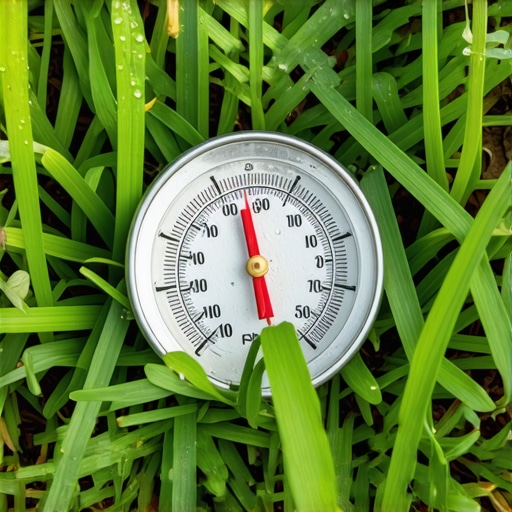
The Science of the 55-Degree Soil Barrier
To stop crabgrass and other invasive annual weeds, apply pre-emergent herbicides exactly when soil temperatures hit 55 degrees Fahrenheit for three consecutive days. This creates a chemical vapor barrier in the top inch of soil that prevents weed seedlings from successfully emerging through the surface of your lawn.
Timing is not a suggestion; it is a biological requirement. If you miss this window, you are essentially throwing money into the wind. I have spent two decades watching homeowners and low-bid contractors dump thousands of pounds of chemicals on frozen ground or, conversely, on soil that is already 70 degrees and teeming with germinated crabgrass. Neither works. By the time you see the lime-green blades of crabgrass, the battle for a clean lawn is already lost for the season. You need to understand that the soil is a massive heat sink. Just because the air feels warm on a sunny March afternoon does not mean the ground has caught up. We use heavy-duty stainless steel probes to get an accurate reading at a two-inch depth. That is where the seeds are waking up.
The Chemical Nightmare: A Case Study in Calibration
A homeowner called me in a panic after they completely torched their front lawn by applying a high-nitrogen weed-and-feed product during a mid-July drought, ignoring the 55-degree soil rule I had preached for years. They thought they could ‘catch up’ on missed spring maintenance. The salt index in that cheap big-box bag was so high it literally desiccated the root zone of their fescue. We had to excavate three inches of topsoil just to get the pH and salinity back into a range where a new sod install would not die on contact. It was a $12,000 mistake that could have been avoided with a $20 soil thermometer and a little patience. This is why I tell my crew: we do not guess; we measure. If the soil is not ready, the spreader stays in the truck.
[IMAGE_PLACEHOLDER]
Soil Temperature vs. Air Temperature: The Great Deception
Soil temperature is the only metric that matters for pre-emergent efficacy. Air temperature fluctuates wildly based on wind and cloud cover, but soil retains thermal energy. You must measure the soil at a depth of two inches, preferably in a spot that gets average sun exposure. North-facing slopes will always be cooler, while areas near concrete driveways or sidewalks will hit that 55-degree mark days or even weeks earlier due to the radiant heat from the hardscape. This is where most people fail. They treat the whole yard as a single unit when it is actually a collection of micro-climates. You need to calibrate your application to the warmest zones first.
“Pre-emergent herbicides must be in place before the soil temperature reaches 55 to 58 degrees F at a 2-inch depth for several days.” – University of Nebraska-Lincoln Extension
How to measure soil temperature for lawn care?
To measure soil temperature correctly, use a digital soil thermometer inserted at least two to four inches into the ground in multiple locations around your property. Take readings at 10:00 AM over three consecutive days to find a stable average that accounts for overnight cooling and daytime warming.
| Weed Species | Germination Soil Temp (F) | Optimal Treatment Window |
|---|---|---|
| Crabgrass (Large) | 55-58° | Pre-55° Stable |
| Crabgrass (Smooth) | 60-62° | Early Spring |
| Foxtail | 60° | Mid-Spring |
| Poa Annua | 70° (Falling) | Late Summer/Early Fall |
The Mechanics of the Chemical Barrier
When you apply a pre-emergent like Prodiamine or Dithiopyr, you are not killing a plant. You are creating a thin, toxic zone. When a seed germinates, it sends out a primary root (radicle) and a shoot. As these hit the herbicide barrier, the chemical inhibits cell division. The seedling starves before it ever sees the sun. If you disturb the soil after application by raking, heavy yard cleanup, or aerating, you break that barrier. It is like poking holes in a dam. This is why your landscaping schedule must be precisely sequenced. You do your heavy cleanup and any sod install work first, then you lay down the chemical shield. If you flip that order, you have wasted your time and money.
“A retaining wall doesn’t fail because of the stone; it fails because of the water trapped behind it, just as a lawn doesn’t fail because of the seed, but because of the environment provided for it.” – Hardscape Engineering Axiom
Integrating Pre-Emergent with Yard Cleanup and Irrigation
Irrigation is the final, critical step in activating your pre-emergent. Most professional-grade products require at least 0.5 inches of water to move the chemical off the grass blade and into the top inch of the soil profile. If you leave it sitting on the surface, UV light will break down the active ingredients through a process called photodegradation. You have about 24 to 48 hours to get that water down. If your irrigation system is not yet de-winterized, you are at the mercy of the rain. This is another reason why I despise hacks who just throw granules down and leave. You need a plan for hydration. If the soil is too dry, the chemical won’t bond; if it’s too wet and you get a washout, the chemical ends up in the storm drain instead of your yard.
Can I apply pre-emergent and grass seed at the same time?
No, you cannot apply standard pre-emergent and grass seed simultaneously because the herbicide cannot distinguish between a weed seed and a grass seed. The chemical barrier will prevent your new grass from germinating, resulting in a total loss of your seeding investment. If you must seed and prevent weeds, you must use a specialized product like Mesotrione.
The 10-Step Pre-Emergent Protocol
- Clean all debris, sticks, and matted leaves from the turf area.
- Verify 811 utility markings if any deep spikes or aeration are planned.
- Check soil temperature at a 2-inch depth in at least four zones.
- Calibrate the broadcast spreader to the specific product’s bulk density.
- Apply the first half-rate in a north-south direction.
- Apply the second half-rate in an east-west direction to ensure total coverage.
- Hand-toss granules into tight corners and around irrigation heads.
- Blow all granules off hardscapes and back onto the lawn to prevent staining.
- Apply 0.5 inches of water via irrigation within 24 hours.
- Record the application date and soil temperature for future year-over-year tracking.
Advanced Calibration: Avoiding the Hack Application
Professional landscaping is a game of math. If your spreader isn’t calibrated, you are either under-applying and leaving gaps for weeds, or over-applying and risking root stunting. We use a catch-pan test to ensure the pounds-per-thousand-square-feet match the label requirements. Most homeowners buy a bag, open the hopper to a random setting, and walk until the bag is empty. That is not lawn care; that is gambling. You also need to consider the Koc (Soil Organic Carbon-Water Partitioning Coefficient) of your product. Some chemicals bind tighter to the soil than others. In high-clay soils, you might get away with one application. In sandy soils, you likely need a split-application strategy to keep the barrier intact through the heavy spring rains. This is the difference between a yard that looks like a golf course and one that looks like a vacant lot by July. Use your head, use a thermometer, and stop guessing.