
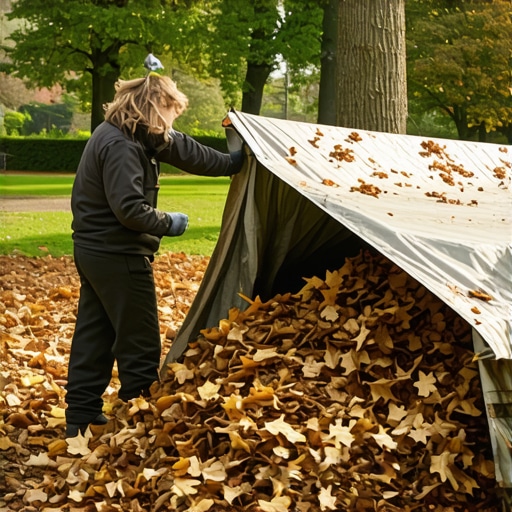
Why Wet Leaf Piles Destroy Your Soil Health
Wet leaf piles create a moisture-rich, anaerobic environment that smothers turf grass, blocks photosynthesis, and invites fungal pathogens like snow mold. Leaving these piles on your lawn for more than 48 hours results in crown rot and systemic nitrogen depletion as the leaves decay. This isn’t just about aesthetics; it is about the structural integrity of your soil biology.
I always drill into my new crew members: if you don’t fix the soil grading first, every plant you put in the ground is just expensive compost. This technical wisdom extends to the fall cleanup. I have seen guys leave a wet mat of maple leaves over a newly installed lawn, and by the time they got back to rake it, the turf was a slime-coated graveyard. You cannot cut corners with moisture. When leaves get wet, their weight triples. The lignin in the leaf cell walls begins to fuse with the moisture, creating a literal carpet that blocks oxygen exchange. If you want a healthy sod install in the spring, you have to deal with the wet debris before the ground freezes. It will rot. Don’t skip this.
The Pathology of Turf Decay Under Heavy Debris
When you leave a massive pile of saturated organic matter on your turf, you are effectively running a biological experiment with high stakes. The lack of UV light halts the grass plant’s ability to produce chlorophyll. Within days, the grass enters a state of etiolation, stretching and weakening its cell walls. This is when the pathogens strike. Rhizoctonia solani and various Pythium species thrive in these oxygen-deprived pockets. They move fast.
“Excessive leaf litter creates a mat that traps moisture and prevents air circulation, leading to the development of fungal diseases such as Typhula blight.” – Penn State Extension
The chemical reality is also grim. As those leaves decompose, the Carbon-to-Nitrogen (C:N) ratio goes haywire. The microbes responsible for breaking down the carbon in the leaves will actually rob the soil of available nitrogen to finish the job. This leaves your grass starving right when it should be storing carbohydrates for the winter dormant period. Your landscaping investment depends on keeping that soil chemistry balanced. If you let the leaves sit, you are basically paying for the destruction of your own property.
How do I remove heavy wet leaves without breaking my back?
The tarp slide method is the most efficient mechanical advantage technique for moving hundreds of pounds of saturated debris with minimal torque on your lumbar spine. By using a heavy-duty 12×16 poly tarp, you distribute the weight across a larger surface area, reducing the friction coefficient against the wet grass blades. It is about physics, not brute strength.
| Leaf Condition | Weight Per Cubic Yard | Decomposition Rate | Risk Level |
|---|---|---|---|
| Dry Oak | 250 lbs | Slow (High Tannin) | Low |
| Wet Maple | 750 lbs | Fast (High Sugar) | Extreme |
| Saturated Pine Needles | 500 lbs | Very Slow (Acidic) | Moderate |
The Tarp Slide Execution: A Master Class
You don’t just throw a tarp down and start raking. You need a staging protocol. First, identify the slope of the yard. You always haul downhill. Second, ensure your irrigation heads are flagged. A heavy tarp dragged over a brittle, cold sprinkler head will snap it off every single time. Third, use a rake with a wide tine spread to pull the leaves onto the center of the tarp. Do not overfill. You want the edges to be able to fold over like a burrito. This prevents the wind from catching the load and scattering your work.
Once the tarp is loaded, grab the front corners and lean your body weight into the pull. This uses your glutes and hamstrings rather than your back. If the pile is particularly heavy, we use a two-man tow system with braided nylon ropes. The ropes should be knotted through the grommets to prevent tearing. We have moved 1,000-pound piles this way without a single machine. It is clean. It is fast. It works.
“Soil compaction and organic matter layering must be managed to maintain a healthy oxygen exchange rate in the root zone.” – Agronomy Manual Volume 4
What is the best way to clean up wet leaves from a lawn?
The best way to clean up wet leaves is to use a power blower to move the bulk of the moisture off the surface before raking them onto a heavy-duty landscape tarp. This reduces the total weight of the haul and prevents the grass from being crushed by the sheer mass of the water-logged debris. Speed is key during the 2026 season given the predicted moisture levels.
- Clear all irrigation zones and flag heads before starting.
- Ensure the tarp is at least 10-mil thickness to resist punctures.
- Wear boots with high-traction soles to prevent slipping on wet leaf slime.
- Deposit the leaves in a designated compost area away from the main landscaping beds.
- Check the soil pH after removal to ensure no acidic spikes from rotting oak.
Post-Cleanup Maintenance: The Recovery Phase
After the leaves are gone, the yard looks like it has been through a war. The grass will be flattened. It might even look yellow. This is the time for a light core aeration if the ground isn’t frozen. Aeration breaks up the surface compaction caused by the weight of the piles and allows the roots to breathe again. If the damage is severe and the grass has turned to mush, you are looking at a sod install in the spring. There is no resurrecting dead crowns. You have to cut it out and start over. Prevention is cheaper than replacement.
Check your yard cleanup schedule. If you are waiting until December to pull those tarps, you are too late. The moisture is already locked in. The goal is to have the lawn clear before the first hard freeze. This ensures the turf enters dormancy in a dry, stable state. We don’t do this for the looks. We do this for the biology. A professional landscaper knows that the real work happens in the soil, hidden from view. Keep it clean. Keep it dry.