
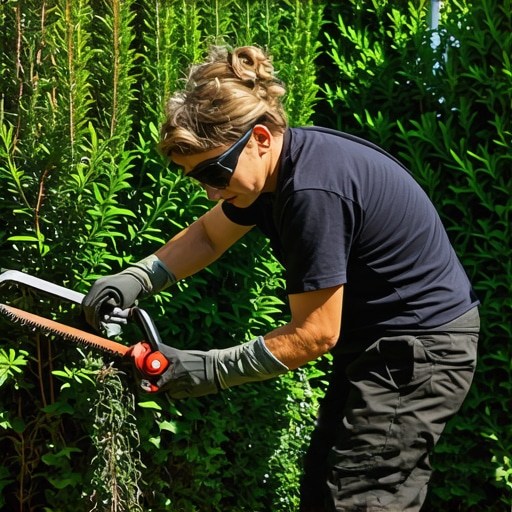
The Forensic Guide to Clearing Overgrown Hedges: Engineering-Grade Safety and Biological Integrity
I always drill into my new crew members: if you don’t fix the soil grading first, every plant you put in the ground is just expensive compost. In the context of 2026 yard cleanup, this technical wisdom extends to how we handle overgrown woody perennials. Most homeowners and ‘mow-and-blow’ hacks look at a tangled wall of Privet or Boxwood and see a nuisance to be hacked. A veteran landscaper sees a biological system under stress. Every cut you make with a pair of loppers is a surgical intervention. If you don’t understand the physics of leverage or the microscopic reality of the vascular cambium, you are just killing assets. Real landscaping is about managing the growth of biological architecture while maintaining structural safety standards. We do not just ‘trim.’ We manage biomass and direct energy.
The Physics of the Cut: Selecting Your Loppers for 2026 Yard Cleanup
Clearing overgrown hedges requires selecting loppers based on the branch diameter and wood density to ensure clean cuts that prevent pathogen entry. Bypass loppers act like scissors for green wood, while anvil loppers use a crushing action for dead wood, requiring specific PSI to penetrate the bark effectively.
When you are staring down a hedge that has not seen a blade in three years, your choice of steel determines the recovery of the plant. A bypass lopper uses two blades that slide past each other. This is essential for living tissue because it minimizes the crushing of the xylem and phloem, the plant’s nutrient and water highways. If you use an anvil lopper on a living branch, you are effectively smashing the vascular system. It is like trying to cut a steak with a hammer. The result is ragged tissue that cannot seal, leading to fungal infections and insect boring. My crew is forbidden from using anvil loppers on anything intended to stay alive. We only pull them out for dead-wooding or preparatory yard cleanup before a full sod install. You must ensure the pivot bolt is torqued to manufacturer specifications; a loose bolt leads to ‘blade bypass’ where the wood twists between the blades rather than being cut. This ruins the tool and the plant simultaneously.
| Lopper Type | Mechanical Action | Best Use Case | Tissue Impact |
|---|---|---|---|
| Bypass Loppers | Scissor action | Living green wood < 2 inches | Clean, surgical slices |
| Anvil Loppers | Blade against flat plate | Dead, brittle branches | Crushing and splitting |
| Geared/Rachet | Compound leverage | Hardwood / High-density limbs | Maximum force, slow speed |
“Proper pruning is essential for plant health and should involve making clean cuts to the branch collar to facilitate rapid compartmentalization.” – Texas A&M AgriLife Extension Service
The Biological Cost of Improper Pruning and Root Stress
Improperly cleared hedges suffer from dieback and root rot because ragged cuts allow pathogens to bypass the plant’s natural defense layers. Vascular cambium damage prevents the formation of woundwood, which is critical for the plant to isolate infections and maintain irrigation efficiency during summer heat.
When you clear a hedge, you are changing the microclimate of the plant’s interior. Overgrown hedges often have ‘naked’ interiors where leaves have died off due to lack of sunlight. If you take too much off at once, you expose the sensitive inner bark to sudden UV radiation, a phenomenon known as sunscald. This kills the cambium layer. I see this constantly: a client wants the hedge ‘knocked back’ by four feet, and six months later the whole row is dead. You cannot ignore the 1/3 rule. Never remove more than one-third of the total leaf surface in a single season. If the hedge is massively overgrown, you need a three-year plan. Year one is for structural thinning; year two is for height reduction; year three is for shaping. This allows the root system, which has a specific energy balance with the canopy, to adjust without going into shock. A plant in shock stops producing defensive chemicals, making it a buffet for pests. We call this ‘biological bankruptcy.’
How much modified gravel do I need for a patio base?
While clearing hedges often precedes landscaping upgrades like patios, you must calculate your base material correctly. For a standard 4-inch compacted base, you need approximately 1 ton of modified gravel (2A or 21A) per 50 square feet. Do not skip the compaction. If you clear a hedge and immediately install a patio over the old root zone, the decaying organic matter will cause the patio to sink within 24 months. You must excavate the root balls and backfill with structural fill.
The 2026 Lopper Safety and Maintenance Protocol
Maintaining lopper safety involves daily blade sterilization with 70% isopropyl alcohol and checking for stress fractures in the handles to prevent mechanical failure. PPE (Personal Protective Equipment) including ANSI Z87.1 rated eye protection and cut-resistant gloves is mandatory to mitigate the high-tension recoil of spring-loaded tools.
Physics doesn’t care about your feelings. When you are deep inside an overgrown hedge, you are working in a high-tension environment. Branches are under ‘spring tension.’ If you cut the wrong limb, the energy release can swing a 2-inch diameter branch directly into your face. We use the ‘three-cut method’ for anything thicker than an inch. First, an undercut six inches from the trunk. Second, a top cut further out to drop the weight. Third, the final cut at the branch collar. This prevents the weight of the falling branch from stripping the bark down the main trunk. This is non-negotiable. I’ve seen ‘professionals’ tear six feet of bark off a mature Maple because they were too lazy to make three cuts. That’s not landscaping; that’s vandalism. Furthermore, your blades must be sharp enough to shave with. A dull blade requires more physical force, which increases the likelihood of the tool slipping. If you are straining, the tool is dull or too small for the job.
When should I replace my lopper blades?
You should replace lopper blades when they show visible ‘daylight’ when closed, or if the steel has been sharpened past the hardened edge. Most high-end loppers allow for individual part replacement. If the blade is pitted or chipped more than 1/16th of an inch, it will no longer produce the clean cut required for biological safety. Don’t sharpen with a bench grinder; use a diamond whetstone to maintain the factory bevel angle.
- Inspect handles for cracks or bends before every shift.
- Sanitize blades between different plant species to prevent the spread of Fire Blight or Verticillium wilt.
- Always cut at a 45-degree angle away from the bud to facilitate water runoff.
- Never over-extend your reach; if you can’t reach it comfortably, get a tripod orchard ladder.
- Use bypass loppers for 90% of your living yard cleanup tasks.
“A cut made at the wrong angle or with a dull blade creates an entry point for pathogens like Cytospora canker, leading to systemic decline.” – Penn State Extension
Soil Health and Post-Cleanup Care
After clearing overgrown hedges, the soil must be aerated and amended with organic compost to replace nutrients depleted by the overgrown biomass. Irrigation systems should be recalibrated to account for the reduced transpiration rates of the trimmed plants, preventing root rot and water waste.
People forget that the soil under a dense hedge has been neglected for years. It is often compacted and hydrophobic. Once you’ve thinned the canopy, you need to address the floor. We use a vertical mulch technique or core aeration to get oxygen back to the roots. This is the perfect time to check your irrigation lines. Overgrown hedges often grow over or crush lateral lines. If you are planning a sod install adjacent to the hedge, ensure you have a clear edge. Grass and hedge roots are in a constant war for nitrogen. We install a 4-inch deep plastic or steel edge to keep the turf out of the hedge’s root zone. This isn’t just for aesthetics; it’s about resource management. If you want the hedge to recover, you need to feed the soil, not just the plant. We use a slow-release 10-10-10 fertilizer in the early spring, but never after August, as late-season growth won’t harden off before the first frost. It will rot. Don’t skip the mulch, but keep it away from the ‘root flare’ of the hedge stems. Mulch volcanoes kill more plants than drought ever will.