
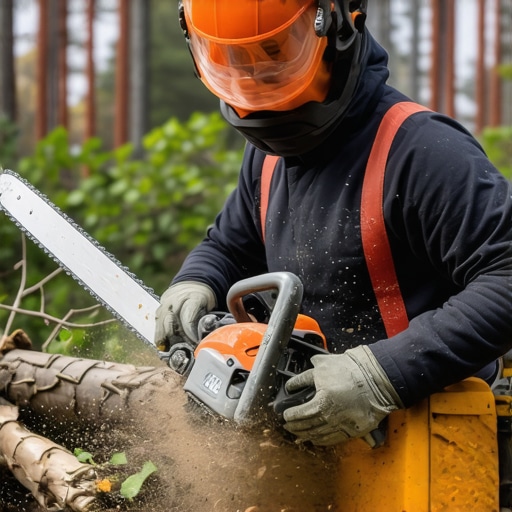
The aftermath of the 2026 storm season has left property owners facing a chaotic landscape of twisted timber and structural debris. This is not a weekend hobbyist project; it is a high-risk engineering environment where thousands of pounds of pressure are stored in bent wood and unstable root balls. I always drill into my new crew members: if you do not understand the physics of wood tension and the mechanics of your saw, you are a liability to the entire job site. I have seen too many rookies treat a fallen oak like a simple log only to have it whip back with enough force to shatter a femur. Clearing a yard after a catastrophic weather event is the first step in a long process that eventually leads to a sod install and landscaping restoration, but if you fail at the chainsaw phase, there will not be anyone left to fix the lawn.
The Critical First Response for Storm Debris Management
Storm debris clearing requires a methodical assessment of overhead hazards and ground-level tension points before a single engine is started. Following the 2026 storms, the priority is identifying widowmakers, which are detached limbs hanging precariously in the canopy, and spring poles, saplings bent under the weight of larger fallen trees. Every cut must be preceded by a clear escape route and a 360-degree hazard scan to ensure the yard cleanup does not result in a secondary emergency.
“A tree under tension is a loaded spring; the moment the wood fibers are severed, that energy must go somewhere, often with lethal velocity.” – National Arborist Association Safety Guidelines
The Physics of the Cut: Compression and Tension
Understanding how gravity and neighboring debris exert force on a trunk is the difference between a clean cut and a pinched bar. When a tree is suspended between two points, the top of the log is under compression, meaning the fibers are being squeezed together, while the bottom is under tension, where fibers are being pulled apart. If you cut into the compression side first, the wood will grab your saw blade and lock it tight. You must always identify the tension side and make your primary cut there, but only after a shallow relief cut on the compression side. This is fundamental landscaping engineering that prevents equipment damage and operator fatigue.
The PPE Standard for High-Stakes Cleanup
Forget the work jeans and leather gloves you bought at the big-box store. For 2026 storm conditions, you need professional-grade armor. This starts with chainsaw chaps made of at least 6 layers of ballistic nylon or Kevlar. These are designed to clog the drive sprocket of a saw instantly upon contact. You also need an ANSI Z89.1 rated hard hat with an integrated face shield and ear protection. Do not rely on earplugs alone; the decibel levels of a 70cc professional saw will cause permanent hearing loss within minutes of sustained operation. Every yard cleanup specialist on my crew wears steel-toed boots with high ankle support to prevent rolls on the uneven, debris-strewn ground.
| Chainsaw Component | Pre-Operation Check | Failure Consequence |
|---|---|---|
| Chain Tension | Snap-test against the bar | Chain derailment/Kickback |
| Chain Brake | Manual engagement check | Uncontrolled blade rotation |
| Bar Oil Level | Verify flow to the tip | Bar warping and friction fire |
| Air Filter | Remove sawdust and grit | Engine stall and power loss |
| Spark Arrester | Check for carbon buildup | Exhaust fire in dry debris |
How do I clear a fallen tree safely?
Safely clearing a fallen tree involves the three-point contact rule and the open-face notch technique. You must never cut above shoulder height, and your feet should always be planted on stable ground, never on the log itself. Start by removing the smaller limbs from the outside in to reduce the weight, a process called limbing. Be hyper-aware of the log rolling as its center of gravity shifts during the landscaping cleanup process.
What is the most common cause of chainsaw accidents during storm cleanup?
The most common cause of injury is kickback, which occurs when the upper quadrant of the bar tip hits a hard object or gets pinched in a cut. This forces the bar upward and backward toward the operator at high speed. You must never use the ‘kickback zone’ of the bar and always maintain a firm, two-handed grip with the left thumb wrapped securely around the handle bar. This is non-negotiable safety protocol.
Restoring the Site After the Saw work
Once the timber is bucked and hauled away, the real landscaping work begins. Heavy machinery used for debris removal often causes severe soil compaction. This ruins the soil structure, making it impossible for roots to breathe or for an irrigation system to penetrate effectively. Before you even think about a sod install, you must address the subsurface damage. The yard will likely need deep core aeration or even a total tilling of the top 6 inches to restore the pore space required for gas exchange and water infiltration.
“Compacted soil is the silent killer of the urban forest; without adequate pore space, even the hardiest turf will succumb to root rot and nutrient deficiency.” – Penn State Agricultural Extension
Repairing the irrigation lines is usually the next headache. Main lines and lateral pipes are often crushed by the weight of falling trees or the heavy equipment used to move them. You need to pressure test the entire system before laying down new grass. If you skip this, you will be digging up your expensive new sod install two weeks later to find a leak. It is a classic amateur mistake that costs thousands in labor and materials. 2026 has taught us that shortcuts in the cleanup phase lead to long-term failures in the restoration phase.
Storm Cleanup Checklist for Property Owners
- Conduct a 360-degree hazard assessment (power lines, leaning trees).
- Don full PPE: Chaps, helmet, eye protection, and gloves.
- Check chainsaw fuel: Fresh 50:1 mix with stabilizer for modern 2-stroke engines.
- Identify tension and compression in every log before the first cut.
- Clear an escape path at a 45-degree angle away from the direction of fall.
- Inspect irrigation heads for physical damage from falling limbs.
- Plan for sod install by testing soil pH after debris is removed.
The 2026 storms were a wake-up call for many. Landscaping is not just about aesthetics; it is about site management and risk mitigation. While the internet tells you that anyone can pick up a saw and clear a yard, the reality is that the sawdust hides a multitude of dangers. If you do not have the calloused hands and the mechanical knowledge to handle a saw under load, call a professional. The cost of a crew is significantly lower than a week in the ICU. Once the ground is clear and the hazards are gone, only then can we talk about the biology of the yard and the installation of a new, resilient landscape.