
Why 2026 Mud Cycles Require Advanced Yard Cleanup Strategies
The 2026 mud cycles following record heavy rain are a direct result of soil saturation levels reaching 100% capacity, leaving excess water to sit on the surface and create a sludge that kills turf via anaerobic suffocation. When your landscaping turns into a slurry, it is not just a mess; it is a sign of failed irrigation drainage and pore space collapse.
I always drill into my new crew members: if you don’t fix the soil grading first, every plant you put in the ground is just expensive compost. I remember an apprentice back in ’19 who thought he could just throw sod over a mud pit. Two weeks later, the sod install was a rotting, black mess because the hydrostatic pressure trapped stagnant water against the roots. You cannot out-plant a drainage problem. You have to move the material properly, or you are just rearranging the deck chairs on the Titanic. Mud is not just wet dirt; it is a structural failure of your yard’s grading. If the water has nowhere to go, it stays. If it stays, the biology dies. It is that simple.
How do you dry out a muddy yard fast?
To dry a yard fast, you must evacuate standing water using a 1/2 HP submersible pump or a French drain system to lower the water table below the root zone. Once the liquid is gone, you must introduce mechanical aeration to break the surface tension of the clay and allow oxygen to reach the rhizomes.
The Tarp Drag Hack: Tactical Mud Removal Without Heavy Machinery
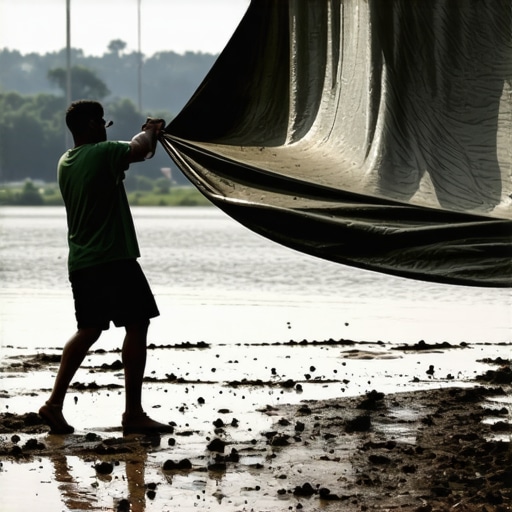
The tarp drag hack involves using high-density polyethylene tarps to manually transport heavy mud across saturated turf without causing the deep ruts and compaction typical of wheelbarrows or skid steers. By distributing the weight across a 10×12 surface area, you protect the remaining grass crowns while clearing debris.
“A saturated soil has zero shear strength; any point-load pressure, such as a wheelbarrow tire, will cause immediate compaction and permanent root zone damage.” – USDA Soil Engineering Manual
Most homeowners make the mistake of grabbing a shovel and a wheelbarrow the moment the rain stops. Stop. That skinny tire puts 40 to 60 PSI on a single point. You will sink. You will leave ruts that stay there for years. Instead, lay out a heavy-duty tarp. Shovel the mud onto the center, keeping the pile low and wide. Grab the grommeted edges and drag. The friction is low because the mud itself acts as a lubricant on the grass blades. It is more work on your back but 100% safer for your landscaping. Do not overload it. A cubic foot of wet mud weighs about 100 pounds. Know your limits.
What is the best way to move mud without a tractor?
Moving mud without a tractor requires friction-reducing tools like heavy-duty tarps or plywood sheets laid down as temporary ‘roads’ to prevent soil compaction. Using a flat-head shovel to skim the top layer of silt prevents you from digging into the healthy sub-soil during your yard cleanup.
The Physics of Soil Saturation: Why Your Yard Turned Into a Marsh
Your yard turns into a marsh when the infiltration rate of the soil is lower than the precipitation rate, leading to a breakdown of the soil’s macro-pores. In heavy clay soils common in many regions, these pores are microscopic, meaning they clog instantly with fine silt during a 2026-style deluge.
| Soil Type | Infiltration Rate (Inches/Hour) | Risk of Mud Accumulation | Primary Remediation |
|---|---|---|---|
| Heavy Clay | 0.01 – 0.10 | Critical | Core Aeration & Sand Capping |
| Silty Loam | 0.10 – 0.50 | High | Organic Matter Integration |
| Sandy Loam | 0.50 – 1.0 | Moderate | Top Dressing |
| Pure Sand | 1.0 – 5.0 | Low | None Required |
Notice the numbers. If you get two inches of rain in an hour and you have clay soil, you have 1.9 inches of water with nowhere to go. That is how the mud starts. It is physics. You cannot argue with it. You have to engineer around it. This is why a sod install without a proper gravel base in low spots is a waste of money. You are just laying a carpet over a swamp.
Corrective Action: Post-Rain Yard Cleanup Checklist
Once you have used the tarp drag hack to clear the heavy sludge, you need a surgical approach to restoration. The goal is to restore oxygen to the soil as fast as possible to prevent root rot (Phytophthora).
- Stop All Foot Traffic: If the ground still ‘squishes’, stay off it. Every step destroys soil structure.
- Clear Drainage Grates: Ensure your irrigation overflows and catch basins are 100% clear of debris.
- Apply Gypsum: In heavy clay, gypsum can help flocculate the soil particles, creating better drainage.
- Mechanical Core Aeration: Pull 3-inch plugs to let the ground breathe. Do not use spike aerators; they cause more compaction.
- Top-Dress with Calcined Clay: This absorbs excess moisture and keeps the surface firm.
“Soil compaction is the single greatest threat to urban landscapes, reducing pore space and forcing plants to survive in an anaerobic environment.” – Penn State Agricultural Extension
Long-Term Mitigation: Beyond the Tarp Drag
If you are dragging tarps every time it rains, your landscaping plan has failed. You need to look at your grading. A 2% slope away from the home is the bare minimum for civil engineering standards. If you have a flat lot, you need a French drain. Use a 4-inch perforated pipe, wrapped in a geotextile sock, and buried in a trench filled with #57 washed stone. This creates a path of least resistance for the water. Don’t use the cheap corrugated pipe. It will crush. It will clog. Use Schedule 40 PVC. It lasts forever. Do it right once, or do it twice every year. The choice is yours. 811 is your first call before you dig a single trench. Don’t hit a gas line because you were too lazy to wait for a mark-out.