
Why Your Small Hardscape Plan Starts with Soil Physics, Not Stone Selection
Designing a high-performance small backyard in 2026 using gravel and pavers requires a strict understanding of subgrade compaction, soil mechanics, and hydrology. Most DIYers and cheap contractors select materials based solely on aesthetics, only to watch their expensive hardscape sink, shift, and weed over within two seasons. Success on a tight footprint is determined entirely by what you excavate and what you pack underneath your visible surface.
I recently got called out to tear up a $30,000 patio that was sinking because the previous contractor used play sand instead of concrete sand and skipped the subgrade compaction entirely. The client’s yard was a low-lying clay mess, and without a geotextile fabric separator, the heavy clay simply swallowed the aggregate base. Every single paver was tilted, holding water, and creating a breeding ground for moss and biting insects. It was a complete structural failure that could have been avoided with sixty dollars worth of woven geotextile fabric and a rented plate compactor. We had to haul out twelve tons of ruined base material, re-excavate, and start from the dirt up. Don’t let this happen to your yard.
“A retaining wall doesn’t fail because of the stone; it fails because of the water trapped behind it.” – Hardscape Engineering Axiom
How much modified gravel do I need for a patio base?
To calculate the required aggregate base, multiply your total patio square footage by the decimal equivalent of your depth (typically 0.33 feet for a 4-inch pedestrian base), then divide by 27 to find the cubic yards needed. Always add a 15% compaction factor to your final volume calculation to ensure you do not run short during installation. For a standard 10×10 foot small backyard patio, you will need approximately 1.5 cubic yards of crushed run gravel before compaction.
The Core Engineering Anatomy of a Gravel and Paver System
A stable gravel and paver patio is a multi-layered drainage system designed to distribute weight loads and shed water away from your home foundation. To prevent shifting, your excavation must reach undisturbed subgrade soil, followed by a geotextile layer, a heavily compacted base of 3/4-inch minus crushed stone, a 1-inch bedding layer of clean angular sand, and finally your pavers locked with polymeric joint sand. Skipping any of these layers guarantees failure.
The dirt under your feet is not a solid mass; it breathes, holds moisture, and moves. When clay soils get wet, they expand; when they freeze, they heave. To combat this, you need a sub-base that acts as a bridge. We use crushed run gravel (often called 21A or QA aggregate) which contains both 3/4-inch stones and fine stone dust. When compacted with a mechanical plate tamper, these multi-sized particles lock together like a puzzle, leaving zero room for shifting. The tamper should literally bounce off the compacted base when it is ready. If you see deep footprints, keep compacting. It must be rock hard.
| Material Layer | Standard Thickness | Primary Engineered Function | Consequence of Omission |
|---|---|---|---|
| Subgrade Soil | Undisturbed | Provides the load-bearing foundation | Structural settling and sinking |
| Geotextile Fabric | 1 Ply (Woven) | Prevents soil migration into base gravel | Gravel sinks into clay, surface deforms |
| Crushed Run Base | 4 to 6 inches | Distributes weight, allows drainage | Severe frost heaving and cracking |
| Angular Bedding Sand | 1 inch (Screeded) | Provides flat nesting bed for pavers | Uneven pavers, stubbed toes, pooling water |
| Polymeric Sand | Joint Depth | Locks paver joints, blocks weeds/ants | Erosion of bedding layer, weed infestation |
Execution Steps: Building the Perfect Small Footprint Hardscape
Executing a flawless small backyard build requires meticulous attention to elevation lines, slope, and compaction passes. Before you swing a shovel, call 811 to map out your buried utilities. A single severed irrigation line or internet cable will instantly ruin your week and drain your wallet. Keep your worksite clean and organized.
First, excavate to a depth of exactly 7 inches for pedestrian traffic. This accounts for 4 inches of compacted gravel base, 1 inch of bedding sand, and a standard 2-inch paver. Run a string line with a line level to establish a 1% to 2% slope away from your home foundation. This means the grade must drop 1/4 inch for every foot of distance. Never slope toward a structure. Once excavated, lay down your woven geotextile fabric, running it up the sides of your dug trench.
Next, dump your aggregate base in 2-inch lifts. Do not dump all 4 inches at once; your plate compactor cannot pack a layer that thick. Dampen the stone slightly with a hose to activate the stone dust, then run the plate compactor over the area at least three times, changing directions with each pass. Once the base is hard as asphalt, set your 1-inch screed pipes. Pour your clean concrete sand between the pipes and pull a straight 2×4 board across them to create a perfectly flat bed. Do not step on this sand. Place your pavers starting from a 90-degree corner, using a dead-blow mallet to set them. Install heavy-duty plastic edge restraints along the perimeter, securing them with 10-inch steel spikes every 12 inches.
“Failure to compact the subgrade and aggregate base in lifts is the primary cause of interlocking concrete pavement failure.” – Interlocking Concrete Pavement Institute (ICPI) Installation Manual
How do I stop weeds from growing in my gravel and pavers?
Weeds do not grow from the soil underneath your pavers; they germinate from seeds blown into open, empty joints from above. To prevent weed growth, you must completely fill all joint spaces with high-quality polymeric sand, sweep away the excess, and mist it with water to activate the binding polymers. This creates a concrete-like barrier that blocks seed penetration while maintaining flexibility.
Essential Hardscape Installation Checklist
- Utility Clearance: Call 811 before digging to mark gas, water, and power lines.
- Slope Check: Establish a minimum 1/8-inch per foot slope away from the house.
- Geotextile Placement: Use professional-grade woven fabric, not cheap weed barrier.
- Compaction Lifts: Compact aggregate base in maximum 2-inch increments.
- Bedding Sand Choice: Use clean, angular concrete sand; never use rounded play sand.
- Edge Restraints: Anchor all open paver edges with structural restraints and steel spikes.
- Joint Seal: Apply polymeric sand only when the pavers are 100% dry to avoid staining.
Managing Drainage, Cleanups, and the Micro-Climate
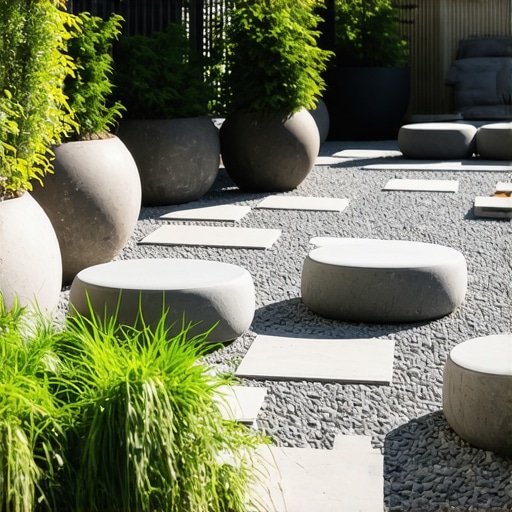
In a small backyard, space is tight, meaning runoff water has nowhere to go. If you cover 80% of your yard in solid pavers, you will create a swamp at the edges of your property. This is why incorporating zones of clean, open-graded gravel (like 3/8-inch pea gravel or Mexican beach pebbles) is a smart play. These porous gravel zones act as natural French drains, letting rainwater soak straight down into the soil rather than pooling on your patio surface.
If you have an existing lawn area surrounding your new hardscape, do not scalp the turf or leave bare spots. A muddy yard cleanup is inevitable after heavy excavation, so plan to lay down fresh sod immediately following your hardscape build to lock down the soil. A tight sod install of dwarf turfgrass or a dense fescue will prevent soil erosion from spilling mud over your brand-new gravel pathways. For the planting beds nestled around your patio, run a dedicated drip irrigation line under the gravel. This delivers water directly to the root zones of your plants, eliminating overspray that can wash away your joint sand over time.
Year-One Hardscape Maintenance and Settling Expectations
Your new backyard hardscape will go through a settling period during its first full year. Heavy rains, winter freeze-thaw cycles, and summer heat will test the engineering of your base. If you compacted the subgrade correctly, the movement will be microscopic. Expect some minor loss of polymeric sand in the joints after the first winter; simply dry the patio completely, sweep in fresh sand to fill any voids, and mist to lock it back down.
Keep leaf litter and organic debris off both your pavers and your gravel areas. Organic matter rots, turning into compost that provides a perfect medium for weed seeds to take root. Use a leaf blower regularly to keep the surface clean. If you notice any pooling water along the edges, adjust your lawn grade with topsoil or add a shallow gravel swale to channel the water away. Hardscaping is an investment in durability. Do the prep work right, sweep your joints, and your small backyard will remain rock solid for decades.