
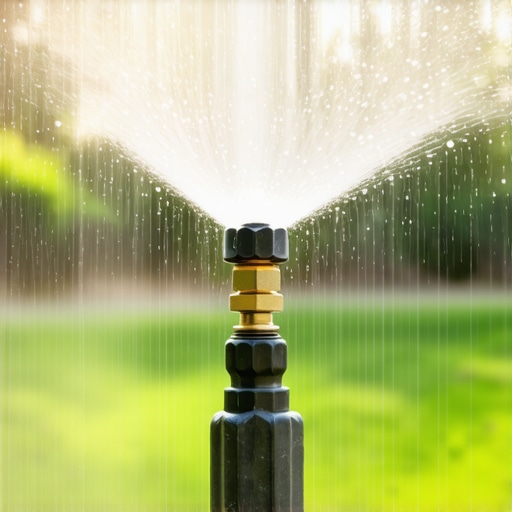
When you look across your lawn and see a fine white fog hovering over your grass while the sprinklers are running, you are not witnessing ‘effective watering.’ You are witnessing a hydraulic failure. Misting is the result of water being forced through a nozzle at a velocity that exceeds the physical limitations of the orifice. Instead of heavy droplets that fall predictably onto your sod install, the water atomizes into a vapor that drifts away in the slightest breeze. It is a waste of money, a waste of water, and a slow death sentence for your landscaping.
The Physics of Irrigation Misting
To stop sprinkler head misting and lower line pressure, you must install a pressure-regulating valve (PRV) at the main line or replace standard sprinkler bodies with pressure-regulating (PRS) heads. These components ensure the dynamic pressure at the nozzle stays between 30 and 45 PSI, preventing the water from atomizing into a fine, inefficient fog.
I always drill into my new crew members: if you don’t fix the soil grading first, every plant you put in the ground is just expensive compost. The same logic applies to irrigation. I recently walked a job site where a homeowner complained about dry spots despite running his system for 40 minutes per zone. The culprit? His line pressure was hitting 85 PSI. The water was literally floating over the grass and landing on his neighbor’s driveway three houses down. He was paying for water that never touched a single blade of his grass. We had to do a complete yard cleanup of dead material because the grass had simply parched under a cloud of mist. It was a textbook case of high-pressure neglect.
“High pressure (above 40 to 50 psi for spray heads) results in ‘misting’ or ‘fogging,’ which leads to poor uniformity and excessive water use due to wind drift and evaporation.” – Texas A&M AgriLife Extension Service
Why High Pressure Destroys Your Sod Install
High line pressure causes rapid wear on internal sprinkler components and prevents the root zone from receiving the deep saturation required for healthy growth. When water is atomized, the droplets lack the mass to penetrate the thatch layer, resulting in surface-level moisture that evaporates before it reaches the roots.
When we do a sod install, the first 14 days are critical. If your system is misting, you aren’t getting the 1 inch of water per week needed to force those roots to chase moisture deep into the soil profile. Instead, you get shallow rooting. Shallow roots mean your lawn will wilt the second the temperature hits 90 degrees. You need heavy droplets. You need consistency. You don’t need a localized weather system of fog.
How much water is actually lost to wind drift?
In a misting system, you can lose up to 50% of your water to wind drift and evaporation. If your water bill is $100, you are effectively throwing $50 into the air. This also leads to salt buildup in the upper soil layers, which can chemically burn the tender roots of new landscaping. We use a pitot tube and a pressure gauge to check this on every site. If the needle jumps past 50 PSI on a spray head, we stop everything and regulate.
How much modified gravel do I need for a patio base?
While not directly related to misting, I get asked this during irrigation installs often when we cross hardscapes. You need a minimum of 6 inches of compacted 21A or 3/4-inch modified gravel for a standard pedestrian patio. For a driveway, 10 to 12 inches is the standard. If you skip the compaction or the depth, your pavers will shift, and your irrigation lines buried beneath them will eventually shear under the stress. Engineering matters from the dirt up.
Diagnosing Your Irrigation PSI
You can diagnose high pressure by observing the spray pattern and using a pressure gauge equipped with a thread-on adapter for your specific sprinkler brand. If the spray looks like a cloud rather than a distinct stream of droplets, your pressure is likely exceeding 50 PSI, which is the danger zone for most residential rotors and sprays.
| System Pressure (PSI) | Water Pattern Visual | Efficiency Rating | Impact on Sod |
|---|---|---|---|
| 20-25 PSI | Large, heavy drops; low range | Poor (Low Coverage) | Dry spots near heads |
| 30-45 PSI | Defined streams; uniform coverage | Optimal (85%+) | Deep root penetration |
| 55-70 PSI | Misting / Fogging at nozzle | Poor (High Drift) | Surface salt buildup |
| 80+ PSI | Cloud-like vapor; component stress | Critical Failure | Root dehydration |
Remediation: How to Lower Line Pressure
The most effective way to lower line pressure is to install a master pressure regulator at the backflow preventer or use zone-specific regulating valves. If only one zone is misting, you can swap out the individual internal assemblies with Pressure Regulating Stem (PRS) heads, which maintain a constant 30 or 45 PSI regardless of the incoming pressure.
- Step 1: Measure Static Pressure. Hook a gauge to your outdoor hose bib. If it reads over 75 PSI, your whole house and yard are at risk.
- Step 2: Install a Master Regulator. This is a brass valve installed after the backflow that can be dialed down with a bolt.
- Step 3: Retrofit with PRS Heads. If the master regulator isn’t an option, use heads like the Rain Bird 1800-PRS. They have a built-in regulator in the stem.
- Step 4: Check Nozzle Orifices. Ensure no debris is partially blocking the nozzle, which can sometimes mimic the appearance of misting by shearing the water stream.
“A sprinkler system is only as efficient as its weakest point of regulation; excessive pressure is the primary cause of system fatigue and water waste.” – Irrigation Association Standards
What is the best pressure regulator for a sprinkler system?
For residential applications, a Wilkins or Watts brass pressure reducing valve is the industry gold standard. They are durable, adjustable, and can handle the high-flow requirements of a large landscaping project without significant friction loss. Don’t buy the plastic junk from big-box stores; they fail within two seasons of freeze-thaw cycles.
The “Information Gain” on Pressure Management
While most DIY blogs tell you to just turn the valve down at the manifold, that is a hack move. Throttling a manual ball valve creates turbulence and can cause water hammer, which eventually cracks your PVC joints underground. Real irrigation pros use dedicated regulation. It is about laminar flow—keeping the water moving smoothly so it exits the nozzle in the exact pattern it was engineered for. If you want a professional lawn, you need professional pressure.