
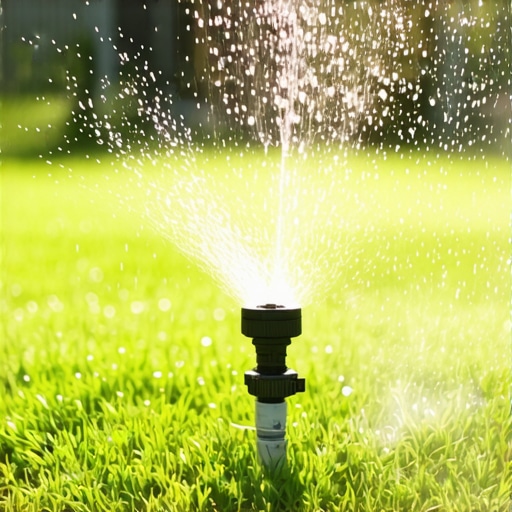
You step out onto your driveway at 5:00 AM and see a ghostly white fog hovering over your lawn. It looks like a low-lying cloud, but it is actually your money evaporating into the atmosphere. This is misting. If your irrigation system looks more like a special effects machine on a movie set than a tool for hydration, you have a high-pressure crisis. As a veteran landscaper who has spent decades diagnosing failed systems, I can tell you that this fog is the enemy of a healthy sod install and the primary cause of astronomical water bills. Misting happens when the water velocity through the nozzle is so high that the stream literally shatters into microscopic particles. These particles are too light to fall. They drift onto the sidewalk, your house, or simply vanish into the air before they ever touch a blade of grass.
The Critical Physics Behind Irrigation Misting and System Failure
Misting occurs when the dynamic water pressure at the sprinkler nozzle exceeds the manufacturer’s specified operating range, typically 30 PSI for spray heads and 45 PSI for rotors. When pressure is too high, the water atomizes into a fine fog that is easily carried away by wind, resulting in poor distribution uniformity and dry spots.
I always drill into my new crew members: if you don’t fix the pressure, you’re just blowing money into the wind. I remember a job in a high-elevation neighborhood where the static pressure coming off the main line was a staggering 110 PSI. The homeowner had just spent $12,000 on a premium sod install, and within two weeks, the grass was turning a sickly straw color despite the sprinklers running for an hour every night. They thought they had a fungus. I walked onto the site, turned on the zone, and couldn’t even see the house through the mist. The water was moving so fast through those nozzles that it was atomizing instantly. The soil was bone dry an inch down. We weren’t watering the grass; we were humidifying the county. If you ignore the PSI, every other part of your landscaping plan is destined to fail.
“Optimal pressure at the sprinkler head is critical; for every 5 psi over the recommended pressure, water use increases by about 6 to 8 percent.” – Texas A&M AgriLife Extension
To understand why this happens, you have to look at the engineering of the nozzle orifice. Every nozzle is designed to create a specific droplet size at a specific pressure. When you push 70 PSI through a nozzle designed for 30, the Bernoulli principle comes into play with a vengeance. The velocity increases, the friction at the orifice edge creates turbulence, and the water stream shears. This doesn’t just waste water. It also causes physical damage. High-pressure misting leads to “impact sealing” on the soil surface, where the tiny droplets pack the top layer of soil so tightly that oxygen can’t reach the roots. This is why a yard cleanup often reveals compacted, anaerobic soil in areas that should be thriving.
How do I check my sprinkler system pressure?
To accurately diagnose the issue, you must use a pressure gauge with a pitot tube or a threaded adapter that fits onto a spray head riser. Check the pressure while the zone is running (dynamic pressure), as static pressure readings from an outdoor spigot do not account for the friction loss occurring within your irrigation pipes. If the gauge reads above 45 PSI for sprays, you have a problem. Most residential systems in municipal areas suffer from this because cities pump water at high pressures to ensure fire hydrants work and multi-story buildings have flow. Your 1/2-inch poly pipe and plastic nozzles were never meant to handle that kind of force. It will rot your seals and blow your nozzles right off the risers.
| System Component | Target PSI (Dynamic) | Misting Threshold | Result of Over-Pressure |
|---|---|---|---|
| Fixed Spray Heads | 30 PSI | >40 PSI | Evaporation, wind drift, seal leaks |
| Rotary Nozzles (MPR) | 40-45 PSI | >55 PSI | Reduced radius, rapid wear, fogging |
| Gear-Driven Rotors | 45-55 PSI | >65 PSI | Internal gear failure, blow-by |
| Drip Irrigation | 20-25 PSI | >35 PSI | Emitter blowout, fitting separation |
The Solution: Pressure Regulation at the Source or the Head
You have three primary ways to kill the mist and save your landscaping. The most effective method for a professional-grade result is installing pressure-regulating spray heads (PRS). These heads have a small regulator built into the stem that maintains a constant 30 or 45 PSI regardless of the incoming pressure. Even if your valves are pushing 100 PSI, the nozzle only sees 30. It is a foolproof engineering fix. The second option is installing a pressure-regulating module on your zone valves. This is cheaper if you have many heads but requires more technical skill. The third, and often least effective, is throttling down the flow control handle on the valve itself. While this reduces volume, it doesn’t always stabilize pressure across the entire line, especially on sloped yards.
- Audit the Zone: Turn on each zone and look for the “white cloud” effect.
- Gauge the Pressure: Use a Hunter or Rain Bird pressure gauge on the last head of the run.
- Replace with PRS Heads: Swap standard bodies for PRS-30 (for sprays) or PRS-45 (for rotors).
- Check for Leaks: High pressure often causes “blow-by” at the wiper seal; look for water bubbling at the base of the head.
- Verify Nozzle Integrity: Ensure nozzles aren’t cracked from previous high-pressure surges.
- Perform Yard Cleanup: Remove any debris or mineral scale that may have built up in the nozzles due to atomized water evaporation.
“A sprinkler system operating at 50 psi instead of the recommended 30 psi will use 40 percent more water.” – EPA WaterSense Specification Manual
When we perform a sod install, we refuse to warranty the grass unless the irrigation pressure is regulated. New sod needs consistent, heavy droplets that can penetrate the thatch and reach the soil-to-root interface. Mist just sits on top of the blades and evaporates, or worse, encourages leaf spot fungus because the blades stay damp while the roots stay bone dry. You are essentially creating a petri dish for pathogens. By dropping the pressure, you increase the droplet mass. Heavier droplets fall exactly where the nozzle is aimed. They penetrate the canopy. They soak the earth. This is how you grow a deep root system that can survive a drought. Don’t skip this. A system running at the correct pressure will last twice as long and cost half as much to operate.
What are the signs of high pressure besides misting?
Look for “weeping” heads that leak water from the top even when they are fully popped up. Listen for a high-pitched whistling sound when the zone is active. You might also notice that the yard cleanup is getting harder because your mulch is constantly being blown out of the beds. High pressure creates a powerful air-water mix that can actually scour the soil and move wood chips. If your pavers or sidewalks are constantly wet but the center of your lawn is brown, the wind is stealing your water. This is a classic symptom of a high-PSI system. Fixing this is not just about saving water; it is about protecting the structural integrity of your landscaping. Over time, the vibration from high-pressure water hammer can even cause cracks in your PVC main lines, leading to underground leaks that are a nightmare to repair.