
The Anatomy of a Cracked Concrete Slab
Concrete is not a static material; it is a rigid, porous sponge that remains chemically active for years after the initial pour. To prevent cracks, you must understand that water is the primary antagonist of any hardscape installation. When water penetrates the surface of an unsealed patio, it undergoes a phase change during freeze-thaw cycles, expanding by nine percent in volume. This internal pressure creates micro-fissures that eventually lead to structural failure. Proper landscaping requires more than just aesthetics; it requires an engineering mindset that prioritizes moisture management above all else.
I recently got called out to tear up a $30,000 patio that was sinking because the previous contractor failed to address the sub-grade drainage and neglected the sealer. The homeowner thought they were buying a permanent outdoor living space, but what they actually bought was a massive block of porous stone sitting on a saturated, uncompacted clay base. Within two winters, the hydrostatic pressure from the trapped water lifted the slab, and because the concrete was unsealed, it absorbed every ounce of road salt and de-icer tracked in by the family. The surface was spalling, the joints were crumbling, and the entire structure was essentially returning to the earth as expensive rubble. This is what happens when you treat concrete as a ‘set it and forget it’ material.
The Core Reasons Behind Concrete Failure
Concrete failure is almost always a result of excessive moisture infiltration, poor base compaction, or chemical erosion. While many homeowners focus on the surface appearance, the real battle happens in the capillaries of the concrete where water molecules move via capillary action, bringing along dissolved minerals that cause efflorescence and eventual structural weakening. Unlike a sod install where you want moisture retention, concrete requires absolute moisture rejection. You have to seal the pores to stop the cycle of decay. It is not optional. It is the only way to protect the integrity of the slab against the relentless pressure of the environment.
“Concrete durability is significantly enhanced when the permeability of the surface is reduced, preventing the ingress of water and deleterious ions that lead to internal expansion and cracking.” – American Concrete Institute (ACI)
How much modified gravel do I need for a patio base?
For a standard residential concrete patio, you need a minimum of four to six inches of compacted modified gravel (2A or QB) to provide adequate drainage and a stable load-bearing surface. This base must be compacted in two-inch lifts using a plate compactor to ensure there are no air pockets that could lead to future settling. Failure to calculate the volume correctly results in a thin base that cannot withstand the weight of the slab or the movement of the soil beneath it.
Selecting the Correct Sealer Chemistry
The market is flooded with cheap acrylic sealers that sit on the surface and peel off within a year. For a professional-grade finish that actually prevents cracking, you must use penetrating sealers like Silanes or Siloxanes. These chemicals do not form a film; instead, they penetrate the top 1/8 inch of the concrete and react chemically with the silica to form a hydrophobic barrier. This barrier changes the surface tension of the concrete pores, causing water to bead off rather than soak in. This is critical for preventing the freeze-thaw damage that leads to deep structural cracks. It also protects the slab from irrigation overspray which often contains high mineral content that can stain and etch the surface over time.
| Sealer Type | Mechanism | Lifespan | Best Use Case |
|---|---|---|---|
| Acrylic | Film-forming | 1-3 Years | Decorative/Wet look only |
| Silane | Penetrating | 5-10 Years | Deep protection for dense concrete |
| Siloxane | Penetrating | 3-7 Years | Porous concrete or brick pavers |
| Epoxy | Coating | 5-15 Years | Indoor garages or high-traffic areas |
Preparation Protocol: Beyond the Pressure Washer
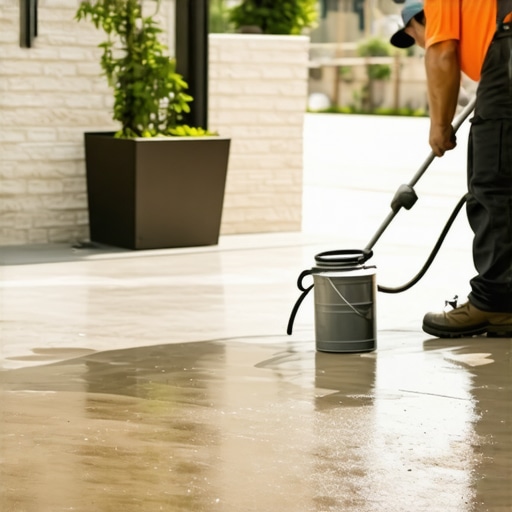
You cannot seal a dirty patio. Any dirt, oil, or organic matter trapped under a sealer will cause the product to fail. A simple yard cleanup isn’t enough; you need a surgical cleaning process. This involves using a degreaser for oil spots and a muriatic acid wash if the concrete is exceptionally smooth or ‘hard-troweled’ to open the pores. The moisture content of the slab must be below 4 percent before application. If you seal a damp slab, you trap the moisture inside, leading to a cloudy, white appearance known as ‘blushing’ which is a nightmare to fix. Use a moisture meter. Don’t guess.
- Clear all debris and perform a deep yard cleanup surrounding the patio.
- Pressure wash the surface at 3000 PSI to remove surface laitance.
- Apply a concrete degreaser to any oil or fuel stains.
- Check the weather: you need at least 24 hours of dry weather before and after.
- Tape off any adjacent sod install or garden beds to prevent chemical runoff.
How often should I reseal my concrete patio?
A high-quality penetrating sealer should be reapplied every five to seven years, depending on the exposure to harsh weather and heavy foot traffic. Unlike topical acrylics that show visible wear, penetrating sealers work invisibly, so you must perform a ‘water bead test’ annually. If water no longer beads on the surface and instead begins to darken the concrete, the hydrophobic barrier has worn down and it is time for a fresh application. Regular maintenance is the only way to avoid a full-scale replacement.
Application Physics: Achieving Total Saturation
When applying a penetrating sealer, the goal is total saturation of the surface. I prefer a high-volume, low-pressure (HVLP) sprayer to ensure an even coat without the roller marks that common DIY tools leave behind. You should apply the sealer in a ‘wet-on-wet’ fashion. This means you apply the second coat while the first coat is still damp but not puddled. This ensures the chemical bonds deeply with the substrate. If you wait for the first coat to dry completely, the hydrophobic properties of that first layer will actually repel the second coat, leading to an uneven and ineffective barrier.
“The longevity of any hardscape structure is directly proportional to the effectiveness of its moisture management system, including both sub-surface drainage and surface sealing.” – Interlocking Concrete Pavement Institute (ICPI)
[image placeholder]The transition between the concrete edge and the surrounding landscape is a critical point for moisture entry. During a landscaping project, ensure that the soil is graded away from the patio at a slope of at least 2 percent. If the yard is flat, you must install a French drain or a swale to move water away. Sealing the concrete protects the top, but proper grading protects the bottom. Both are required for a crack-free existence. If you see water pooling at the edge of your slab, your sealer is fighting a losing battle against the laws of physics. Move the water or lose the patio. It is that simple.