
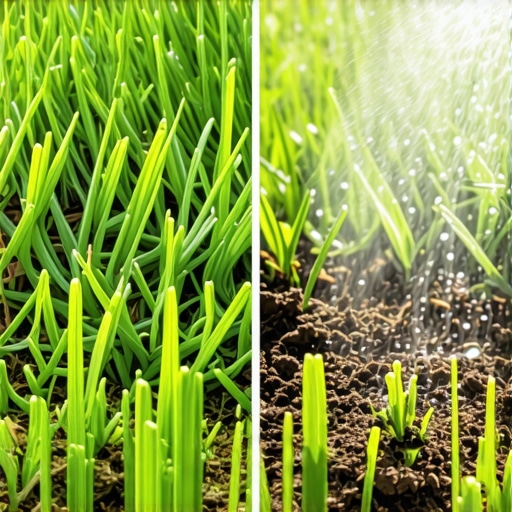
The Physical Reality of Soil Compaction
Core aeration and liquid aeration are often marketed as interchangeable solutions, but they function on entirely different physical and chemical planes to resolve soil compaction, thatch buildup, and nutrient deficiency. While mechanical aeration physically removes 2-3 inch plugs of soil to create immediate macropores, liquid treatments use surfactants and organic acids to chemically alter the soil structure over a longer duration.
I recently got called out to a property in a high-end development where the homeowner had spent thousands on a sod install that was turning into a yellow, anaerobic mess. They had been sold a ‘proprietary’ liquid aeration package by a mow-and-blow crew who didn’t understand the first thing about bulk density. The soil under that new sod was as hard as a kiln-fired brick. The homeowner had applied a high-concentration chemical surfactant during a record-breaking heatwave, thinking it would ‘open up’ the soil. Instead, they completely torched the rhizomes of their Kentucky Bluegrass. The grass wasn’t thirsty; it was literally suffocating because the hydrostatic pressure of the compacted clay was preventing any gas exchange. We had to do a forensic autopsy of the lawn, peeling back sections of dead turf to show them that the roots were growing sideways because they couldn’t penetrate the first inch of soil. It was a $5,000 mistake that a simple yard cleanup and mechanical aeration could have prevented.
“Core aeration is the most effective method for reducing soil bulk density and improving the physical properties of compacted soils, which is essential for healthy root development in turfgrass.” – Penn State Center for Turfgrass Science
How does liquid aeration actually work?
Liquid aeration does not actually create holes in the ground. It uses wetting agents and polymers to reduce the surface tension of water, allowing it to penetrate deeper into the soil profile. These products often contain humic acid and sea kelp to stimulate soil microbiology. It is a slow-burn process. You are not getting the immediate oxygen diffusion that a mechanical core provides. If your yard is so compacted that a screwdriver won’t sink two inches, a liquid solution is like trying to put out a forest fire with a squirt gun. You need the heavy machinery first.
Will core aeration damage my irrigation lines?
Mechanical aeration can damage irrigation heads or shallow-buried lateral lines if the system isn’t properly marked before the work begins. A professional crew will always insist on a zone test and 811 utility marking before the aerator tines hit the dirt. If your irrigation lines are buried at the industry-standard depth of 6 to 12 inches, the 3-inch tines won’t touch them. The danger is to the sprinkler heads and valve boxes. Don’t skip the marking. It will cost you a fortune in repairs.
[image_placeholder_1]
The Engineering of a Healthy Lawn
When we look at landscaping through the lens of civil engineering, we have to talk about pore space. In a perfect world, your soil should be 50% solid matter and 50% pore space (half water, half air). In most suburban yards, that pore space is crushed down to 10% or 15%. This leads to runoff, fungal pathogens, and root rot. Core aeration is the only way to physically reset that ratio. By removing the plug, you allow the surrounding soil to expand into the void, which naturally lowers the bulk density. Liquid products can then be used as a secondary treatment to maintain that porosity, but they are rarely a standalone fix for heavy traffic areas.
| Feature | Mechanical Core Aeration | Liquid Soil Conditioning |
|---|---|---|
| Primary Action | Physical removal of soil cores | Chemical surface tension reduction | Immediate Result | Improved O2 and H2O infiltration | Increased water penetration | Best Use Case | High compaction, heavy clay | Maintenance, sandy soils | Longevity | One season of physical change | Requires multiple applications | Risk Level | Potential irrigation head damage | Chemical burn if misapplied |
The Post-Aeration Checklist
- Flag all irrigation: Identify every sprinkler head and valve box cover.
- Mow low: Cut the grass to about 2 inches to ensure the aerator makes clean contact.
- Saturate the soil: Water the lawn 24 hours prior to help the tines reach maximum depth.
- Overseed immediately: The holes are the perfect seed bed for new growth.
- Fertilize: Use a high-phosphorus starter fertilizer to encourage root expansion into the new voids.
“Soil compaction is the single greatest barrier to successful turfgrass management in urban environments, often exceeding the impact of climate and nutrient availability.” – USDA Soil Quality Institute
Which is better for clay soil, liquid or core aeration?
For heavy clay soils, core aeration is the undisputed champion. Clay particles are microscopic and flat, like tiny plates. When they get pressed together, they create a waterproof seal. Liquid aerators can help lubricate these particles, but they cannot create the vertical drainage channels that a mechanical tine provides. If you live in a region with heavy red clay, you should be core aerating every fall without exception. It is the lifeblood of your landscaping. Once the cores are pulled, top-dressing with a 1/4 inch of compost or sand will ensure those holes stay open and become permanent conduits for nutrients.
The Bottom Line on Soil Breathability
Don’t be fooled by cheap marketing. Soil doesn’t care about your feelings; it cares about gas exchange and water movement. If you are planning a sod install, aerate the subsoil before the sod goes down. If you are doing a yard cleanup, make aeration the centerpiece of the project. A yard that can’t breathe is a yard that will die. Use core aeration for the heavy lifting and liquid treatments for the fine-tuning. That is how the pros do it. Anything else is just expensive compost.