
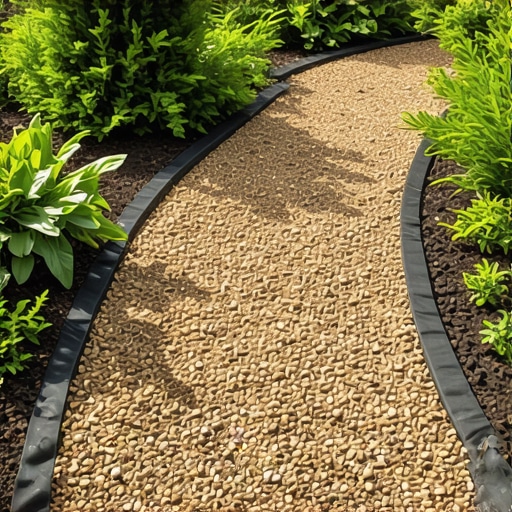
The Engineering Necessity of Geotextile Separation
Landscape fabric under gravel serves as a vital stabilization layer that prevents the vertical migration of stone into the soil subgrade while allowing for gas and moisture exchange. By creating a distinct barrier between the crushed aggregate and the native soil, it preserves the load-bearing capacity of the path or driveway and prevents the aggregate from sinking into the earth over time. Skip this step, and your stone will eventually become part of the mud. It is physics, not a suggestion.
The Hardscape Autopsy: Why This $15,000 Project Failed
I recently got called out to tear up a massive decorative gravel courtyard that was sinking into the earth just fourteen months after installation. The previous contractor had skipped the geotextile layer to save a few hundred bucks on a five-figure job. The result? Every time it rained, the hydrostatic pressure forced the heavy river rock down and the clay subsoil up. The homeowner was literally losing inches of stone every season. We had to excavate 40 tons of mud-caked rock, regrade the entire site, and start from scratch. It was an expensive lesson in soil mechanics. Don’t let your yard become a cautionary tale. Soil behaves like a fluid under pressure. Without a separator, your expensive stone is just a temporary topping.
“The primary function of a geotextile in a gravel application is the separation of two dissimilar materials so that the integrity and functioning of both materials can remain intact or be improved.” – Geosynthetic Institute (GSI) Specification Standards
Woven vs. Non-Woven: Choosing Your Weapon
Selecting the right material is the difference between a project that lasts twenty years and one that fails in two. Landscaping professionals generally categorize fabrics into woven and non-woven varieties. Woven fabrics offer incredible tensile strength, making them ideal for driveways where heavy vehicles apply lateral shear. Non-woven fabrics, often needle-punched, have higher permeability. These are better for drainage scenarios and irrigation zones. If you put a heavy woven plastic under a French drain, you will cause a flood. If you put a thin non-woven under a driveway, it will tear. Match the fabric to the load.
| Fabric Type | Best Use Case | Key Benefit | Permeability Rate |
|---|---|---|---|
| Woven Polypropylene | Driveways/Parking | High Tensile Strength | Low |
| Non-Woven (Needle-Punch) | Paths/Gardens | Excellent Drainage | High |
| Heavyweight Geotextile | Retaining Walls | Soil Stabilization | Medium |
How much modified gravel do I need for a patio base?
To calculate your needs, multiply the square footage by the desired depth in feet (usually 0.33 feet for a 4-inch base) then divide by 27 to find the cubic yards. For a stable gravel path over landscape fabric, aim for a minimum of 3 to 4 inches of compacted aggregate. Anything less will shift underfoot. Anything more without proper compaction will feel like walking through beach sand. Remember that 1.5 tons of gravel typically covers about 1 cubic yard. Do the math before the truck arrives. Over-ordering is a headache; under-ordering is a work-stopper.
The Interaction with Irrigation and Sod Install
When you are planning a sod install adjacent to a gravel area, the fabric edge becomes a critical failure point. If the fabric extends too far under the sod, it creates a perched water table that rots the grass roots. Conversely, if you don’t secure the edge, the gravel will migrate into your lawn, turning your lawnmower into a shrapnel launcher. During yard cleanup, you will thank yourself for using high-quality 4-ounce or 6-ounce fabric. It prevents the soil from mixing with the stone, meaning you can blow leaves off the gravel without kicking up a dust storm of pulverized dirt. It keeps the system clean.
How to Install Geotextile Fabric Like a Pro
- Excavate to Depth: Remove all organic matter and yard cleanup debris. You need a clean subgrade.
- Grade for Drainage: Slope the soil 2 percent away from structures before laying fabric.
- Overlap the Seams: Always overlap fabric edges by at least 12 inches to prevent soil bleed-through.
- Anchor the Material: Use 6-inch steel sod staples every 3 feet. Wind is your enemy during install.
- Protect the Barrier: Never drive equipment directly on the fabric; always spread a layer of stone ahead of the tires.
“A retaining wall or gravel base doesn’t fail because of the stone; it fails because of the water and fines trapped within the structural layers.” – Hardscape Engineering Axiom
The Myth of the Weed-Free Yard
Let’s be clear: landscape fabric is not a magic shield against weeds. Wind-blown seeds will land in the dust that accumulates on top of your gravel and germinate. However, the fabric prevents deep-rooted perennial weeds from anchoring into the subsoil. This makes yard cleanup significantly easier because the weeds are growing in the stone layer rather than the earth. You can pluck them with two fingers. Without fabric, those weeds would be tied into the clay, requiring a shovel to remove. It is about maintenance reduction, not maintenance elimination. It works.