
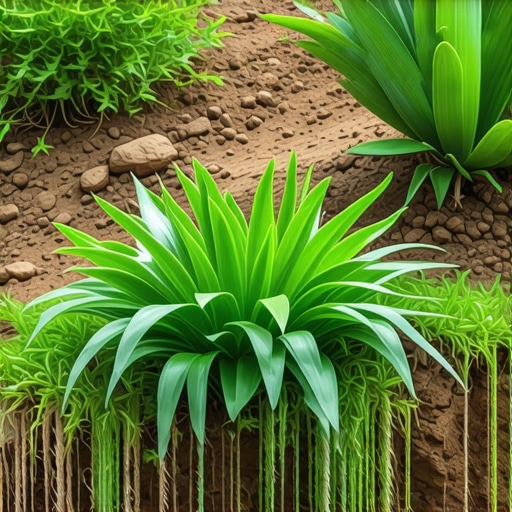
The Foundation of Erosion Control: Why Soil Grading Trumps Aesthetics
Erosion control using low-water groundcovers requires a deep understanding of geotechnical engineering and soil microbiology to prevent slope failure and surface runoff. Effective stabilization involves selecting species like Kurapia or Myoporum that provide high root tensile strength and rapid lateral spread to anchor the topsoil against hydraulic forces. I always drill into my new crew members: if you don’t fix the soil grading first, every plant you put in the ground is just expensive compost. I have seen countless greenhorns throw five-gallon shrubs onto a 30-degree incline without checking the compaction levels or the hydrostatic pressure building up behind the surface. Within one season of heavy rain, that expensive nursery stock is sitting in the neighbor’s pool because the coefficient of friction between the root ball and the native clay was effectively zero. We do not just plant; we stabilize. If your landscaping firm starts digging holes before checking the soil pH or the percolation rate, fire them. You are building a living retaining wall, not a flower bed. Every square inch of sod install or groundcover placement must account for how water moves across the topographical contours of the site. Underestimating the power of a three-inch rain event is the fastest way to a $50,000 lawsuit. We focus on macropores and micropores within the soil structure to ensure that irrigation actually penetrates the rhizosphere instead of sheeting off the surface.
“A retaining wall doesn’t fail because of the stone; it fails because of the water trapped behind it.” – Hardscape Engineering Axiom
How long does it take for groundcover to stop erosion?
Visible surface stabilization begins within 60 to 90 days after planting high-density plugs, provided the irrigation system is calibrated for deep root penetration and soil microbiology is active. Full structural anchoring of the slope typically requires two full growing seasons to establish a mature root matrix. It is a game of biological physics. We are looking for stoloniferous growth patterns that knit the soil together at the surface while deep taproots or fibrous systems provide vertical stability. Yard cleanup is not just about removing leaves; it is about clearing the allelopathic debris that might inhibit these new stabilizers from taking hold. If you leave a thick thatch layer or allow invasive species to compete for nitrogen, your erosion control project will fail before the first frost.
Top 3 Low-Water Groundcovers for 2026 Site Engineering
Selecting the right species for 2026 involves looking at climate resilience and evapotranspiration rates to ensure survival in increasingly erratic weather patterns. We prioritize non-invasive, drought-tolerant cultivars that offer high-density coverage. 1. Phyla nodiflora ‘Kurapia’: This is the heavy hitter for 2026. It is a sterile hybrid that handles salinity and extreme heat while maintaining a deep root system that can reach five feet down. 2. Myoporum parvifolium ‘Putah Creek’: A classic for a reason, this woody groundcover creates a massive biomass blanket that suppresses weeds and locks down the soil. 3. Dymondia margaretae: Best for high-visibility areas with lower incline, its tensile strength and resistance to foot traffic make it a multi-functional tool in the landscaper’s kit. Avoid the big-box store ‘quick fix’ seeds. They usually contain annual rye which dies off, leaving your slope more vulnerable than it was before you started.
| Groundcover Species | Root Depth (Inches) | Water Need (Low/Med) | Lateral Spread Speed | Erosion Control Rating |
|---|---|---|---|---|
| Phyla nodiflora (Kurapia) | 36-60 | Low | Very Fast | Elite |
| Myoporum parvifolium | 12-24 | Low | Fast | High |
| Dymondia margaretae | 6-10 | Very Low | Moderate | Moderate-High |
What is the best groundcover for steep hillsides with poor soil?
The best groundcover for degraded hillsides is Myoporum parvifolium because it thrives in nutrient-poor soil and provides immediate canopy cover to prevent raindrop impact erosion. Its ability to tolerate high pH levels and compacted clay makes it an engineering favorite for difficult terrain. We often combine this with jute netting or coir logs during the initial 12 months. This provides mechanical stability while the mycorrhizal fungi we inoculate into the soil begin to form a symbiotic bond with the Myoporum roots. Without this biological component, you are just sticking a straw into a brick. You need that fungal network to break down minerals and deliver them to the plant, especially in high-stress environments. Don’t fall for the ‘no maintenance’ lie either. Everything requires integrated pest management and nutrient monitoring in the first year.
The Logistics of Yard Cleanup and Site Preparation
Before a single plug goes in, the yard cleanup must be forensic in its execution, removing every trace of rhizomatous weeds that could choke out your new groundcover. We use a mechanical sod cutter or hand-tilling depending on the slope, but the goal is always the same: a clean seedbed or planting surface. If you are doing a sod install on a flat area adjacent to the slope, the transition zone is where most failures occur. You need a header board or a concrete mow strip to prevent the sod and the groundcover from becoming a tangled mess. This is about spatial management and resource allocation. We look at the Cation Exchange Capacity (CEC) of your soil to determine how much organic matter needs to be tilled in. If the CEC is low, your irrigation and fertilizer will just wash away, wasting money and polluting the watershed.
“Soil organic matter is the primary driver of soil health and structural stability in managed landscapes.” – Penn State Agricultural Extension
- Check 1: Verify utility markings (811) before any excavation.
- Check 2: Conduct a soil test for N-P-K levels and bulk density.
- Check 3: Inspect irrigation valves for pressure regulation.
- Check 4: Clear all woody debris larger than 1 inch in diameter.
- Check 5: Apply pre-emergent if the weed seed bank is high.
- Check 6: Grade the slope to a maximum of 2:1 for best results.
- Check 7: Install temporary silt fencing at the toe of the slope.
Irrigation Architecture for Drought-Resilient Slopes
A standard irrigation setup will fail on a slope due to low-head drainage and uneven distribution; you must use pressure-compensating emitters and check valves. We design systems that account for the infiltration rate of the soil to prevent ponding and surface runoff. For 2026, we are moving toward smart controllers that use evapotranspiration (ET) data to adjust watering schedules in real-time. This isn’t just a gadget; it’s a necessity for water conservation. If you over-water a slope to ‘get the plants established,’ you might actually trigger a mudslide by saturating the shear plane. We use cycle-and-soak programming to allow the water to move deep into the profile through capillary action without exceeding the field capacity of the top six inches. This forces the groundcover to send roots deeper, searching for moisture, which is exactly what you want for erosion control. It is a biological tug-of-war where we want the plant to win by being slightly thirsty. It sounds counterintuitive to the ‘mow-and-blow’ guys, but it’s how you build a resilient micro-climate.