
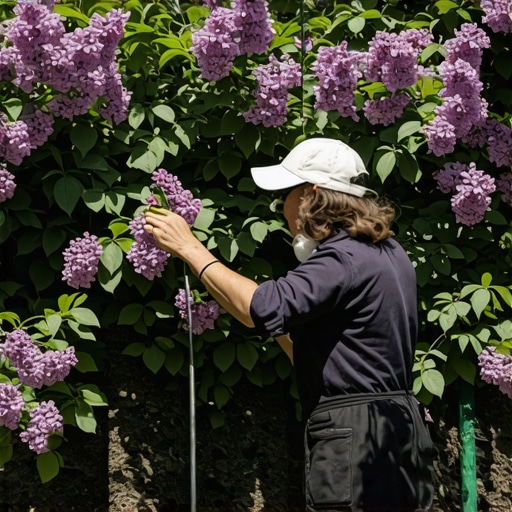
The Horticultural Physics of the Syringa Rebuild
To prune overgrown lilacs for better airflow, you must employ a three-year rejuvenation strategy that removes one-third of the oldest canes each season. This structural thinning increases interior light penetration and oxygen exchange, effectively mitigating powdery mildew and bacterial blight while stimulating new basal growth for future flowering. If you take the whole plant down at once, you shock the root system and lose three years of blooms. Patience is the only way.
I always drill into my new crew members: if you don’t fix the soil grading first, every plant you put in the ground is just expensive compost. I saw this last week on a site where a homeowner wanted a full sod install around a stand of 40-year-old lilacs. The previous landscaping crew had piled six inches of heavy clay over the root flares to ‘level’ the yard. Those lilacs weren’t just overgrown; they were suffocating. We had to perform a yard cleanup that involved more than just hauling away brush; we had to excavate the root collars by hand before we even touched a pair of pruners. You cannot fix the canopy if the feet are underwater.
“A lilac’s vigor is directly proportional to the age of its wood; canes older than five or six years become less productive and more susceptible to scale and borer.” – Penn State Extension Horticultural Manual
The Science of Fungal Pressure and Airflow
Airflow isn’t a vague concept; it is a measurable necessity for the Syringa vulgaris species. When a lilac becomes a tangled mass of crossing branches, the relative humidity inside the canopy stays at near-saturation levels for hours after a rain or morning dew. This creates a micro-incubator for Microsphaera alni, better known as powdery mildew. This fungus doesn’t just look ugly; it prevents photosynthesis by coating the leaf surface in a white mycelial mat. By 2026, if you haven’t thinned the interior, your lilac will be a skeleton by August. We prune to drop the humidity levels and let the wind strip away the moisture.
How much wood should I remove at once?
You follow the rule of thirds. Identify the oldest, thickest canes—usually those with shaggy, peeling bark and a diameter exceeding two inches. Cut these back to the ground or to a vigorous side shoot near the base. Never leave a six-inch ‘dead leg’ stump; it will rot. We use bypass loppers for anything up to 1.5 inches and a folding pull-saw for the heavy timber. If you take more than 33% of the total leaf mass, the plant will panic and throw out thousands of ‘water sprouts’—weak, vertical shoots that ruin the structure and suck energy away from flower production.
| Pruning Phase | Action Item | Target Material | Objective |
|---|---|---|---|
| Year 1: Foundation | Aggressive Thinning | Oldest 33% of canes | Light penetration to the crown |
| Year 2: Structural | Selective Heading | Remaining old wood | Incentivize new basal shoots |
| Year 3: Refinement | Final Transition | The last of the original wood | Complete canopy replacement |
The Tool Kit: Professional Grade Only
Stop using anvil pruners. They crush the vascular tissue (xylem and phloem) instead of slicing it. A crushed stem is an open door for pathogens. For a professional landscaping result, use bypass blades that act like scissors. I keep my blades sharp enough to shave with because a clean cut heals faster. We also carry a 10% bleach solution or isopropyl alcohol to dip the tools between plants. If one lilac has Pseudomonas syringae (bacterial blight) and you don’t sanitize your saw, you’ve just vaccinated every other bush in the yard with a death sentence. Don’t skip this. It’s non-negotiable.
Can I prune my lilacs in the winter?
Technically, yes, but you’re a fool if you do. Lilacs set their flower buds the previous summer. If you prune in the dead of winter, you are cutting off the 2026 bloom. The optimal window is the two-week gap immediately after the flowers fade. This gives the plant the entire growing season to develop new wood and set buds for the following year. If you wait until July, it’s too late. The plant is already shifting its hormonal balance toward bud set.
The Critical Role of Irrigation and Soil pH
Proper irrigation management is the silent partner of pruning. Once you’ve opened up the canopy, the plant’s transpiration rate changes. Over-watering a freshly pruned lilac is a recipe for root rot, especially in compacted soils. I see homeowners install a sod install with high-flow spray heads that soak the base of the lilacs every morning. Stop it. Lilacs prefer deep, infrequent watering that reaches 12 inches into the soil profile. They also demand a neutral to slightly alkaline pH (6.5 to 7.0). If your soil is acidic, that lilac won’t take up the nutrients it needs to heal from your pruning cuts, no matter how much fertilizer you throw at it.
“Compacted soil and poor drainage account for more woody ornamental failures than all pests and diseases combined.” – International Society of Arboriculture (ISA) Standards
- Inspect the collar: Ensure no mulch is touching the bark. Mulch volcanoes cause rot.
- Check the drainage: Water should not stand for more than two hours after a heavy rain.
- Monitor for borers: Look for small holes and ‘sawdust’ (frass) at the base of old canes.
- Sanitize: Clean your tools after every 5-10 cuts.
What is the best way to handle yard cleanup after pruning?
Do not compost diseased lilac wood. If you’ve pruned out mildewed or blighted branches, that material needs to be hauled off-site or burned. Composting in a backyard pile rarely reaches the 140-degree internal temperature required to kill fungal spores. If you leave those clippings near the base of the plant, the next rainstorm will just splash the spores back up onto the new growth, neutralizing all the work you did to improve airflow. A professional yard cleanup means total sanitation of the area.
Advanced Physiological Balancing
When we prune, we are manipulating the plant’s apical dominance. The terminal bud on a branch releases auxins that suppress the growth of lateral buds below it. By cutting off that terminal bud, you release the brakes. This is why heading cuts—cutting just the tips—result in a ‘witch’s broom’ of growth at the top. To get a better lilac, you must make thinning cuts at the base. This forces the plant to push new canes from the root system, which are much more vigorous and produce larger flower panicles. It’s about redirecting the hydraulic pressure of the plant’s sap to where it’s most productive.
Long-Term Maintenance for 2026 and Beyond
Once you’ve achieved a balanced structure, the work doesn’t stop. You move into a maintenance cycle. Every year, remove any dead, damaged, or diseased wood (the 3 Ds). Take out any ‘suckers’—those spindly little shoots that grow from the roots far away from the main clump. These are often from the rootstock if the lilac was grafted, and they won’t produce the flowers you want. Keep the center open. If a bird can’t fly through your lilac without hitting its wings, it’s too thick. Air is your best fungicide. Use it.