
The Imminent Threat of Emerald Ash Borer (EAB) in 2026
The Emerald Ash Borer (Agrilus planipennis) is an invasive wood-boring beetle that targets all species of North American ash trees, leading to 100% mortality without immediate chemical intervention. For homeowners, 2026 represents a critical deadline for systemic trunk injections to preserve the vascular integrity of their canopy before larval galleries cause irreversible canopy decline.
I always drill into my new crew members: if you don’t fix the soil grading or understand the tree’s internal plumbing first, every plant you put in the ground is just expensive compost. I remember a job last spring where a client spent $5,000 on high-end sod install and a new irrigation system, but ignored the massive white ash in the center of the yard. By July, the tree was flagging. Upon inspection, I found the tell-tale D-shaped exit holes. Because they waited too long, the cambium was so shredded that the tree couldn’t even transport the water the new irrigation was providing. It died by October. That is the reality of EAB. It does not negotiate.
“The Emerald Ash Borer has killed hundreds of millions of ash trees in North America since its discovery in 2002, making it the most destructive forest pest ever seen on the continent.” – USDA Forest Service EAB Assessment
Identifying EAB Infestation: The Forensic Autopsy
Identifying an EAB infestation requires looking past the foliage and examining the bark integrity and epicormic sprouting near the base of the trunk. Once a tree loses more than 30% of its canopy to larval girdling, the success rate of DIY injections drops significantly because the xylem can no longer distribute the pesticide.
How do I know if my ash tree has borer?
To diagnose Emerald Ash Borer, look for 1/8-inch D-shaped exit holes, vertical bark splitting, and S-shaped larval galleries etched into the wood beneath the bark. Woodpecker damage, known as ‘flecking,’ is often the first visible sign of a heavy larval load beneath the surface.
You have to understand the biology of the beetle to beat it. The larvae are the real killers. They spend their life cycle chewing through the phloem and cambium. This isn’t just cosmetic. This is the tree’s circulatory system. When those S-shaped galleries intersect, they effectively garrotte the tree. Water stops moving up. Sugars stop moving down. The tree starves while standing in water. It is a slow, agonizing structural failure. If you see suckers growing from the base of the trunk, that is a ‘Hail Mary’ from the tree. It’s trying to survive because the top is already dead.
The Science of Trunk Injections vs. Soil Drenches
Successful EAB mitigation relies on choosing between soil drenches (Imidacloprid) and trunk injections (Emamectin Benzoate) based on the tree’s Diameter at Breast Height (DBH) and local environmental regulations. Trunk injections are superior for larger specimens as they deliver the chemical directly into the active xylem without environmental runoff.
| Soil Drench | Imidacloprid | Early Spring/Fall | 1 Year | Low to Moderate |
| Trunk Injection | Emamectin Benzoate | Post-Leaf Out | 2-3 Years | High (99%) |
| Basal Spray | Dinotefuran | Late Spring | 1 Year | Moderate |
Don’t fall for the big-box store ‘all-in-one’ fertilizers claiming to kill borers. They are too diluted. For a tree with a DBH over 15 inches, a soil drench is like trying to put out a house fire with a squirt gun. You need the heavy hitters. Emamectin Benzoate is the gold standard. It is a macrocyclic lactone derivative that paralyzes the larvae. When the beetle eats the treated tissue, its nervous system shuts down. It stops feeding. It dies. Simple as that.
“Systemic insecticides, particularly emamectin benzoate, provide the highest level of control for EAB, often lasting up to three growing seasons with a single application.” – Purdue University Extension – Entomology Dept
A Step-by-Step DIY Injection Guide
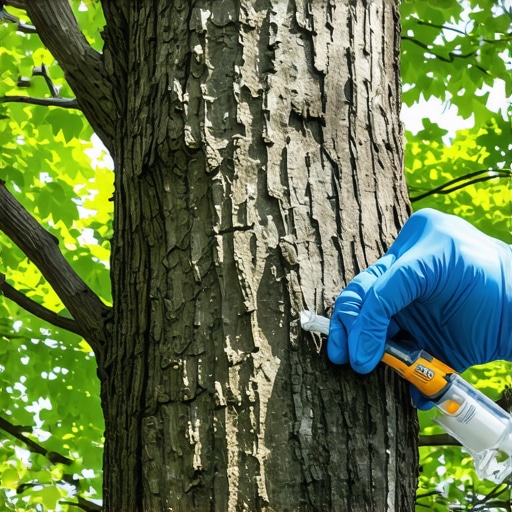
A DIY ash tree injection involves drilling precisely into the root flare and using a pressurized delivery system to introduce pesticides into the tree’s vascular tissue. This process must be performed during peak transpiration periods when the tree is actively pulling water from the roots to the leaves.
When is the best time to inject ash trees for borers?
The optimal window for ash tree injections is between mid-May and mid-June, specifically after the tree has fully leafed out and before the heat of summer. High transpiration rates during this period ensure the pesticide moves rapidly from the trunk to the outermost canopy branches.
- Measure DBH: Use a diameter tape to find the tree’s width at 4.5 feet above the ground. This determines your dosage.
- Expose the Root Flare: Remove mulch or soil to find the area where the trunk expands into the roots. This is where the vascular flow is most active.
- Drill the Ports: Use a clean, sharp 3/8-inch bit. Drill at a slight downward angle, only 1 to 1.5 inches deep. Don’t go deep. The sapwood is right under the bark.
- Set the Plugs: Hammer in your injection plugs until they are flush with the cambium.
- Inject: Connect your pressurized lines. Watch the gauge. If it won’t take the fluid, you’ve hit a dead spot in the wood. Move over 2 inches and try again.
It will rot if you drill too deep. I see guys drilling 4 inches into the heartwood. Heartwood is dead tissue. It’s just structural support. It doesn’t move fluid. If you inject there, the chemical just sits in a pool and causes internal decay. You need to hit the sapwood—the ‘live’ part of the straw. Also, check your drill bits. A dull bit heat-sears the wood fibers as it cuts, cauterizing the very vessels you’re trying to fill. Use a high-speed steel bit and replace it every five trees. Precision matters.
Why Traditional Yard Cleanup and Irrigation Won’t Save Your Ash
While yard cleanup and proper irrigation are vital for general tree health, they cannot stop an EAB infestation once the larvae have entered the bark. A healthy tree might resist fungus, but it cannot fight off a mechanical wood-borer without systemic chemical assistance designed to target the insect’s nervous system.
I’ve had clients tell me, ‘I water my trees every day, they should be fine.’ Wrong. In fact, over-watering can sometimes mask the early symptoms of EAB, making the eventual collapse even more sudden. And don’t get me started on ‘cleanup’ hacks. Raking up leaves does nothing to the larvae overwintering under the bark. You can have the cleanest yard in the county and still lose every ash tree on your property. You have to go internal. You have to turn the tree into a poison pill for the beetle. Anything else is just gardening while the house burns down. Stop wasting time with surface treatments. If 2026 hits and you haven’t injected, start calling the guys with the chainsaws. It’s going to be an expensive year for removals.