
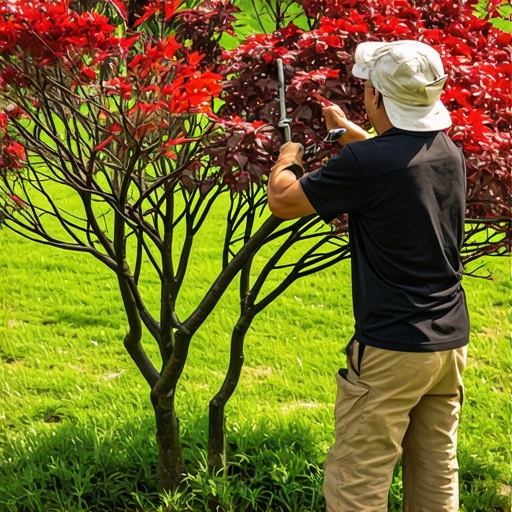
Pruning a specimen Acer palmatum is not a cosmetic chore; it is an act of surgical engineering. If you treat your Japanese Maple like a common hedge, you are inviting structural failure and fungal pathogens. Precision in removing crossing limbs ensures that the tree’s internal vascular system remains unobstructed and its canopy remains aerated. Don’t let a ‘mow-and-blow’ crew near these trees with shears. They will butcher them.
The Critical Importance of Structural Pruning for Japanese Maples
Structural pruning of Acer palmatum prevents mechanical damage and internal rot by eliminating crossing limbs that rub against each other during wind events. This practice maintains the apical dominance where necessary and promotes a balanced canopy architecture, which is vital for long-term health in high-end landscaping projects. You must act before the friction destroys the protective bark layer.
I always drill into my new crew members: if you don’t fix the soil grading first, every plant you put in the ground is just expensive compost. I remember an apprentice who spent three hours meticulously pruning a ‘Bloodgood’ only to realize the tree was sitting in a bowl of standing water because the irrigation was poorly calibrated and the grade was negative. No amount of perfect cuts can save a tree whose roots are suffocating. Pruning is the final touch on a healthy system, not a band-aid for poor installation. We checked the soil pH—it was 7.5, way too alkaline for a maple. We had to remediate the entire site before we even thought about the canopy.
“A pruning cut that removes the branch collar or leaves a stub interferes with the tree’s natural ability to compartmentalize decay.” – ANSI A300 Pruning Standards
Identifying Destructive Crossing Limbs
Identifying crossing limbs requires a forensic eye for cambium health. When two branches overlap and touch, the constant movement of the wind causes them to saw into each other. This creates ‘included bark’ and open wounds. These wounds are neon signs for Verticillium wilt and Botryosphaeria canker. You aren’t just ‘cleaning it up’; you are closing a gateway for infection.
How do I know which branch to remove?
Select the branch that disrupts the natural radial symmetry of the tree. Usually, this is the smaller of the two or the one growing back toward the center of the trunk. Look for ‘V-shaped’ crotches, which are structurally weak. We prefer ‘U-shaped’ attachments for their superior strength. Use your bypass pruners—never anvil pruners—to make a clean, sharp snip. Don’t crush the tissue. It will rot.
| Feature | Proper Technique | Material/Tool | Target Outcome |
|---|---|---|---|
| Crossing Limbs | Thinning Cut | Bypass Pruner | Airflow & Light Penetration |
| Dead Wood | Sanitation Cut | Folding Saw | Pathogen Prevention |
| Water Sprouts | Base Removal | Hand Snips | Redirected Energy |
| Root Flare | Exposure | Hand Trowel | Gas Exchange |
The Physics of the Three-Step Cut
For larger crossing limbs, you cannot simply hack through the wood. You must use the three-step cut to prevent the weight of the branch from stripping the bark down the trunk. First, make an undercut six inches from the trunk. Second, remove the limb entirely further out. Third, make your final cut just outside the branch collar. This is non-negotiable. If you strip the bark, you might as well cut the tree down.
- Step 1: The Undercut (Prevents bark tearing).
- Step 2: The Weight Cut (Removes the bulk).
- Step 3: The Collar Cut (The surgical finish).
- Step 4: Tool Sanitation (Clean with 70% isopropyl alcohol between trees).
“The removal of more than 25 percent of a tree’s foliage in a single season can significantly deplete the starch reserves necessary for winter survival.” – Arboricultural Manual for Woody Ornamentals
Integrating Tree Care with Total Yard Cleanup
Pruning is often the messiest part of a yard cleanup. However, the debris you remove is a goldmine of information. Inspect the wood you’ve cut. If you see dark streaks in the sapwood, you have a systemic issue. Once the pruning is finished, ensure your sod install isn’t creeping up the root flare. Grass should never touch the trunk. This is where most homeowners fail. They want the ‘green carpet’ look right up to the wood, which creates a moisture trap that invites Phytophthora root rot. Keep the mulch two inches away from the trunk.
How much modified gravel do I need for a patio base near a maple?
If you are installing a patio near a Japanese Maple, you need at least 4-6 inches of compacted 2A modified gravel, but you must keep the excavation outside the drip line. Compacting soil over the root zone of a maple is a death sentence. The hydrostatic pressure of the water must be managed with a French drain to keep the roots from drowning. High-end landscaping requires balancing hardscape stability with biological survival.
The Long-Term Maintenance Schedule
After the 2026 pruning cycle, monitor the tree for ‘water sprouts’—those vertical, fast-growing shoots that appear after a heavy prune. They are the tree’s panicked response to lost foliage. Rub them off while they are young and succulent. Check your irrigation emitters. Maples need deep, infrequent watering. One inch of water per week, delivered to the soil, not the leaves. Surface watering leads to shallow roots. Force them to go deep. Don’t skip this. Your tree’s life depends on it.