
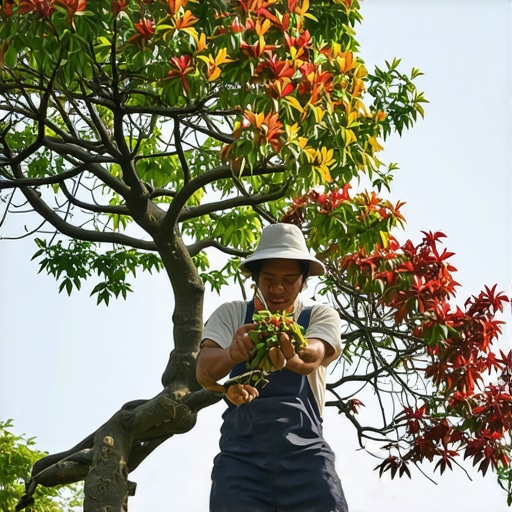
The Science of Sculpting Acer Palmatum
Pruning a Japanese Maple requires an understanding of apical dominance and vascular compartmentalization to maintain the tree’s natural architectural form without inducing stress-related epicormic sprouting. To successfully prune these specimens, one must identify the primary scaffold branches and selectively remove competing lateral growth while respecting the branch bark ridge to ensure rapid wound occlusion. Stop treating these trees like boxwood hedges. They are not shrubs; they are specimens of civil engineering in wood.
The Apprentice Lesson: Soil and Foundation First
I always drill into my new crew members: if you don’t fix the soil grading and root environment first, every plant you put in the ground is just expensive compost. I remember a job three years ago where a client wanted me to ‘save’ a Bloodgood maple that was losing its lower canopy. The previous landscaper had buried the root flare under six inches of mulch and installed a heavy-duty irrigation line that was drowning the feeder roots. We didn’t start with shears; we started with an air spade to find the trunk flare. You cannot prune a tree into health if the root system is suffocating in anaerobic soil. The structure of the tree starts beneath the dirt. If the base isn’t right, your pruning cuts won’t heal because the tree lacks the metabolic energy to seal the wound. Proper landscaping starts with biology, not aesthetics.
“Pruning is the most common tree maintenance procedure, but if done incorrectly, it can cause lasting damage or even death to the specimen by removing energy-producing foliage or creating entry points for pathogens.” – Penn State Extension: Tree Pruning Guide
The Anatomy of a Precision Cut
Precision pruning for Japanese Maples involves identifying the branch collar and making a clean cut just outside the branch bark ridge to facilitate natural healing through the tree’s internal defense system. This technique prevents wood decay and ensures that the tree can effectively compartmentalize the injury. Most hacks will perform ‘flush cuts’ which remove the branch collar. This is a death sentence. When you remove that collar, you are cutting into the trunk’s vascular tissue. The tree cannot seal that hole. It will rot. You need to look for the slight swelling where the branch meets the trunk. That is where the magic happens.
| Pruning Action | Biological Result | Proper Timing |
|---|---|---|
| Thinning Cut | Reduces density without stimulating regrowth | Late Winter (Dormant) |
| Heading Cut | Forces lateral budding and bushy growth | Early Spring (Use Sparingly) |
| Deadwooding | Removes necrotic tissue to prevent fungal spread | Anytime |
| Crown Lifting | Improves clearance and highlights trunk structure | Late Summer |
How do I know which branches to remove first?
Start with the three D’s: Dead, Damaged, and Diseased wood must be excavated before any aesthetic decisions are made. Once the necrotic tissue is cleared, look for ‘crossing’ branches. When two branches rub against each other, the friction wears down the bark, exposing the cambium to pests and infection. This is basic yard cleanup on a microscopic level. Choose the branch with the better structural angle and remove the other. Avoid the ‘meatball’ look at all costs. You want to see the ‘bones’ of the tree. If a bird can’t fly through your maple, it is too dense. Sunlight needs to penetrate the interior canopy to prevent inner-twig dieback.
Operational Lane: Arboriculture and Growth Logic
In arboriculture, the goal of pruning a Japanese Maple is to enhance its genetic phenotype, whether it is an upright Dissectum or a weeping variety, by managing the distribution of growth hormones like auxins. Auxins are produced in the terminal buds and travel down the stem to suppress lateral growth. When you ‘tip’ a branch, you remove the auxin source. This causes the tree to explode with messy, weak shoots. This is why you never use shears on a maple. You use bypass pruners to make selective thinning cuts. This maintains the flow of nutrients and keeps the growth habit predictable. For those looking at a sod install or new landscaping around these trees, remember that the drip line of the maple is sacred. Don’t compact the soil under the canopy or you’ll see the results in stunted branch extension next season.
“Proper pruning is a combination of art and science, requiring a deep understanding of the species-specific response to wounding and the mechanical stresses placed on the tree structure.” – Texas A&M AgriLife Extension
What is the best time of year to prune a Japanese Maple?
The optimal window for structural pruning is during the late dormant season, specifically late January to early March, before the sap begins to run heavily in the spring. If you prune too early in the winter, the tree is susceptible to desiccation. If you prune too late, you get ‘bleeding’ sap. While the sap loss isn’t usually fatal, it is a waste of the tree’s stored sugars and attracts insects. For minor thinning, you can prune in mid-summer once the first flush of leaves has hardened off. This helps reduce the vigor of the tree if it is outgrowing its space.
The Checklist for Structural Integrity
- Sanitize your tools with 70 percent isopropyl alcohol between every tree to prevent the spread of Verticillium wilt.
- Identify the ‘leader’ and ensure no secondary branches are competing for dominance.
- Remove any ‘suckers’ growing from the base of the graft union immediately.
- Check the irrigation coverage; maples hate wet feet but need consistent moisture during the heat of July.
- Evaluate the root flare; if you can’t see where the trunk widens at the soil line, you have a problem.
Information Gain: The One-Inch Rule
While most homeowners focus on the top of the tree, the most critical data point for a Japanese Maple’s health is the one-inch rule: These trees require exactly one inch of water per week, delivered deeply and slowly. Surface watering leads to shallow root systems that cannot support the weight of a mature canopy. If you are doing a sod install nearby, ensure the heavy equipment stays away from the tree’s root zone. One pass with a Bobcat can compact the soil enough to kill a 50-year-old maple over the course of three years. It is a slow, silent death. The soil structure is just as important as the branch structure.