
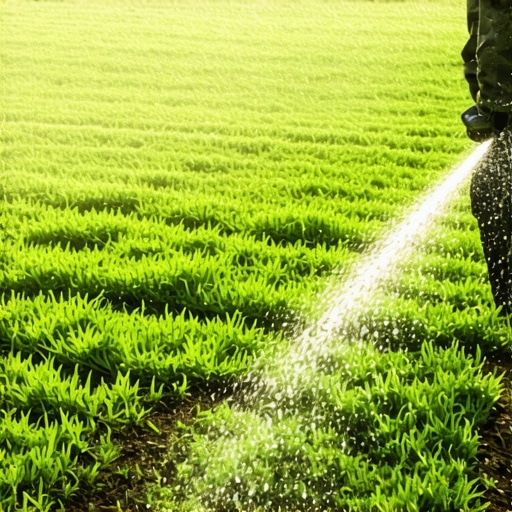
The Forensic Autopsy of a Failed $12,000 Sod Installation
I recently walked onto a job site where a homeowner had spent five figures on premium Kentucky Bluegrass sod, only to watch it turn the color of a discarded cardboard box within six days. They followed the big-box store advice: “Water it every evening for twenty minutes.” That single piece of generic, low-effort advice killed the project. By watering at dusk, they created a high-humidity incubation chamber for Pythium blight while failing to actually saturate the root zone. The sod wasn’t just thirsty; it was literally boiling from the ground up because the thatch layer acted as an insulator for the trapped heat. It was a total loss. This is the reality of heat stress in the landscaping industry—if you don’t understand the physics of soil moisture, you’re just throwing money into a compost pile.
Why Traditional Watering Schedules Kill New Sod
Traditional watering schedules fail because they prioritize human convenience over the biological requirements of the grass plant, leading to shallow root systems and high evaporation rates. Successful sod establishment requires deep-soil saturation that reaches four to six inches below the surface to drive root downward growth during high-heat intervals.
When you lay a fresh slab of sod, you are dealing with a plant that has had 90% of its root system sheared off. It is in a state of biological shock. Most people think if the grass looks wet, it is fine. Wrong. In 90-degree weather, surface water evaporates in minutes. What matters is the hydrostatic pressure within the soil profile. If the soil underneath the sod is dry, it will actually wick moisture away from the new roots, a process known as soil desiccation. You aren’t just watering a plant; you are managing a thermal mass. The 3:00 AM strategy isn’t a suggestion; it’s a mechanical necessity for survival in high-temp zones.
“Effective irrigation during peak heat periods must account for the Evapotranspiration (ET) rate, ensuring that the volume of water applied exceeds the rate of moisture loss to the atmosphere by at least 20% to maintain cell turgidity.” – Agronomy Field Manual for Turfgrass Professionals
The 3:00 AM Deep-Soak Strategy Explained
The 3:00 AM deep-soak strategy works by applying the maximum volume of water during the lowest period of evapotranspiration and wind drift, allowing the moisture to move vertically through the soil profile without evaporating. This ensures the root zone is fully saturated before the sun begins heating the surface.
Why 3:00 AM? It is the coldest part of the diurnal cycle. If you water at 6:00 PM, the ground is still radiating heat from the day, which causes immediate evaporation. If you water at 8:00 AM, the rising sun starts the evaporation process before the water can penetrate the compacted soil layers. At 3:00 AM, the water has hours to soak deep. It lowers the core temperature of the soil. This prevents the “steaming” effect that occurs when midday sun hits wet grass. It’s about efficiency. Don’t waste water on the air; put it in the dirt.
How often should I water new sod in 90 degree weather?
In temperatures exceeding 90 degrees, new sod requires a heavy deep-soak at 3:00 AM followed by two shorter “spritzing” or syringing cycles at 11:00 AM and 2:00 PM. These midday cycles are not for deep watering but for evaporative cooling of the leaf blade to prevent crown scorch. One inch of water per day is the absolute minimum during the first 14 days of establishment.
The Science of Soil Temperature and Root Girdling
When soil temperatures exceed 85 degrees Fahrenheit, root growth in many cool-season grasses begins to shut down. If the sod is not properly knitted to the soil, the air gap between the sod slab and the ground acts like an oven. I’ve seen temperatures in that gap reach 120 degrees. This causes root girdling, where the tiny root hairs literally curl up and die rather than penetrating the hard-packed earth. This is why yard cleanup and site prep are non-negotiable. If you have a layer of old thatch or debris under your new sod, you’ve created a thermal barrier that will kill your investment. You need soil-to-soil contact. Period.
| Grass Type | Heat Tolerance | Water Requirement (Establishment) | Soil pH Target |
|---|---|---|---|
| Kentucky Bluegrass | Low/Moderate | 1.5″ / day | 6.5 – 7.2 |
| Tall Fescue | High | 1.0″ / day | 5.8 – 7.0 |
| Bermuda (Sod) | Very High | 0.75″ / day | 6.0 – 6.5 |
| St. Augustine | High | 1.25″ / day | 6.0 – 7.5 |
Irrigation Calibration: Measuring Inches, Not Minutes
Irrigation calibration is the process of measuring the actual depth of water delivered to a specific area using catch-cans to ensure even distribution and prevent localized dry spots. Relying on timer minutes is useless because nozzle GPM (Gallons Per Minute) varies wildly based on water pressure and head type.
I tell my crew every day: “Minutes don’t grow grass; inches do.” If your irrigation system is running for 30 minutes, but your heads are clogged or your pressure is low, you might only be putting down a tenth of an inch. That’s a death sentence. Use the tuna can test. Place three empty tuna cans around your yard. Run your sprinklers. If it takes 45 minutes to fill the can to one inch, then your run time is 45 minutes. It’s simple math, but most “mow-and-blow” contractors don’t even own a rain gauge. They just guess. Don’t guess with $8,000 of sod.
“A retaining wall doesn’t fail because of the stone; it fails because of the water trapped behind it, and a lawn doesn’t fail because of the sun; it fails because of the lack of pore-space moisture.” – Hardscape Engineering Axiom
Is it better to water grass at night or in the morning?
The optimal window is between 2:00 AM and 5:00 AM. Watering earlier in the evening (8:00 PM – 12:00 AM) leaves the grass blades wet for too long, which invites fungal pathogens like Rhizoctonia (Brown Patch). Watering after 8:00 AM results in massive water loss due to evaporation and wind. The 3:00 AM window provides the best balance of absorption and disease prevention.
The Pre-Sod Checklist: Don’t Skip These Steps
- Call 811: Never excavate or grade without marking utility lines. I’ve seen people hit gas lines for a simple French drain.
- Soil Test: If your pH is below 5.5, your new sod cannot uptake phosphorus, no matter how much you water it.
- Core Aeration: If you aren’t tilling, at least aerate. You need holes for the water and roots to go.
- Grade for Drainage: Ensure a 2% slope away from the house foundation. Sod won’t fix a swamp.
- Remove Debris: Every rock or piece of old wood under the sod is a future localized dry spot.
Hardscape Influence on Turf Temperature
If your new sod is adjacent to a concrete driveway or a dark paver patio, you need to water that edge 50% more than the rest of the yard. Hardscapes act as heat sinks, absorbing UV radiation and bleeding it back into the soil for hours after the sun goes down. This creates a “burn zone” about 12 inches wide along the perimeter. If you don’t adjust your irrigation heads to overlap these edges, the sod will peel back like a burnt orange. It’s basic thermodynamics. The stone is hot; the grass is thin; the water is the only coolant available.
The Maintenance Schedule: Year One Survival
The first year is a marathon, not a sprint. After the initial 14-day soak period, you don’t just stop. You have to “wean” the grass. Slowly reduce watering frequency while increasing the duration. You want to force the roots to go deep to find the water. If you keep the surface wet forever, the roots will stay in the top inch of soil. Then, the first time you miss a day in July, the whole lawn dies. You are training the plant to be resilient. It takes 12 to 18 months for a sod lawn to become fully established. Until then, you are its life support system. Treat it like that.