
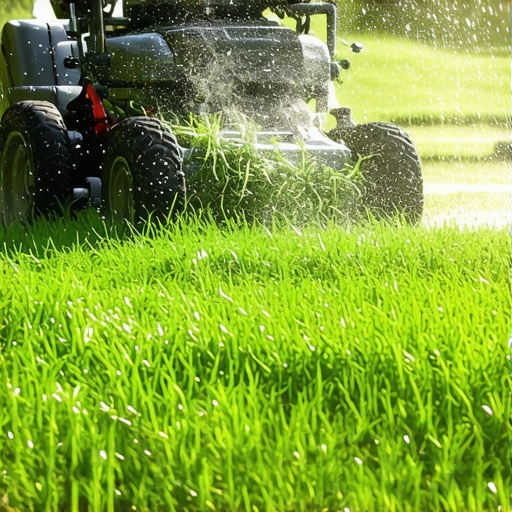
The Wet Grass Dilemma in 2026: Why You Cannot Always Wait
Mowing wet grass requires understanding turfgrass turgor pressure and leaf blade morphology. When soil saturation is high, standard mulching mowers fail because they trap moisture, leading to fungal pathogens like Brown Patch and Pythium; however, utilizing a side-discharge strategy preserves turf health during high-moisture windows.
I always drill into my new crew members: if you don’t fix the soil grading first, every plant you put in the ground is just expensive compost. It is the same with maintenance. You can have a $50,000 sod install of high-end Kentucky Bluegrass or Tall Fescue, but if you go out there with a dull blade when the dew point is at 70 degrees and the soil is spongy, you are effectively performing a slow-motion execution of your landscaping investment. In my twenty years of managing high-end estates, I have seen more yard cleanup bills generated by improper wet-mowing than by actual storms. The hack isn’t just about moving the grass; it is about managing the micro-biology of the cut. Don’t skip the details. It will rot.
The Mechanics of the Side-Discharge Hack
The side-discharge hack utilizes high-lift blades to create maximum aerodynamic lift within the mower deck. By removing the mulching plug, you reduce hydrostatic resistance, allowing saturated clippings to exit the deck before they can clump and suffocate the crown of the grass plant or cause soil compaction through repetitive passes.
“A lawn mower deck is essentially a centrifugal pump for air and organic matter. When that matter is saturated with water, the weight increases by 400%, requiring a total shift in discharge physics to maintain turf integrity.” – Agronomy Mechanical Standards Manual
When you mow dry grass, the clippings are light. They circulate in the deck and get pulverized. In 2026, our summers are increasingly humid. Irrigation systems often overlap with morning rain cycles. When the leaf blade is engorged with water (high turgor pressure), it becomes brittle. A mulching mower will beat that blade into a pulp. The pulp then sticks to the underside of the deck, creating a thick, anaerobic sludge. This sludge is a breeding ground for Rhizoctonia solani. The side-discharge hack bypasses this. By opening the chute, you allow the blade’s centrifugal force to eject the heavy water-weight immediately. It keeps the deck clean. It keeps the cut clean.
How high should I set my mower deck for wet grass?
You must set your mower deck height to at least 4 inches or the highest possible setting to reduce the volume of organic matter being processed. Increasing the cutting height reduces the load on the mower engine and ensures that only the top third of the grass blade is removed, which is critical for maintaining photosynthetic capacity in wet turf.
| Condition | Blade Type | Discharge Method | Risk Level |
|---|---|---|---|
| Light Dew | Standard Lift | Mulch | Low |
| Post-Rain (Saturated) | High-Lift G6 | Side-Discharge | Moderate |
| Heavy Rain (Standing Water) | Do Not Mow | N/A | Critical |
The Biology of the Tear: Why Blade Sharpness Matters
Blade sharpness determines whether a grass plant recovers within 24 hours or becomes a vector for turf disease. A dull blade when mowing wet grass results in cellular tearing rather than a clean transverse incision, which leads to desiccation and increased fungal susceptibility across the lawn.
Look at the tip of your grass after you mow. Is it a clean, straight line? Or is it white and shredded? Shredded tips mean your blades are dull. When the grass is wet, it is even harder to cut. Think of it like trying to cut a wet sponge with a butter knife. You end up pulling the grass out of the soil instead of cutting it. This is especially dangerous for a recent sod install where the root system hasn’t fully knitted into the subsoil. You can literally pull up patches of your new lawn. We use angle grinders with flap discs every morning to ensure a surgical edge. You should sharpen yours every 10 to 12 hours of use. No excuses.
“Pathogenic fungi such as Pythium blight thrive in the jagged, wounded tissue of grass blades that have been crushed by dull equipment in high-moisture environments.” – Penn State Agricultural Extension
Does mowing wet grass cause fungus?
Mowing wet grass does not inherently cause fungus, but it creates the environmental conditions for pathogen proliferation. Clumping wet clippings trap heat and moisture against the soil surface, creating an incubation chamber for spores that can devastate a fescue or ryegrass lawn in less than 48 hours.
The 2026 Wet-Mow Checklist
- Check the Deck: Clean out all old, dried grass before starting.
- High-Lift Blades: Ensure you are using blades designed for maximum air movement.
- Side-Chute Open: Remove the mulching plug and ensure the discharge guard is functional.
- Overlap 50%: Reduce the width of each pass to minimize the engine load.
- Clean After Use: Immediately scrape the deck once finished to prevent rust and mold.
The goal is airflow. If the air can’t move, the grass can’t move. If the grass can’t move, it clumps. If it clumps, it dies. It is that simple. Most mow-and-blow hacks will just charge through it and leave the clumps for you to deal with. That is how you end up with dead spots and a high irrigation bill to fix the dry-spot symptoms that are actually fungal damage. Professional landscaping is about foresight. Use the side-discharge. Watch your speed. Keep your blades sharp. Your lawn will thank you in 2027.