
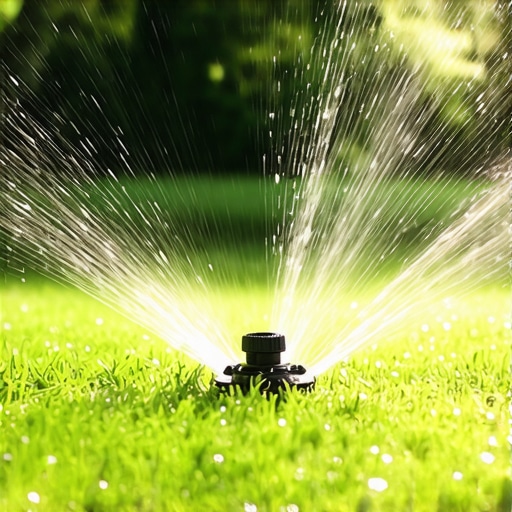
The Anatomy of a Dying Lawn: Why Your Irrigation is Failing
A dead zone in your irrigation system is typically caused by low pressure, improper head spacing, or clogged spray nozzles that fail to provide head-to-head coverage, leading to turf stress and eventual sod failure. I always drill into my new crew members: if you don’t fix the soil grading and water delivery first, every plant you put in the ground is just expensive compost. Last season, a client called me out to a site where they had replaced their sod three times in two years. Each time, the grass withered in the same four-foot radius. The previous contractor just kept blaming the heat. I took one look at the pressure gauge and the fixed-pattern spray heads and knew the culprit. The water was misting and drifting away in the breeze before it ever touched the roots. The soil was bone dry two inches down despite the system running daily. This is the hallmark of a failed hydraulic design. You cannot fight physics with a garden hose and a prayer.
Why Standard Spray Heads Create Dead Zones
Standard fixed-arc nozzles are relics of a bygone era. They dump water at a rate of 1.5 to 2.5 inches per hour. This exceeds the infiltration rate of almost every soil type except pure sand. On heavy clay, that water just sits on top, creates a thatch-rotting puddle, and then runs off into the street. The grass underneath stays thirsty. We call this a pseudo-drought. You think you are watering, but the root zone is starving. It is a fundamental engineering failure. Fixed sprays also suffer from massive pressure sensitivity. If your home pressure drops by 5 PSI, your coverage radius shrinks by two feet. That creates the gap. That gap becomes the dead zone. Don’t ignore it. It will kill your yard.
“High-efficiency nozzles, like multi-stream rotators, provide a more uniform distribution of water than traditional spray heads, reducing runoff and improving deep root development.” – Irrigation Association Technical Manual
The Science of Rotary Nozzles and Matched Precipitation
Rotary nozzles solve the dead zone crisis by delivering water in multiple rotating streams at a much slower precipitation rate of approximately 0.4 to 0.6 inches per hour. This allows the soil to actually absorb the moisture. By slowing down the delivery, we match the soil’s natural intake capacity. This is known as Matched Precipitation Rate (MPR). It ensures that a 90-degree head and a 360-degree head are putting down the exact same depth of water over the same period. Old-school nozzles can’t do this. A 90-degree fixed nozzle will put down four times as much water as a 360-degree nozzle on the same zone. That is how you get one spot that is a swamp and another that is a desert.
| Feature | Standard Spray Nozzles | High-Efficiency Rotary Nozzles |
|---|---|---|
| Precipitation Rate | 1.5 – 2.5 in/hr | 0.4 – 0.6 in/hr |
| Wind Resistance | Poor (Mists easily) | High (Heavy droplets) |
| Coverage Uniformity | Low (Heavier near head) | High (Matched Precipitation) |
| Pressure Tolerance | Narrow (30 PSI ideal) | Wide (25 – 55 PSI) |
| Runoff Risk | Extreme | Minimal |
How much pressure is needed for rotary nozzles?
Most rotary nozzles require a minimum of 40 to 45 PSI at the head to operate the internal turbine effectively and maintain the intended throw distance. If your system pressure is too low, the streams will barely dribble out, failing to reach the next head. Conversely, if your pressure is too high (above 60 PSI), the internal components can wear out prematurely. I always recommend using pressure-regulating heads like the Pro-Spray PRS40. These ensure every nozzle gets a consistent 40 PSI regardless of where it is on the line. Consistency is king in landscaping. Without it, you are just guessing.
The Retrofitting Process: A Step-by-Step Action Plan
Fixing your dead zones is not just about swapping a part. It requires a forensic audit of the zone. You need to ensure your yard cleanup is done so you can see the soil surface. Follow this checklist to remediate your irrigation failures.
- Audit the Zone: Turn on the system and flag every head that is tilting or buried.
- Measure the Pressure: Use a pitot gauge to check the PSI at the furthest head from the valve.
- Check Spacing: Ensure you have head-to-head coverage. A 15-foot nozzle should be exactly 15 feet from the next head.
- Flush the Lines: Remove the old nozzles and run the water for 30 seconds to clear out debris that will clog new rotary gears.
- Install the Rotaries: Screw in the new nozzles. Hand-tight only.
- Adjust the Arc and Radius: Use the manufacturer’s tool to set the left and right stops.
- The Catch Can Test: Place tuna cans around the yard and run the zone for 20 minutes. The water level in every can should be identical.
Can I mix rotary nozzles with standard spray heads?
You must never mix rotary nozzles and standard spray heads on the same irrigation zone because their precipitation rates are fundamentally incompatible. If you run the zone long enough to satisfy the rotary nozzles, the areas covered by standard sprays will be flooded and root rot will set in. If you run it for the standard sprays, the rotary sections will remain in a permanent state of drought. It is an all-or-nothing upgrade. You have to commit. Halfway measures lead to sod install bills. Do it right the first time.
“Uniformity of application is the most critical factor in professional turf management to prevent localized dry spots and nutrient leaching.” – Penn State Center for Turfgrass Science
The Financial Logic of the Switch
I get homeowners complaining about the cost of rotary nozzles. They are five times the price of a cheap plastic spray head. But look at the math. A standard system wastes 30% of its water to wind drift and runoff. If your water bill is $150 a month, you are throwing $45 into the gutter every month. Over a five-year period, that is $2,700 wasted. A full set of high-end rotaries costs maybe $200. The ROI is immediate. Beyond the cash, you are protecting the landscaping investment. A dead lawn costs thousands to replace. A few nozzles cost a steak dinner. Buy the nozzles. Stop being cheap with your infrastructure.
Long-Term Maintenance and System Health
Once the rotaries are in, your job isn’t over. These are precision instruments. They have fine mesh filters that catch the grit in your water lines. Once a year, you need to pull the nozzles and rinse those filters. If you see a stream start to wobble or stop rotating, it is likely a grain of sand in the gear drive. Don’t hit it with a shovel. Clean it. Also, check your sod for compaction. Even the best irrigation can’t penetrate soil that is as hard as concrete. If you can’t push a screwdriver six inches into the ground, you need to aerate. Water needs a path to the roots. Open the door for it. Your lawn will thank you with deep green color and resilience that can actually survive a July heatwave. Irrigation is a tool, not a miracle. Use it like a pro.