
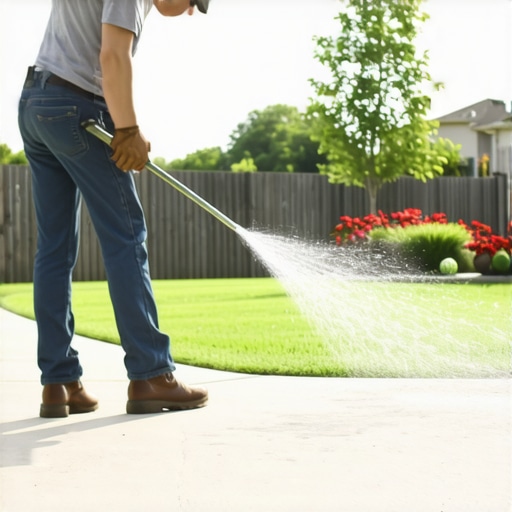
The Forensic Autopsy of a Mismanaged Irrigation System
Adjusting sprinkler heads to prevent driveway runoff involves modifying the arc and radius settings to match the specific geometry of your turf. By utilizing pressure-regulated heads and high-efficiency nozzles, you eliminate wind drift and overspray, ensuring every drop reaches the root zone instead of the pavement. When I step onto a property where the driveway is constantly damp, I do not just see wasted water; I see a structural failure in the making. Water hitting asphalt or concrete for years leads to spalling, erosion of the sub-base, and premature cracking. It is a slow-motion wrecking ball for your hardscape.
I always drill into my new crew members: if you do not fix the spray pattern, you are just paying to erode your driveway base. Last month, we pulled up a sod install that failed in three weeks because the previous contractor had the rotors hitting the fence and the sidewalk, leaving the center of the yard a bone-dry dust bowl. Irrigation is not a suggestion; it is the lifeblood of the engineering. We found the hydrostatic pressure from the overspray had actually begun to undermine the edge of the pavers, causing a lateral shift in the soldier course. If you do not respect the physics of water trajectory, the ground will remind you of your mistake through subsidence and fungal pathogens.
“Irrigation systems should be designed to apply water as uniformly as possible to avoid overwatering some areas and underdogging others.” – Penn State Extension
How do I adjust my rain bird sprinkler heads?
To adjust a Rain Bird rotor, you use the arc adjustment socket located on the top of the head to set the left and right rotation limits. Using a flat-head screwdriver, you turn the radius reduction screw to break up the stream, ensuring the water does not overshoot the turfgrass canopy and land on the driveway. Precision is mandatory here. A quarter-turn can be the difference between a uniform application and hydro-locked soil at the curb.
The Engineering of Hydraulic Efficiency
The goal of any irrigation audit is to achieve matched precipitation rates (MPR). When you have a 180-degree head and a 360-degree head on the same zone, the 180-degree head is applying twice as much water to its area if they have the same nozzle size. This causes nutrient leaching and anaerobic soil conditions. To stop watering your driveway, you must understand the Vane inside the nozzle. This small plastic component shapes the water droplets. If the PSI (pounds per square inch) at the head is too high, the water atomizes into a mist that drifts away in the slightest breeze. This is why pressure-regulated stems are non-negotiable for high-end landscaping.
| Nozzle Type | Effective Radius | GPM Range | Optimal Application |
| Fixed Spray | 5 to 15 feet | 0.5 to 4.0 | Small irregular turf areas |
| High-Efficiency Rotary | 13 to 30 feet | 0.6 to 1.6 | Slopes and clay-heavy soils |
| Pro Rotor | 25 to 50 feet | 1.2 to 9.5 | Large open lawns |
Why is my sprinkler head leaking from the bottom?
A sprinkler head leaking from the base usually indicates a failed wiper seal or a cracked body due to lateral line pressure surges or mechanical damage from a mower. If the leak occurs only when the zone is off, you are likely dealing with low-head drainage, where the water in the pipes drains out the lowest point. Installing a check valve (HCV) at the head will stop this immediately, preventing the puddle that attracts mosquitoes and rots sod installs.
“Uniformity of application is the most important factor in the performance of an irrigation system.” – Texas A&M AgriLife Extension
The Physics of Water Management and Soil Integrity
In regions with heavy clay soils, the infiltration rate is often less than 0.2 inches per hour. If your sprinkler is hitting the driveway, that water is not just lost; it is carrying your expensive nitrogen fertilizers directly into the storm drain. This is non-point source pollution. By adjusting the nozzle trajectory, we force the water into larger droplets that can penetrate the thatch layer. For yard cleanup and long-term health, we recommend aeration to reduce bulk density, allowing the soil to actually hold the water you are paying for. If the water is hitting the pavement, it is 100% waste.
- Inspect each head for vertical alignment; tilted heads cause dry spots.
- Clear grass encroachment from the pop-up to prevent spray deflection.
- Check filter screens for debris that causes pressure loss.
- Verify that nozzle orifices are not enlarged by sand or grit.
- Conduct a catch-can test to measure actual distribution uniformity.
Stop thinking about your sprinklers as a set-it-and-forget-it system. It is a mechanical assembly that exists in a harsh environment of freeze-thaw cycles, UV degradation, and mechanical stress. Check your spray patterns every spring. It will save your driveway. It will save your lawn. Do not skip this step.