
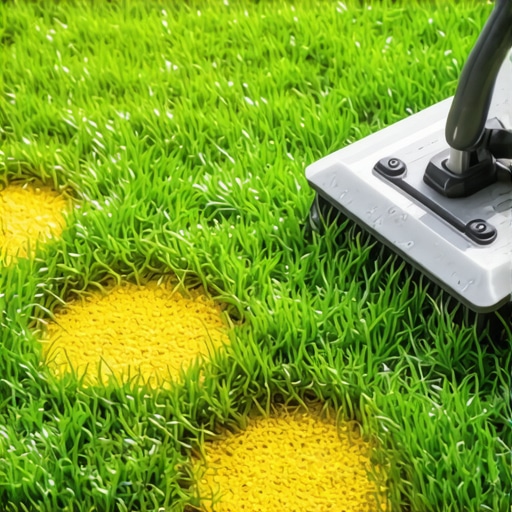
Diagnosing Yellow Grass Patches
Yellow grass patches occur when turf lacks chlorophyll, often due to iron chlorosis, nitrogen deficiency, or improper soil pH preventing nutrient uptake. To fix this, you must determine if the issue is a lack of iron in the soil or a chemical lockout caused by high alkalinity. I recently saw the aftermath of a chemical nightmare where a homeowner torched their front lawn. They applied a heavy dose of high-nitrogen fertilizer during a 95-degree heatwave without checking soil moisture. The grass didn’t just turn yellow; it turned a brittle, metallic tan. The salts in the fertilizer sucked the moisture right out of the root zone, a process known as osmotic stress. It was a total loss. When you see yellowing, do not just throw more nitrogen at it. You have to look at the cellular level. Most yellowing is actually iron chlorosis. This happens when the grass cannot produce enough chlorophyll. It looks sickly, pale, and weak. If the veins of the grass blade stay green while the rest turns yellow, you have a definitive iron problem. It is not always a lack of iron in the dirt. Often, the iron is there, but the soil pH is so high that the roots cannot grab it. It is locked away. Stop guessing and start measuring. Get a soil test kit before you spend a dime on chemicals.
The Science of Iron Chlorosis
Iron chlorosis is a metabolic deficiency where turfgrass fails to synthesize chlorophyll despite having enough nitrogen, typically triggered by high soil alkalinity. In alkaline soils, iron converts into an insoluble form that roots cannot absorb.
“Iron deficiency is often not a result of a lack of iron in the soil, but rather the soil’s pH level being too high for the plant to utilize the available iron.” – Texas A&M AgriLife Extension
This is why your neighbor’s yard might be dark green while yours looks like straw. If your soil pH is above 7.0, the iron is likely bound up. You can dump iron filings on the lawn until you are blue in the face and it will not change a thing. You need to bypass the soil or change the chemistry. This is where the iron-rich hack comes in. We use chelated iron. The term chelate comes from the Greek word for claw. A chelating agent wraps around the iron molecule, protecting it from reacting with the soil and keeping it available for the plant. It is engineering, not magic. For immediate results, we use foliar applications. This means the liquid iron hits the leaf blade and enters the plant directly, bypassing the hostile soil environment entirely. You will see a color shift in 48 hours. It is a temporary fix, but it buys you time to address the root cause: the soil pH.
Chelated Iron vs. Iron Sulfate
Choosing between chelated iron and ferrous sulfate depends on your soil pH and how fast you need the grass to green up. Chelated iron is more expensive but stays available in the plant for longer periods in high-pH environments. Ferrous sulfate is cheaper but is quickly neutralized in alkaline dirt. Use the following table to decide which material fits your yard cleanup strategy.
| Feature | Ferrous Sulfate | Chelated Iron (EDDHA/EDTA) |
|---|---|---|
| Cost | Low | High |
| Speed of Action | 12 to 24 hours | 24 to 48 hours |
| Longevity | Short (1-2 weeks) | Long (4-6 weeks) |
| Best Soil pH | Below 7.0 | Works above 7.0 |
| Staining Risk | Extremely High | Moderate |
Be careful. Iron products will stain your concrete driveway, your porch, and your fence. It will turn them a permanent, ugly rust color. If you spill it, wash it off immediately with a high-pressure hose. Do not wait. I have seen $10,000 paver jobs ruined by one careless pass with a broadcast spreader. If you are doing a yard cleanup, do the iron application last, after the hard surfaces are blown clean.
How to Apply an Iron-Rich Hack
To execute an iron-rich hack, apply a liquid chelated iron solution using a calibrated sprayer during the early morning to maximize leaf absorption. Do not apply when rain is expected within 6 hours. You want the product to sit on the leaf blade, not wash into the thatch. Follow this checklist for a professional-grade application:
- Mow the lawn 24 hours before application to ensure maximum leaf surface area.
- Calibrate your sprayer to deliver 0.5 to 1.0 ounces of actual iron per 1,000 square feet.
- Mix the iron with a surfactant to help the liquid stick to the waxy grass blades.
- Apply during the ‘cool’ of the morning when the stomata (pores) of the grass are open.
- Avoid irrigation for at least 12 hours after the spray hits the grass.
Why is my grass turning yellow in spots?
Grass turns yellow in spots due to uneven irrigation, localized soil compaction, or concentrated pet urine. Compaction prevents oxygen from reaching the roots, which halts nutrient uptake regardless of how much fertilizer you apply. If the spots are circular and bright yellow, check for fungal pathogens like dollar spot or brown patch. These require fungicides, not iron. Use a screwdriver to poke the yellow spots. If it is hard to push in, you have a compaction problem that needs core aeration.
How much iron should I put on my lawn?
You should apply no more than 1 pound of actual iron per 1,000 square feet per season. Over-application can lead to a dark, blue-black tint that looks unnatural and can cause heavy metal toxicity in the soil microbiology. Stick to the label rates. More is not better; it is just more expensive and potentially toxic. Most liquid supplements require about 2 to 4 ounces of product per gallon of water to cover 1,000 square feet. Check the concentration of your specific brand.
Yard Cleanup and Soil Preparation
Effective yard cleanup involves removing excess thatch and debris that block iron and water from reaching the root zone. If your lawn has more than half an inch of thatch, your iron spray is just feeding the dead organic matter. You need to power rake or verticut. This opens up the canopy. A clean lawn responds to treatments faster. If you are planning a sod install soon, do not skip the soil prep. Most hacks fail because the foundation is garbage. If you lay high-quality sod over compacted, high-pH clay, you are just buying expensive compost. Incorporate elemental sulfur months in advance if your pH is too high. This is a slow process. Biology takes time. There are no shortcuts in the nitrogen cycle. If you want that deep, forest-green color, you have to manage the micronutrients as carefully as the macronutrients.
Beyond the Quick Fix: Long-term Irrigation and Sod Health
Long-term turf health requires deep, infrequent irrigation to force roots to grow deeper into the soil profile where moisture and minerals are more stable. Shallow watering creates a weak lawn that is prone to yellowing as soon as the sun gets hot.
“A lawn should receive roughly one inch of water per week, delivered in one or two heavy sessions rather than daily light mists, to promote deep root architecture.” – Penn State Center for Turfgrass Science
If your irrigation system is poorly designed, you will have dry spots and wet spots. Wet spots lead to anaerobic soil conditions where roots rot and turn yellow. Dry spots lead to dormancy. You need head-to-head coverage. Check your zones. If one head is clogged or the pressure is low, that section of your landscaping will fail. It is physics. If you are doing a fresh sod install, water it every day for the first 14 days, then taper off. If you don’t, the edges will dry out and die, leaving you with yellow gaps. It will rot if you over-water it in the shade. It’s a balance.
The Maintenance Schedule
Maintaining a dark green lawn requires a consistent schedule of soil testing, core aeration, and preventative iron applications throughout the growing season. Do not wait for the grass to turn yellow before you act. Preventive maintenance is cheaper than emergency remediation. In the spring, focus on core aeration to break up compaction. In the early summer, apply your first round of chelated iron. In the fall, focus on potassium to build cell wall strength for the winter. This is the blueprint for a professional lawn. Avoid big-box store weed-and-feed products that promise everything in one bag. They usually contain low-quality iron that stains your driveway and doesn’t help the grass. Buy professional-grade liquid chelates. They work. Your yard is an investment. Treat it like one. Don’t be the homeowner who burns their lawn because they didn’t read the label or test their soil. Precision matters. Results follow the work. Stick to the plan and the grass will stay green.